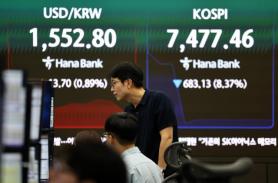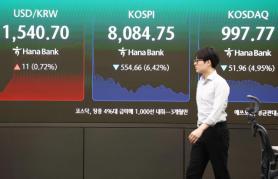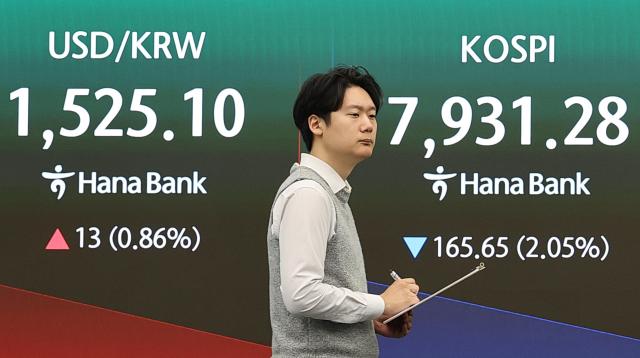
Each measure has offered short-term relief, only to wear off with every bout of KOSPI volatility and fresh wave of capital outflows driven by geopolitical risks, tighter global monetary conditions and a growing shift of funds toward U.S. assets.
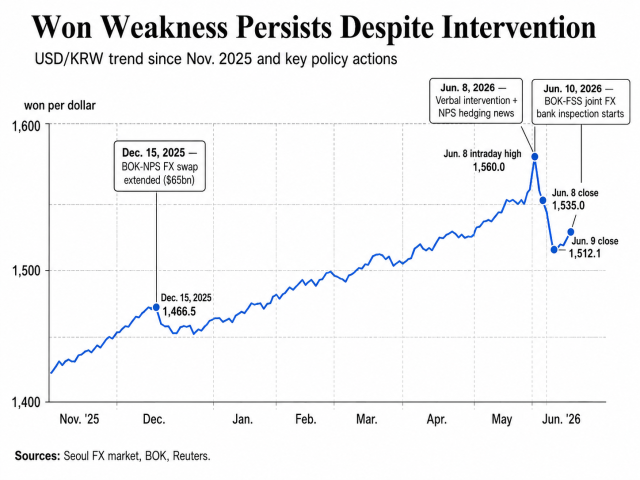
The dollar ended Wednesday at 1,524.2 won, up from 1,512.1 won the previous session, though below Monday's intraday high near 1,560 won.
Stock market flows have increasingly dictated the won's direction.
Foreign stock selling increases demand for dollars as investors repatriate funds overseas, adding upward pressure on the exchange rate. A weaker won, in turn, raises concerns over currency losses and prompts further reductions in Korean equity exposure, creating a potentially self-reinforcing cycle.
Foreigners have sold a net 144.2 trillion won worth of KOSPI shares this year. During the same period, the won has lost more than 5 percent against the dollar, significantly underperforming both the dollar index, which gained about 1.75 percent, and the Japanese yen, against which the greenback rose roughly 2.2 percent.
One emerging catalyst behind the recent acceleration in outflows is the upcoming debut of SpaceX on Nasdaq on Friday. The highly anticipated listing, expected to value the company at around $1.8 trillion, has prompted global investors to reposition capital toward U.S. technology assets, making Korea's highly liquid equity market an attractive source of funds.
One of the authorities' key tools has been the foreign exchange swap arrangement with the National Pension Service.
The foreign exchange authorities and the pension fund agreed last December to extend their $65 billion FX swap line through the end of 2026. Because large overseas investments by the pension fund can intensify downward pressure on the won, the arrangement allows part of that dollar demand to be absorbed outside the spot market.
Still, repeated stabilization efforts appear to be placing pressure on the country's foreign exchange reserves.
According to the Bank of Korea, foreign exchange reserves fell from $430.66 billion at the end of November last year, just before the swap line was extended, to $426.99 billion at the end of May, a decline of $3.67 billion over six months.
The drop in May alone was notable. Reserves fell by $880 million even as the KOSPI reached record highs during the month.
Although the benchmark index climbed above 8,400 on May 27, foreign investors remained net sellers for 16 consecutive trading days from May 7 through the end of the month.
The Bank of Korea said the decline in reserves partly reflected market stabilization measures, effectively acknowledging that intervention-related operations contributed to last month's fall.
On Wednesday, when the KOSPI tumbled 4.52 percent to close at 7,730.82, foreign investors sold a net 2.77 trillion won worth of shares, extending their selling streak to 23 consecutive trading days. The sustained outflows have continued to pressure the won even as authorities intensify efforts to stabilize financial markets.
A foreign exchange dealer at a local commercial bank, who requested anonymity, said authorities appeared determined to defend the currency.
"Although it is impossible to officially confirm whether the authorities are conducting direct smoothing operations, the market has clearly observed continued inflows and movements aimed at defending the won's lower bound," he said.
Policymakers are also publicly acknowledging rising volatility in financial markets.
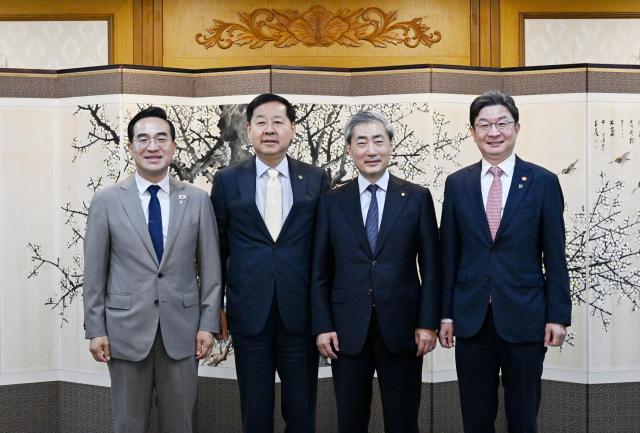
The same day, Deputy Prime Minister and Finance Minister Koo Yun-cheol chaired an expanded macroeconomic, fiscal and financial policy meeting attended by Budget Minister Park Hong-keun, Financial Services Commission Chairman Lee Eog-weon and BOK Governor Shin Hyun-song to review financial-market risks and vulnerabilities.
Market participants view the inspection as a sign that authorities have stepped up their defense of the currency, with regulators now scrutinizing actual trading records.
So far, policymakers have managed to prevent the won-dollar exchange rate from testing the psychologically important 1,600 level.
What they have not achieved is a decisive reversal of the broader weakness that has kept the currency trapped in the 1,500-won range.
"Since mid-May, the scale of foreign selling in the stock market has increased sharply to around 3 trillion won per day on average," said Jung Yong-taek, an analyst at IBK Securities. "The current factors are unlikely to be resolved in the short term."
For now, Seoul's financial markets remain caught in a vicious cycle in which foreign capital outflows weaken both stocks and the currency, while authorities can slow the slide but struggle to change its direction.

Copyright ⓒ Aju Press All rights reserved.