

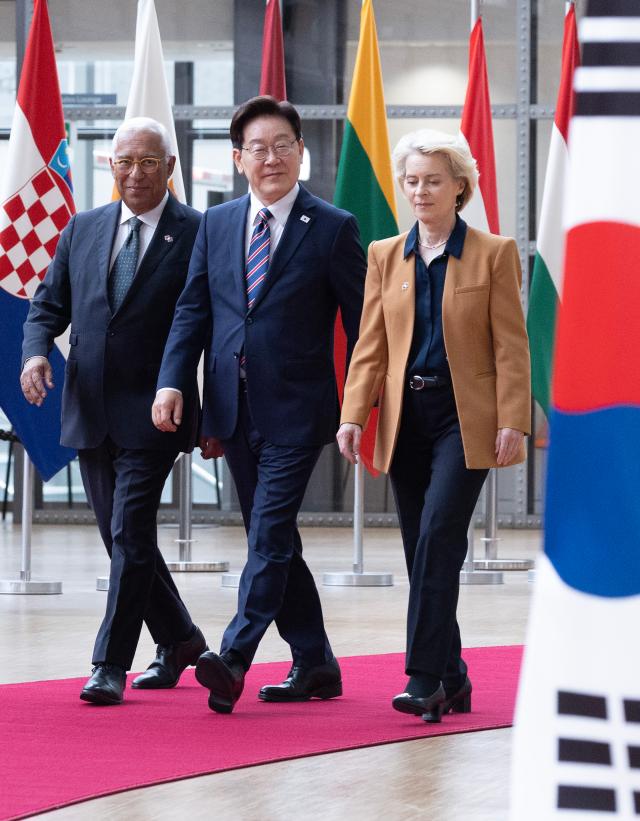
In a joint statement released after the summit, President Lee, EU Council President Antonio Costa, and EU Commission President Ursula von der Leyen stated, "We condemn the Russian invasion of Ukraine, which has caused immense humanitarian suffering, and emphasize the importance of a comprehensive ceasefire."
The leaders reaffirmed the need for a just and lasting peace based on the principles of the UN Charter and international law, including independence, sovereignty, and territorial integrity. They emphasized the importance of ensuring justice for the victims of the war.
The statement highlighted concerns that North Korea is providing third-party support that enables Russia's continued aggression in Ukraine, labeling this as "illegal military cooperation." They urged both Russia and North Korea to immediately cease all related activities and comply with the UN Charter and all relevant UN Security Council resolutions.
On the issue of North Korea's nuclear program, the leaders expressed serious concerns and reiterated their commitment to the complete denuclearization of the Korean Peninsula in accordance with relevant UN Security Council resolutions. They called on North Korea to fully comply with its obligations as a non-nuclear weapon state under the Treaty on the Non-Proliferation of Nuclear Weapons (NPT) and to implement the Comprehensive Safeguards Agreement with the International Atomic Energy Agency (IAEA). They stressed that North Korea will never be recognized as a nuclear-armed state and will not hold any special status in this regard.
The leaders also demanded that all UN member states fully implement relevant Security Council resolutions and urged North Korea to engage in meaningful discussions with all relevant parties.
Regarding peace and stability on the Korean Peninsula, they supported South Korea's efforts to resume dialogue with North Korea through active tension reduction and confidence-building measures, recognizing the essential need for tangible improvements in North Korea's human rights situation and calling for the country to allow access for international and humanitarian organizations.
On regional issues, the leaders reaffirmed their support for freedom of navigation and overflight in accordance with the United Nations Convention on the Law of the Sea (UNCLOS), including in the South China Sea, and emphasized the importance of maintaining peace and stability in the Taiwan Strait while opposing unilateral attempts to change the status quo in the Indo-Pacific region.
In relation to the ongoing conflict in the Middle East, they stressed the need for freedom of navigation and safe passage in the Strait of Hormuz, the protection of civilians and civilian infrastructure, and the full respect for international law, including maritime law as reflected in UNCLOS. They stated that only through dialogue and diplomatic efforts, fully respecting the UN Charter and international law, can tensions be eased and peace and stability restored in the Middle East.
The leaders agreed to continue close consultations on the EU's proposed steel tariff quotas and Carbon Border Adjustment Mechanism (CBAM), as well as on their respective legislative and policy measures related to industrial policy, circular economy, and energy-intensive industries. They committed to ongoing joint efforts to address global steel overproduction through forums like the Global Forum on Steel Excess Capacity (GFSEC).
This visit marks the first time in nearly eight years that a South Korean president has visited the EU, which is the world's largest trading bloc and South Korea's third-largest trading partner, encompassing a population of 450 million across 27 member states.
Despite the rise of protectionism globally, South Korea and the EU maintain a trade relationship valued at approximately $130 billion based on their free trade agreement, with last year's merchandise trade reaching an all-time high.
Before the summit, Chief Presidential Spokesperson Kang Yu-jeong stated during a local briefing at a hotel in Brussels that they plan to convey the position that recent EU regulatory legislation, including steel tariff quotas (TRQ) and CBAM, should not become new trade barriers, despite their aims to enhance EU competitiveness and address climate change.
* This article has been translated by AI.

Copyright ⓒ Aju Press All rights reserved.