

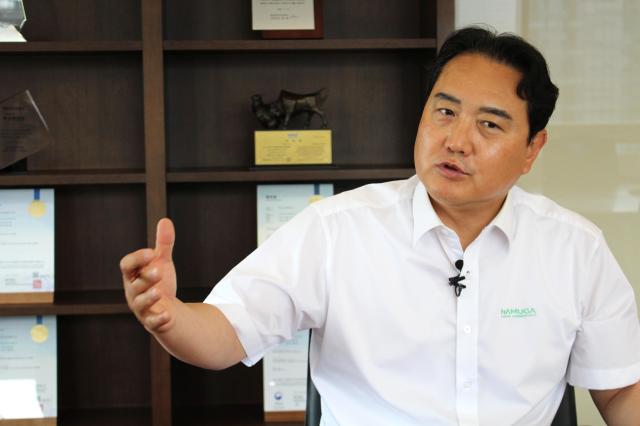
"Since the emergence of generative artificial intelligence (AI), graphics processing units (GPUs) and memory have become essential infrastructure. Now, in the era of Physical AI, sensors will take on that role," said Lee Dong-ho, CEO of Namuga. He emphasized that sensors will be the most crucial components in the spread of Physical AI, explaining that various sensing technologies, such as 3D sensors and LiDAR, are essential for AI to perceive and interact with the real world.
Namuga has grown primarily by supplying camera modules for Samsung Electronics smartphones but has recently expanded its business to include vision solutions for robotics and mobility. Lee noted, "We are entering the era of the Sensor of Things (SoT), and we will secure global competitiveness in the sensor field, which acts as the eyes and nerve cells of Physical AI."
Below are excerpts from the interview with Lee:
- What kind of company is Namuga, celebrating its 21st anniversary and 10 years since its KOSDAQ listing?
"Namuga is a sensing specialist that has grown based on smartphone camera modules. We possess various advanced sensor technologies, including 3D sensors, LiDAR, and infrared (IR) sensors, and our goal is to continue growing centered around sensing technology."
- Most of your revenue comes from Samsung Electronics' smartphone camera modules. How do you evaluate your business structure?
"Being a key partner of Samsung Electronics' Mobile (MX) division is Namuga's greatest strength. The Galaxy ecosystem is a market where world-class technological innovation occurs. We plan to strengthen our existing business while expanding into new areas based on the technology and manufacturing capabilities we have accumulated."
- Your operating profit margin is higher than that of your peers.
"I believe the most important metric in manufacturing is inventory turnover. The speed at which parts are assembled and shipped from the factory determines profitability. Therefore, Namuga has focused on improving inventory turnover and investing in process automation. Currently, we manage inventory turnover on a weekly and monthly basis, and a significant portion of our main production lines is automated. In fact, while the workforce at our factory in Vietnam has decreased from around 1,500-1,600 in 2023 to about 800, both revenue and operating profit have increased."
- You have been selected as a supplier of 3D sensing modules for global automotive and robotics platforms. What does this mean?
"Being chosen as a supplier is significant not only for our product competitiveness but also for our manufacturing capabilities. Global clients evaluate not just product performance but also quality control systems, production stability, and manufacturing systems comprehensively. Namuga has established the industry's first real-time process monitoring system, allowing us to check quality metrics, inventory turnover, and process status in real-time using just a smartphone. I believe our ability to identify and respond to issues before they arise has been a key factor in receiving high evaluations from global clients."
- What is your outlook for the future of the robotics and mobility market?
"If smartphones represent the leading market in the IT industry, I believe automobiles are the second market. Recently, cars have evolved from mere machines into platforms that integrate advanced IT technologies. We are no longer in an era where automotive components and IT components are separate; sensor technologies used in smartphones and advanced devices are now being applied to automobiles. I believe we are moving into the SoT era, which goes beyond the Internet of Things (IoT). While IoT connected devices to a network, the future will involve various sensors collecting information from the real world, with AI understanding that data. 2D and 3D cameras, radar, and LiDAR sensors will serve as the eyes of Physical AI and function like human nerve cells."
- What significance does the LiDAR 'Stella-2,' unveiled at this year's CES, hold?
"Stella-2 is a product that combines ultra-compact solid-state LiDAR with Time-of-Flight (ToF) technology. It can be applied in various fields, including automotive, logistics automation, industrial robots, and service robots. Currently, many companies, including global logistics and IT firms, are conducting sample evaluations."
- Why is a hardware company strengthening its software capabilities?
"Ultimately, sensors need to connect with the platforms that customers use. No matter how good the hardware is, there are limits to market expansion if it is not integrated with software. Our collaboration with AI software company AImatics is part of our strategy to secure competitiveness by connecting sensors and platforms."
- What global threats do you consider most concerning?
"The pursuit of Chinese companies is the biggest threat. To survive, we must continuously secure technological superiority and automation capabilities. We maintain our competitiveness by conducting research and development in Korea while manufacturing in Vietnam. Our goal is to achieve world-class technology in the 3D sensor field."
- Why do you maintain a high dividend payout ratio and conduct large-scale stock buybacks?
"One of the most important responsibilities of a listed company is to enhance shareholder value. We must create a corporate culture that respects shareholders to gain long-term trust in the market. Our current shareholder return policy is also an expression of confidence in future growth."
- What role can Namuga play in the AI era? What kind of company do you envision Namuga becoming in three years?
"In the era of generative AI, GPUs and memory were highlighted. As we transition to the era of Physical AI, the importance of sensors will grow even more. For AI to perceive and act in the real world, sensors are ultimately necessary. Namuga aims to become a leading company in the SoT era based on 3D sensors and vision technology. I believe we have a solid foundation for growth. Our revenue has expanded from 360 billion won when I took office to around 450 billion won now. By 2028, we aim for sales of 600 billion to 700 billion won, and in the long term, we aspire to grow into a company with sales of 800 billion to 1 trillion won by 2030."
* This article has been translated by AI.
Copyright ⓒ Aju Press All rights reserved.