

SEOUL, August 13 (AJP) — A little kindness can go a long way, but on South Korea's penny-stock boards this week, investors were wondering whether sympathy could go far enough to save a company from delisting.
Online investment communities filled with anxious questions, angry recriminations and the occasional speculative wager after the Korea Exchange placed dozens of stocks under regulatory watch Wednesday in the first broad application of tougher rules aimed at pushing chronically weak companies out of the market.
“Will it really be delisted if it can't get back above 1,000 won?” one investor asked Thursday after finding CMG Pharmaceutical, a South Korean drug developer, among companies caught by the country's new minimum share-price rule.
Another investor offered what sounded almost like charity: “I might just buy 1,000 shares.”
The advice came quickly.
“I bought it yesterday because I felt bad for the company, but now it might hit the daily limit at this rate.”
CMG Pharmaceutical was up 11.17 percent at 679 won as of 1:41 p.m. Thursday, showing how quickly a delisting scare can turn into a speculative trade.
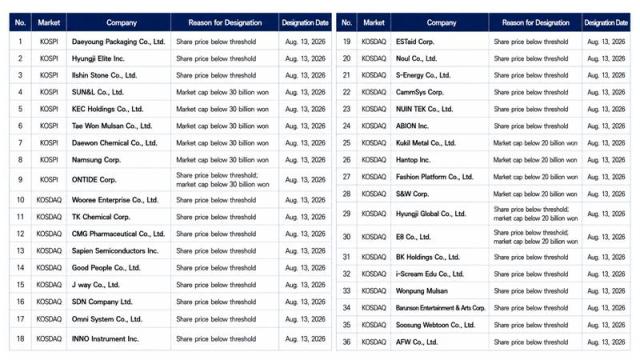
A total of 36 stocks were designated or additionally flagged Wednesday — nine on the main KOSPI and 27 on the junior KOSDAQ — according to KRX data. Six KOSDAQ stocks were already under regulatory watch and received an additional designation after remaining below 1,000 won for 30 consecutive trading days.
For shareholders, designation does not mean their stock suddenly becomes worthless. It means the clock has started.
Under rules effective July 1, a stock that closes below 1,000 won ($0.71) for 30 consecutive trading days is designated an administrative issue. During the following 90 trading days, it must remain at or above 1,000 won for 45 consecutive sessions or face delisting. The dollar conversion is based on the won trading around 1,414.40 per dollar Thursday.
The same countdown applies to companies falling below minimum market-capitalization requirements. Since July 1, the floor has been 30 billion won for KOSPI companies and 20 billion won for KOSDAQ companies. The KOSDAQ threshold rises again to 30 billion won on Jan. 1, 2027, while the KOSPI requirement climbs to 50 billion won.
Of Wednesday's affected KOSDAQ stocks, 21 failed the share-price test, four fell below the market-cap floor and two failed both, according to KRX. On the KOSPI, three failed the price requirement, five the market-value test and one both.
Sympathy, anger and speculation
The new rules turned company message boards into a mixture of blame, bewilderment and bargain hunting.
On Hyungji Elite's board, one user blamed management, asking how the apparel company could be “so incompetent that it ended up like this.”
An investor discussing Ilshin Stone, a processor and seller of construction stone including marble and granite, questioned the rule itself.
“Why is it being put under watch just because it fell below 1,000 won?” Others were looking for an opportunity.
The reactions illustrate the central risk of the new regime.
Stocks facing a possible exit from the exchange can look extraordinarily cheap in nominal terms, tempting retail investors to bet on a rebound precisely when the downside risk is greatest.
Lee Jeong-hwan, a professor of economics at Hanyang University, warned against buying such companies simply because their shares appear inexpensive.
“Delisting is clearly not good news for individual shareholders,” Lee said. “There is always a risk because once a company is delisted, investors could be left holding shares that are worthless.”
He said tougher removal rules are nevertheless necessary from the perspective of overall market quality, even if they impose losses on shareholders of individual companies.
Some companies are already trying to outrun the clock.
Shaperon, a KOSDAQ-listed drug developer, decided in June on a five-for-one share consolidation, reducing the number of shares while mechanically raising the price of each remaining share. The company has presented the move as part of an effort to stabilize its share price and improve market conditions.
But regulators have anticipated that strategy. The revised regime contains safeguards against companies repeatedly using reverse stock splits or capital reductions simply to escape the penny-stock threshold.
A consolidation can change the number on the screen. It cannot by itself repair the business underneath it.
From penny stock to chip giant
SK hynix offers an extreme example of what a genuine turnaround can look like.
Long before becoming one of the world's dominant memory-chip makers, Hynix Semiconductor was itself a penny stock struggling through a severe liquidity and debt crisis.
Its recovery required far more than lifting its share price. Hynix separated or sold noncore telecommunications and LCD businesses, disposed of assets and concentrated its resources on semiconductors. The company entered joint creditor management in October 2001 and eventually exited the program ahead of schedule after returning to sustained profitability from the second half of 2003.
That distinction goes to the heart of the government's delisting campaign.
The objective is not simply to make low-priced stocks more expensive. It is to remove companies unable to meet basic standards of market value, financial viability and disclosure, while forcing those capable of recovery to demonstrate it.
The potential effect on KOSDAQ is significant. According to an NH Investment & Securities estimate, excluding weak companies targeted by the tougher regime would raise combined operating profit among KOSDAQ-listed firms last year to 18.8 trillion won from 14.1 trillion won, while cutting the market's price-to-earnings ratio to 31.3 from 112.6.
The arithmetic captures the trade-off. Removing chronic loss-makers can improve the profitability and valuation profile of the market as a whole, but shareholders caught in the cleanup can suffer heavy losses.
For investors now betting on stocks trapped below the new thresholds, getting back above 1,000 won may buy time.
The stock may recover. Whether the company can is another question.
AJP Takeaways
• South Korea's new penny-stock rule has started a delisting countdown for companies trading below 1,000 won for 30 consecutive sessions, requiring them to recover above the threshold for 45 straight trading days within the next 90.
• The crackdown is concentrated on KOSDAQ, where 27 stocks were caught in Wednesday's sweep, fueling everything from sympathy buying to speculative bets on companies trying to escape the threshold.
• A higher nominal share price alone is not enough. Reverse stock splits can lift the price mechanically, but the SK hynix precedent shows that lasting recovery requires restructuring, stronger earnings and a viable underlying business.

Copyright ⓒ Aju Press All rights reserved.
