

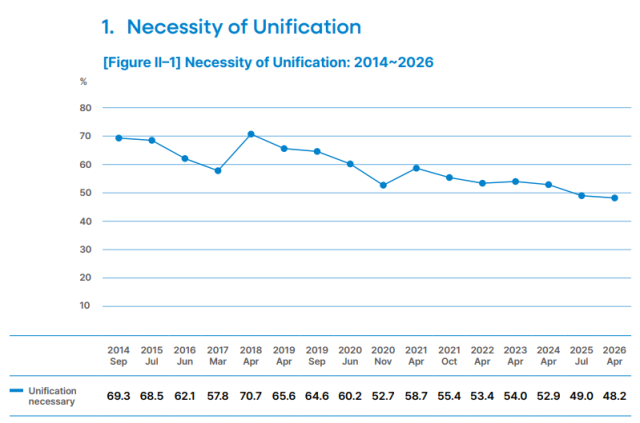
The 2026 survey by the Korea Institute for National Unification (KINU) found that 48.2 percent considered unification necessary, down from 49 percent last year, when support slipped below a majority for the first time.
Meanwhile, 70.3 percent expressed little or no interest in North Korea, the highest share since KINU began asking the question in 2015. The figure has climbed from 50.8 percent that year and 68.1 percent last year.
KINU described the trend as closer to "structural disengagement" than a temporary reaction to changes in inter-Korean relations.
The estrangement is reshaping how South Koreans envisage the peninsula’s future, with peaceful coexistence drawing far more support than reunification.
Some 66.9 percent agreed with the statement that unification would not be necessary if South and North Korea could coexist peacefully without war, up from 63.2 percent last year and 43.1 percent in 2016.Asked whether the future of inter-Korean relations should prioritize eventual unification into a single state or peaceful coexistence while maintaining separate systems, 57.6 percent chose peaceful coexistence and 16.4 percent chose unification.
Views on unification also differed sharply by generation.
The share saying unification was necessary stood at 61.6 percent among the war generation and 61.3 percent among the industrialization generation, compared with 33.4 percent among millennials and 36.3 percent among Generation Z.
Public attention to North Korea's nuclear threat also declined. Interest in the issue fell from 45.6 percent in 2016 to 27.9 percent this year, while anxiety dropped from 58.5 percent to 44.3 percent. KINU said the trend could reflect fatigue with repeated nuclear threats and the normalization of the risk.
Support for South Korea developing its own nuclear weapons stood at 68 percent, while 59.6 percent favored the redeployment of U.S. nuclear weapons to South Korea. KINU described the results as a paradox in which emotional attention to the threat has declined while demand for substantive deterrent capability remains strong.
The survey also showed weakening trust in the United States despite continued strong support for the alliance.
Some 37.5 percent said South Korea-U.S. relations had worsened over the past year. Among those respondents, 66.2 percent attributed the deterioration to the United States. Trust in U.S. policy toward the Korean Peninsula fell 15.2 percentage points to 47.7 percent.
Still, 87.3 percent said the South Korea-U.S. alliance remained necessary and 82 percent said the current presence of U.S. Forces Korea was necessary. KINU said the findings point to a broader preference for security autonomy while maintaining the alliance as a core security institution.
The survey was conducted through face-to-face interviews with 1,003 adults nationwide from April 2 to 24. It has a maximum sampling error of plus or minus 3.1 percentage points at the 95 percent confidence level.

Copyright ⓒ Aju Press All rights reserved.
