
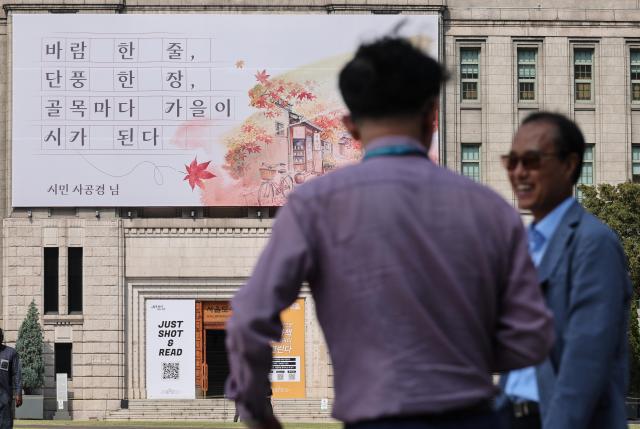
A message reading, "A line of breeze, a leaf of autumn foliage, and autumn becomes poetry in every alley," is displayed on the exterior wall of Seoul Metropolitan Library in central Seoul, Sept. 30, 2026. AJP Yoo Na-hyun
Yoo Na-hyun
Photojournalist, AJU PRESS (AJP) Covering news, culture and society in South Korea through an Asian perspective.
Copyright ⓒ Aju Press All rights reserved.
Related News
-
 Knowledge Industry Center Auction Prices Fall Below Appraisal Values
The knowledge industry centers, suffering from increased vacancies and unsold units, are facing challenges in the real estate project financing (PF) auction market promoted by financial authorities. Concerns are rising that the minimum auction prices for some properties are falling below half of their appraised values, which could increase the burden on financial institutions for recovering their loans. An analysis of the "Current Status of Properties for Sale" released on the PF information disclosure platform on November 19 revealed that a total of eight knowledge industry centers have appeared on the sale list at least once from November last year to October this year. Among these, the total appraisal value of seven properties, for which the appraisal values and minimum auction prices can be compared, was 261.2 billion won (KRW), while the total minimum bid was only 110.2 billion won (KRW), representing just 42.2% of the appraisal value. This figure represents the sum of the last publicly disclosed prices for each property and does not indicate the actual winning bid prices. In real estate auctions, if a property fails to sell, the minimum bid for the next round is often lowered. The extent of the price reduction varies depending on the auction conditions, and as repeated failures occur, the gap between the initial appraisal value and the minimum bid can widen. For instance, the appraisal value of the knowledge industry center in Uijeongbu, Gyeonggi Province, is 30.51 billion won (KRW), but as of the end of last month, the minimum auction price was only 7.63 billion won (KRW), about 25% of the appraisal value. Some properties have seen further reductions in their minimum bids. The knowledge industry center in Seongseong-dong, Cheonan, has maintained an appraisal value of 46.35 billion won (KRW), but its minimum bid was reduced from 34.03 billion won (KRW) to 30.63 billion won (KRW), a 10% decrease. Three other centers in Sin-gal-dong, Yongin, Chilgoe-dong, Pyeongtaek, and Bitgaram-dong, Naju, have remained on the sale list for nearly a year, waiting for a sale. The issue is that delays in sales or winning bids below appraisal values could lead to increased burdens on financial institutions for recovering their loans. PF loans are typically repaid through the proceeds from sales or leases of development projects, so delays and price declines can hinder the recovery of principal. However, the actual scale of losses will vary depending on the winning bid price, remaining loan balances, and the seniority of the claims. The difficulties in selling are attributed to the poor sales and leasing conditions of knowledge industry centers. According to the Ministry of Trade, Industry and Energy, the average vacancy rate for knowledge industry centers completed between 2023 and 2025 is 43.5%, with an unsold rate of 26.9%. Existing facilities are struggling to secure tenant demand, and with falling transaction prices and discounted sales from surrounding properties, it has become challenging for knowledge industry centers to even begin sales before construction. An industry insider stated, "As the commercial real estate market has stagnated recently, buyers often wait for price reductions due to failed bids rather than participating in immediate auctions," adding, "As repeated failures lower the sale prices, the losses for financial companies could increase." * This article has been translated by AI.
-
Samhyang Baribari Market Connects Urban and Rural Communities in Fall Festival
In Muan County, South Jeolla Province, the 'Samhyang Baribari Market' has emerged as a new link for urban-rural harmony and local economic revitalization, attracting residents from both the urban area of Namak New Town and the rural town of Samhyang.Held on November 7 at Namak Central Park, the market featured a direct sales venue for agricultural and marine products, local food, a flea market, and various experiential programs, drawing families out for a weekend outing.This market is particularly significant as it serves as a natural meeting and exchange space for residents of the urbanized Namak New Town and the traditional rural community of Samhyang, which have seen limited interaction due to differences in living environments.Residents from both areas shared their lifestyles and cultures through the market, strengthening community bonds.Notably, the direct sales market for seafood, which has been integrated into this year's event, became a highlight.The seafood sales area, linked with Muan County's Marine and Fisheries Department, showcased a variety of local seafood, including freshwater eel, shrimp, seaweed, and mudflat octopus, capturing the interest of visitors.The seafood booths, reminiscent of a small fish market, attracted residents eager to purchase local products, bringing the freshness of the sea to the heart of the city.Consumers enjoyed the convenience of finding both everyday seafood items like seaweed and shrimp, as well as locally produced and processed goods, while producers gained access to new sales channels.Kim Byeong-tae, 54, who purchased seasoned seaweed, said, "I usually buy seaweed at the supermarket, but buying it directly from our local market gives me more confidence. It’s even more enjoyable knowing I’m helping local producers while getting delicious seafood."The agricultural sales area was also bustling. The Samhyang Urban-Rural Exchange Association organized a direct sales market featuring local products such as red pepper powder, sesame, sesame oil, sweet potatoes, and bellflower root, enhancing the warm atmosphere of a rural market.Additionally, a variety of food stalls offering kimchi, fish cakes, rice cake soup, and chicken feet, along with participation from local small businesses in the flea market, kept visitors engaged.For children, the market became an alternative playground.Holding their parents' hands, children enjoyed cotton candy while exploring the market, and families created memories of their autumn weekend by selecting agricultural and marine products and participating in experiential programs.Various hands-on activities, such as natural soap making, mini fruit candle crafting, and character cookie icing, transformed the market from a simple trading space into a cultural hub for families.On this day, Muan County Mayor Kim San and other officials visited the market, showing interest in local agricultural and marine products and encouraging event organizers.This visit heightened awareness of expanding sales channels for local farmers and small businesses while fostering direct communication with residents.The event was hosted and organized by the Samhyang Town and the Samhyang Town Residents' Committee, with participation from local organizations such as the Samhyang Urban-Rural Exchange Association, the Saemaul Women's Association, the Senior Citizens' Association, and the Namak Red Cross, emphasizing the community-led nature of the market.It was noted that the agricultural products produced in rural areas and the seafood harvested from the sea are making their way to the tables of consumers in Namak New Town, creating a virtuous cycle where local consumption translates into income for farmers and small businesses.The distance connecting Namak and the original town of Samhyang is not merely physical; it represents a process of sharing a sense of community among residents living in different environments.Under the autumn sun, the Baribari Market showcased new possibilities as a space for harmony, where urban and rural, producers and consumers, and adults and children came together.Each local agricultural and marine product in the small baskets serves as a precious link connecting Namak and Samhyang.* This article has been translated by AI.
-
Korean Won Strengthens Despite Strong Dollar, Expected to Fall Further by Year-End
Despite ongoing pressures from a strong U.S. dollar due to uncertainties surrounding the Federal Reserve's monetary policy, the Korean won is showing relative strength. Recently, the won-dollar exchange rate dipped to the 1,330 won range before slightly rebounding to the 1,340 won level. Analysts suggest there is potential for further declines by year-end, supported by robust semiconductor exports and expectations of domestic economic recovery.As of 3:30 PM on November 2, the won-dollar exchange rate was trading at 1,343.8 won, up 9.5 won from the previous week's closing price. The exchange rate had soared to over 1,550 won in June but has since declined, reaching a record low in the low 1,320 won range last month.Notably, the won has maintained a relatively stable position in the foreign exchange market despite global pressures on the dollar. Factors such as uncertainties in U.S. monetary policy and geopolitical risks have supported the dollar's value, yet the won has shown resilience, contributing to downward pressure on the exchange rate.One key factor supporting the won's strength is the strong performance of semiconductor exports. Improved earnings and increased exports from semiconductor companies have positively influenced the inflow of foreign currency, which could lead to greater dollar selling demand from exporters, thereby increasing dollar supply in the foreign exchange market and contributing to a lower exchange rate.Expectations for domestic economic recovery also bolster the won's strength. The Bank of Korea reported on October 27 that the real GDP for the third quarter of this year grew by 1.0% compared to the previous quarter, exceeding its earlier forecast of 0.3% by 0.7 percentage points. Strong semiconductor exports and capital investment are driving this growth, raising the likelihood of an upward revision in the economic growth forecast for the year.Additionally, the possibility of further interest rate hikes by the Bank of Korea is seen as another factor contributing to downward pressure on the exchange rate. Given the higher-than-expected growth rate and inflationary pressures, market analysts predict a strong likelihood of an additional rate hike this month. An increase in domestic interest rates could enhance the relative investment appeal of won-denominated assets, further supporting the won's strength.Bank of Korea Governor Shin Hyun-song recently noted that the won remains undervalued based on effective exchange rates. This suggests that there is potential for further appreciation of the won in the medium to long term.Experts are forecasting a downward trend in the exchange rate. Korea Investment & Securities has revised its average fourth-quarter won-dollar exchange rate forecast from 1,350 won to 1,320 won, reflecting the won's stronger-than-expected performance despite the dollar's strength. The anticipated range for the exchange rate by year-end has also been lowered to between 1,250 and 1,390 won.However, there remains a possibility of a temporary rebound during the decline in the exchange rate. Factors such as the U.S. midterm elections, uncertainties surrounding the Federal Reserve's monetary policy, and geopolitical risks could stimulate demand for the dollar as a safe-haven asset, potentially leading to a short-term increase in the exchange rate. Additionally, the recent sharp decline in the exchange rate may create upward pressure on levels, limiting further declines.Moon Da-un, a researcher at Korea Investment & Securities, stated, "If the pressure from a strong dollar gradually eases, the lower bound of the exchange rate may open up further. However, considering the recent rapid decline and the remaining time until year-end, we expect that the exchange rate will face increased rigidity around the 1,270 to 1,280 won range during any further downward trajectory."* This article has been translated by AI.