
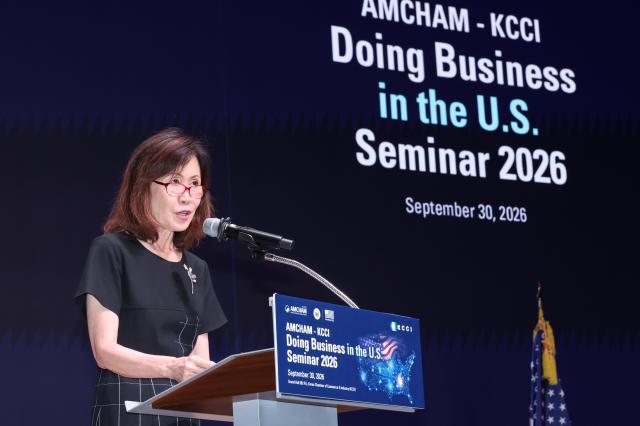
Michelle Steel, U.S. ambassador to South Korea, delivers congratulatory remarks during the 2026 Doing Business in the U.S. Seminar at the Korea Chamber of Commerce and Industry in central Seoul, Sept. 30, 2026.
Yoo Na-hyun
Photojournalist, AJU PRESS (AJP) Covering news, culture and society in South Korea through an Asian perspective.
Copyright ⓒ Aju Press All rights reserved.
Related News
-
 Sejong Concludes Seminar on Stewardship Code Revision Strategies
Sejong Law Firm (CEO Oh Jong-han) announced on the 18th that it successfully concluded the seminar titled 'Stewardship Code Revision and Response Strategies for Institutional Investors and Companies' on the 17th at the seminar room on the 24th floor of Grand Seoul in Jongno-gu, Seoul. Organized by Sejong's Corporate Governance Strategy Center and in collaboration with the International Corporate Governance Network (ICGN), the event aimed to explore domestic and international institutional changes and practical responses ahead of the revised stewardship code's implementation on January 1 of next year. The seminar opened with welcoming remarks from ICGN CEO Jen Sisson and Oh Jong-han, who heads Sejong's Corporate Governance Strategy Center. The ICGN Global Policy Team, which delivered the keynote address, discussed trends in code revisions in countries like the UK and Japan, sharing insights on changes in global institutional investors' shareholder engagement methods and implications for the domestic market. In the first session, Hwang Hyun-young, a senior researcher at the Capital Market Research Institute, stated, "The stewardship code, which has been comprehensively revised for the first time in ten years, has transitioned to a system that substantively verifies the fulfillment of fiduciary responsibilities by introducing compliance checks." He added, "With the strengthening of disclosures and amendments to the Commercial Act and Capital Markets Act, companies must thoroughly present the basis for their decision-making." Following this, Yoon Tae-jun, a specialist at Sejong, suggested, "As institutional demands have evolved from shareholder returns to board independence and protection of shareholder rights, companies should internalize their own response capabilities and actively utilize external advice." The panel discussion, moderated by Ahn Hyo-seop, a senior specialist at Sejong, included participation from Sejong attorney Hong Hyun-pyo, specialist Yoon Tae-jun, researcher Hwang Hyun-young, SustainBest CEO Oh Seung-jae, and Mirae Asset Asset Management Center Head Lee Wang-gyeom. Attorney Hong, a former official at the National Pension Service's Fiduciary Responsibility Office, remarked, "The influence of institutions is growing, as seen in the increased domestic stock ratio of the National Pension Service and the rising rate of dissenting votes on resolutions." He advised, "Starting from next year's regular general meeting of shareholders, the expanded separate election of audit committee members and the 3% voting rights limit will apply, making institutional votes pivotal in determining outcomes, thus necessitating consistent justification through candidate pre-verification and compensation policy adjustments." Ahn emphasized, "This revision signals the end of the era of formal checklists and demands mutual accountability from both institutions and companies." He added, "As shareholder engagement becomes a constant, companies must move beyond defensive responses and transparently explain the decision-making processes of their boards to enhance long-term corporate value." CEO Oh stated, "The revised code is significant in promoting sustainable growth through constructive communication," and pledged to provide substantial legal services to both institutions and companies based on extensive advisory experience.* This article has been translated by AI.
-
Law Firm Lounge: Barun, Botulab, and KORPA Conclude '2027 Annual General Meeting Response Strategy Seminar'
Barun Law LLC, in collaboration with Botulab (TwoSun ESG) and KORPA (Korea Proxy Advisory), announced on November 18 that they held the '2027 Annual General Meeting Response Strategy Seminar' on the 17th at the Korea IR Council in Yeouido, Seoul. Over 100 attendees, including IR, disclosure, and legal personnel from listed companies, showed great interest in the rapidly changing general meeting environment.Next year's general meetings will see the first application of mandatory cumulative voting, expanded separate elections for audit committee members, strengthened 3% aggregate rules, and the introduction of mandatory electronic general meetings, which will reduce the voting rights of major shareholders and lower the barriers for minority shareholders and activist funds to enter the board.The first speaker, Jin Seong-hoon, head of the research policy group at the KOSDAQ Association, stated, "All listed companies must prioritize revising their articles of incorporation," urging the incorporation of changes in the Commercial Act, such as the renaming of outside directors to 'independent directors' and the separate election of audit committee members, into their articles before the general meeting. He also added that the duty of care for directors is a comprehensive concept that considers the interests of all shareholders, and explaining reasons and alternatives for not distributing dividends at the general meeting would not constitute a violation.Practical tips included the necessity of general meeting approval for the disposal of treasury shares for employee incentives, strengthening disclosure standards for treasury shares (1% or more), and noting the ratio of votes for and against in the minutes.Jeong Seok-ho, representative of KORPA, pointed out that the recently amended stewardship code expanded the fiduciary responsibilities of institutional investors to all assets, allowing for 'collaborative engagement.' He noted that since the pre-disclosure standard for the National Pension Service's voting rights has been lowered to a 5% stake, companies with low price-to-book ratios should proactively enhance shareholder value through value-up disclosures and direct communication with management to eliminate reasons for engagement.Han Tae-young, a lawyer at Barun, explained that based on recent Supreme Court precedents, shareholder directors have their voting rights restricted as interested parties regarding their own compensation limit agenda and are excluded from the total number of issued shares. However, he introduced lower court judgments indicating that family members or controlling corporations are not subject to these restrictions and suggested practical responses such as separately presenting compensation limits for individual directors, introducing general meeting approval for executive compensation regulations, and providing prior notice of the number of excluded shares by the chairperson on the day of the general meeting.Kwon Jae-yeol, a professor at Kyung Hee University Law School, emphasized that the mandatory electronic general meetings for listed companies with assets exceeding 2 trillion won (KRW) next year should be conducted alongside in-person meetings. He recommended entrusting specialized institutions like the Korea Securities Depository due to the lack of related guidelines and advised that to avoid disputes during emergencies, the 'electronic general meeting operating regulations' should be pre-established with board approval, including severity grading (L1 to L4) and a seven-step response protocol.Oh Yu-mi, a director at Botulab, analyzed that approximately 12% (353 companies) of listed companies faced agenda rejections or unresolved issues during last year's annual general meetings, with 148 cases related to director compensation limits. She emphasized the need to standardize the provision of judgment information, including business background, expected effects, and risks, along with the notice of the meeting at least three weeks in advance, and to secure voting rights through a four-stage continuous communication strategy encompassing both before and after the general meeting.* This article has been translated by AI.
-
NH Investment & Securities Hosts Exclusive Seminar for Family Office Clients
NH Investment & Securities announced that it held an "Exclusive Family Office Seminar" on November 11 at the Parnas Hotel in Samsung-dong, Seoul, for clients enrolled in its family office services.This seminar was a private event aimed at institutional investors, exclusively inviting clients with entrusted assets exceeding 30 billion won.The seminar focused on the upcoming "2027 Global Asset Market Outlook and Investment Strategies." It also addressed tax issues related to tax-saving strategies, which are of particular interest to high-net-worth individuals.The presentations were tailored for ultra-high-net-worth individuals. Ha Jae-seok, a research fellow at NH Investment & Securities, discussed the "2027 Global Asset Market Outlook and Investment Strategies," while Ko In-seong presented on "Top Picks for Overseas Stocks to Watch in 2027," and tax accountant Song Seong-jin covered "Tax Issues and Tax-Saving Strategies for 2027." NH Investment & Securities' family office provides comprehensive asset management services that connect family assets, businesses, and future generations. It designs solutions tailored to each family's challenges, from business growth to asset succession and social contributions. In particular, it explores various options related to asset succession, including inheritance and gift tax, business succession, and the establishment of family corporations and charitable foundations, while supporting the establishment and operation of these entities.The focus of the service is not only on proposals but also on execution. The firm aims to clarify the challenges families need to address and work alongside them throughout the implementation process, bridging the gap between consultation and practical problem-solving.Lee Jae-yeol, head of the WM Division at NH Investment & Securities, stated, "The family office seminar is an opportunity for our in-house experts, including those from the research department and investment advisory committee, to share insights directly with clients. We are refining the seminar's topics and content to help clients deeply examine market changes and tax issues, allowing them to establish asset management directions suited to their families."* This article has been translated by AI.