

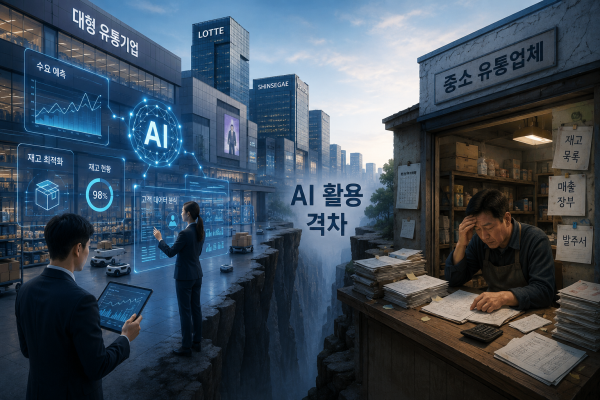
Image generated by AI [Photo=ChatGPT]
The use of artificial intelligence (AI) in the retail sector is expanding, but a growing divide exists between large retailers and small businesses. Major retailers are applying AI to key operations such as pricing, customer analysis, and inventory management, while many small retailers struggle to even begin the transition due to cost, workforce, and data infrastructure limitations.
According to the retail industry, major companies like Lotte, Shinsegae, and Hyundai have established dedicated AI teams to broaden the scope of AI development and application. They are enhancing productivity and efficiency through demand forecasting, inventory optimization, and personalized recommendations based on their own customer, logistics, and sales data.
In contrast, many small retailers recognize the need for AI but have not progressed to actual implementation. A survey conducted last year by the Korea Institute for Advancement of Technology on 4,300 small businesses with sales under 150 billion won found that only 0.9% of them used AI to identify and address problems.
Furthermore, only 0.1% of respondents reported using AI for real-time problem identification and decision-making across the organization. A mere 2.8% indicated that some departments were able to identify and monitor issues.
Notably, the utilization rate of AI in the retail and transportation sectors was reported at 0%. Despite the potential for AI to be applied in demand forecasting, pricing adjustments, and order automation based on sales, inventory, and customer data, actual implementation remains in its infancy.
The low adoption of AI among small retailers is partly due to weak data foundations. The same survey revealed that 38.5% of all small businesses do not collect any data at all. While 57.8% collect some data, it has not translated into actual AI utilization. Effective AI application requires prior data collection, refinement, and analysis, but securing the necessary skilled personnel and budget is a common challenge.
Small business owners face similar challenges. According to a survey released in November by the Seoul branch of the Korea Federation of Small and Medium Enterprises, only 9.7% of respondents reported using AI in their operations. Although they recognize the potential benefits of AI, the initial investment costs are a significant barrier. Among the surveyed businesses, 69.0% cited 'cost burden' as the reason for difficulty in adopting AI technology, followed by 'lack of knowledge and personnel' (30.7%) and 'difficulty integrating with existing systems' (23.0%).
Industry experts warn that the disparity in AI adoption could widen productivity gaps among retailers. While large retailers enhance their pricing, inventory, and logistics operations, small businesses that remain reliant on manual processes may find it increasingly difficult to compete on cost and customer responsiveness.
Kim Ik-sung, a professor at Dongduk Women's University and former president of the Korean Society of Retail Studies, stated, "The level of AI utilization among domestic small retailers is very low. Given the significant cost burden of AI adoption, continuous government support is necessary." He added, "Practical training and support for real-world applications must be implemented in tandem, as retailers that leverage AI will secure market competitiveness in the future."
* This article has been translated by AI.

Copyright ⓒ Aju Press All rights reserved.