

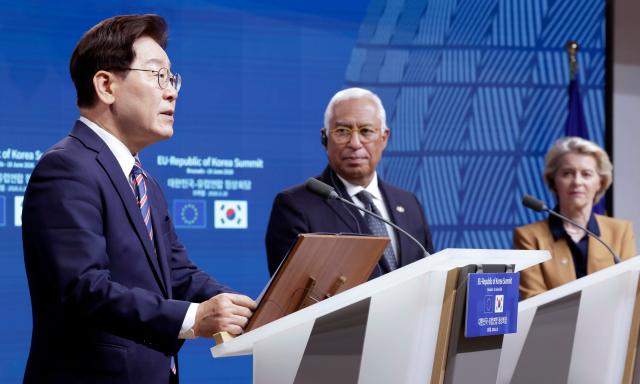
Additionally, the two sides officially signed a Digital Trade Agreement (DTA), marking significant cooperation in trade, investment, and digital sectors.
This visit is the first by a South Korean president to the EU in nearly eight years. The EU is the world's largest trading bloc and South Korea's third-largest trading partner, comprising 27 member states with a population of 450 million and a GDP of 18 trillion euros.
The Ministry of Trade, Industry and Energy, in collaboration with KOTRA, held an 'Investment Declaration Ceremony for Europe' and a 'European Investment Roundtable' to discuss expanding investments from European companies in South Korea and future cooperation directions.
During the investment declaration ceremony, Minister Kim Jeong-kwan attended as four European companies reported a total of $165 million in foreign direct investment.
German advanced materials company Orafol plans to expand its factory in South Korea, which it acquired last year in the reflective film sector. The company aims to leverage its technology and the global network of South Korean firms exporting to over 80 countries to create an export hub for the Asia-Pacific region's reflective film demand.
French company Quandela, a leader in photonic-based quantum computing, plans to enhance research and development collaboration with South Korean academia and industry. This investment is expected to help establish South Korea as a research and manufacturing hub, accelerating the spread of quantum computing technology.
Dutch firm Prodrive Technologies intends to establish its first Korean subsidiary to import and sell advanced industrial equipment modules, including semiconductors. This move will expand its participation in South Korea's advanced industrial supply chain and may lead to future manufacturing and R&D center developments based on business outcomes.
Swedish electronic components and display equipment specialist Mycronic aims to use this investment to establish South Korea as a research base, accelerating technological innovation in display and semiconductor equipment.
The European Investment Roundtable explored future investment cooperation directions with European investment firms.
Minister Kim Jeong-kwan stated, "South Korea's competitive advanced industrial supply chain and AI ecosystem will continue to provide new cooperation opportunities for European companies. We will actively support the expansion of foreign investment incentives and improve the regulatory environment, ensuring that foreign companies' concerns are addressed promptly during the investment process."
During the summit, Han Gu-yeong, head of the Trade Negotiation Headquarters at the Ministry of Trade, and EU Commissioner for Trade and Economic Security Valdis Dombrovskis officially signed the Korea-EU DTA in the presence of the two leaders.
The Korea-EU DTA is the second bilateral digital trade agreement South Korea has signed, following Singapore, and the first with one of its top five trading partners.
The agreement expands the traditional trade relationship, established under the Korea-EU Free Trade Agreement (FTA) that took effect in 2011, into the digital domain, creating a regulatory framework to respond to the rapidly changing digital trade environment.
The DTA consists of 42 provisions and was finalized after seven rounds of official negotiations that began in October 2023, culminating in a declaration of agreement in March 2025.
Key provisions include prohibiting the localization of computing facilities and data, allowing South Korean companies to process data collected in the EU on domestic servers without the need to establish local data centers. Furthermore, it protects source code, a critical business asset, by preventing requirements for source code transfer or access as a condition for software import, export, distribution, or sales.
The agreement also establishes measures to prevent fraud in e-commerce activities conducted by South Korean consumers on EU platforms and ensures appropriate remedies for consumers. It strengthens consumer rights by allowing them to refuse or consent to receiving spam messages from EU-based e-commerce companies and senders.
In the digital trade process, the DTA recognizes the legal validity of electronic signatures and certifications, encourages the use of data-based documents instead of paper in import and export processes, and aims to streamline administrative and customs procedures by electronically receiving various documents and data through a single window.
During the Korea-EU summit, both sides agreed to broadly develop their strategic partnership in security and economic areas.
President Yoon stated during the joint press conference that the two sides have decided to initiate negotiations for a 'Confidential Information Protection Agreement' to strengthen security and defense cooperation. He expressed hope that the agreement would be concluded swiftly, allowing for the safe sharing of sensitive information and facilitating active industrial and research collaboration.
The push for the Korea-EU Confidential Information Protection Agreement is a response to increasing uncertainties in the international order and the interconnectedness of security in the Indo-Pacific region and Europe.
In the economic sphere, both sides reaffirmed their commitment to strengthening and reforming the World Trade Organization (WTO) as the central axis of the multilateral trading system and deepening bilateral cooperation in strategically important areas such as trade, investment, supply chains, digital technology, advanced technology, energy, and innovation.
The government conveyed concerns regarding the EU's trade regulations, including steel tariff quotas (TRQ) and the Carbon Border Adjustment Mechanism (CBAM), and requested regulatory easing.
President Yoon noted, "The EU is our third-largest trading partner after China and the United States and our number one investment partner. This agreement will create a stable data business environment and further activate digital trade between the two sides."
Regarding energy, both sides agreed to launch a high-level consultative body to coordinate cooperation in energy security, energy systems, and energy transition.
EU Commission President Ursula von der Leyen stated, "We will also cooperate in offshore wind and hydrogen energy, and even in nuclear and space sectors. The discussions on small modular reactors (SMR) held during this summit will enhance our competitiveness in the long term."
* This article has been translated by AI.

Copyright ⓒ Aju Press All rights reserved.