

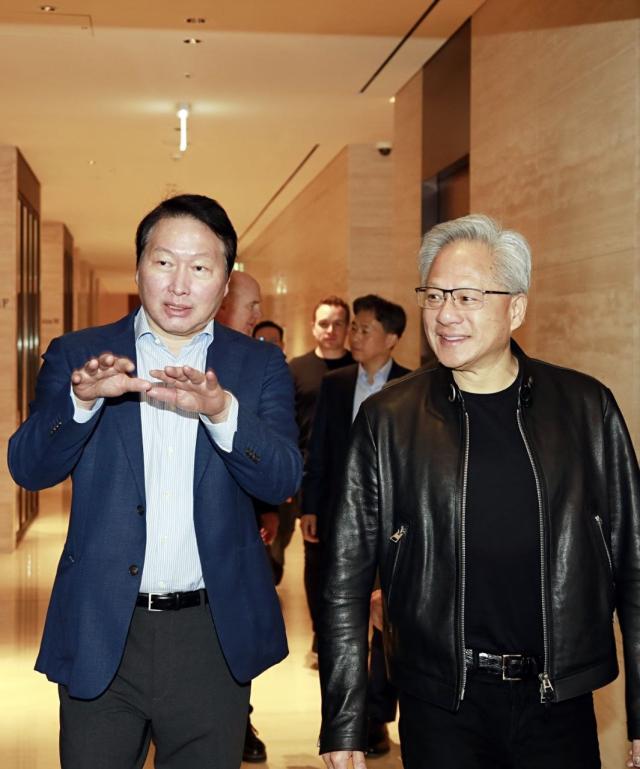
On June 10, Chey Tae-won, Chairman of SK Group, stated in an interview with the Nihon Keizai Shimbun in Tokyo that the company aims to build an AI-specialized data center, referred to as an "AI factory," by 2028-2029.
The AI factory will be a next-generation data center optimized for training and inference of large language models (LLMs). It will combine SK's high-bandwidth memory (HBM) with NVIDIA's graphics processing units (GPUs) to achieve high computational performance while minimizing power consumption.
SK plans to first establish its initial AI factory in South Korea by 2027, with Japan selected as the first overseas expansion site. The facility in Japan will be constructed in collaboration with local companies, and specific discussions are already underway, targeting operational readiness by 2028-2029.
While the investment scale has not been disclosed, the facility is expected to have a gigawatt (GW) power capacity, comparable to the energy consumption of a major city. SK is currently searching for a suitable site with ample space and reliable power supply.
Chey explained, "We expect to support Japanese companies in expanding their AI utilization while showcasing our semiconductor technology as a 'showcase.'"
He also mentioned that if additional expansion is necessary, the company may consider building overseas production bases. He praised Japan as a "very excellent candidate" due to the concentration of semiconductor equipment and material companies, indicating that the necessary ecosystem is already in place.
Earlier, on June 9, after attending the Nikkei Forum at the Imperial Hotel in Tokyo, Chey shared his views on how to utilize investment returns from Kioxia.
He stated, "If we earn money in a region, we should consider ways to grow together with that area. Just as our citizens would not feel positively if foreign companies invest in Korea and take all the profits away, Japan may feel the same way." He emphasized that there are many areas for cooperation between Korea and Japan, particularly in investing in Japan's semiconductor materials and components sector.
Chey clarified that regarding Bain Capital's recent addition of 'management participation purpose' in Kioxia's public disclosures, SK's direct management involvement is not possible due to trust structure constraints. He noted, "Kioxia is both an investment company and a competitor in the market, so we must maintain a strict competitive order." However, he added, "While management operates independently, collaboration in other areas is certainly possible."
Regarding Kioxia Holdings, with which SK has an indirect investment relationship, Chey expressed a desire to seek various collaborations in talent, research and development, and ecosystem development, even amid competition. He also expressed hope for the smooth construction of the Hokkaido plant by Rapidus, Japan's next-generation semiconductor national project company, and indicated a willingness to cooperate if necessary.
Additionally, Chey has been consistently proposing the idea of a "Korea-Japan Economic Community," where both countries can collaborate as a single economic zone. He argued that amid ongoing U.S.-China tensions, private companies in Korea and Japan can create an environment conducive to cooperation through regulatory easing and joint procurement, leading to mutual growth for both nations.
* This article has been translated by AI.
Copyright ⓒ Aju Press All rights reserved.