

That search is reshaping not only Asia's semiconductor industry but also its capital markets. As investors crowd into a handful of AI champions, exchanges are racing to launch new products while regulators grapple with where to draw the line between financial innovation and market stability.
South Korea has emerged as Asia's real-world test case.
Its AI-driven stock rally transformed Samsung Electronics and SK hynix into the foundation of one of the world's busiest single-stock leveraged exchange-traded fund (ETF) markets, offering regulators—and rival financial centers—a preview of both the opportunities and the risks.
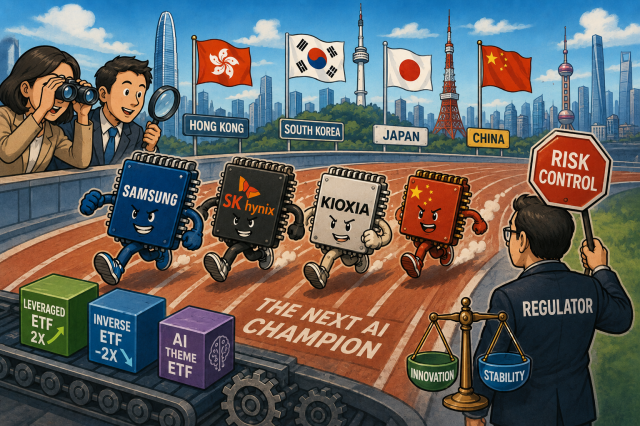
Hong Kong moved first by listing Asia's first single-stock leveraged and inverse ETFs in 2025. Japan may be next, with proposed leveraged products linked to memory-chip maker Kioxia. China, meanwhile, is steadily expanding the pool of semiconductor companies that could underpin similar products as Beijing builds domestic AI champions.
Increasingly, the race is shifting from semiconductor fabs to capital markets, where exchanges, asset managers and regulators are shaping the next generation of AI investment products—and the rules that govern them.
Asia's single-stock leveraged ETF story began in Hong Kong.
Seeking to strengthen its position as a regional ETF hub, Hong Kong Exchanges and Clearing approved Asia's first single-stock leveraged and inverse ETFs in 2025, initially allowing investors to take amplified long or short positions in companies including Samsung Electronics and SK hynix without directly trading derivatives.
Since then, the market has expanded to products linked to global technology companies such as Nvidia and Tesla, reflecting Hong Kong's strategy of competing through increasingly sophisticated exchange-traded products rather than market size alone.
If Hong Kong pioneered the products, South Korea demonstrated how quickly the market could grow.
The country's AI rally turned Samsung Electronics and SK hynix into magnets for leveraged investment, attracting billions of dollars into products offering two-times exposure to the chipmakers at the center of the global AI infrastructure boom.
Just as importantly, South Korea became a case study in the risks.
As assets under management expanded, regulators warned that funds designed to track individual stocks could themselves begin influencing trading in those shares. The debate quickly shifted from investor demand to whether leveraged ETFs had become large enough to amplify volatility in the underlying market.
South Korea's experience has drawn attention well beyond its borders. Hong Kong-listed leveraged ETFs tied to Samsung Electronics and SK hynix have attracted substantial assets, while U.S. issuers have proposed additional leveraged products linked to Korean semiconductor stocks.

Yang Jun-sok, professor of economics at the Catholic University of Korea, said South Korea's experience had likely influenced the development of similar products elsewhere in Asia.
"South Korea's single-stock leveraged ETFs have had some influence," Yang said. "As long as a handful of stocks continue to outperform, demand for these products is inevitable. Once that demand exists, more developed financial markets will create products to meet it."
Japan may offer a glimpse of the industry's next phase.
Several U.S. asset managers have proposed leveraged and inverse ETFs linked to memory-chip maker Kioxia as optimism grows over AI infrastructure spending.
Unlike South Korea, where leveraged ETFs followed a surge in retail demand, Kioxia's proposed products are emerging before a comparable trading boom has taken hold.
That marks an important shift. Rather than responding to investor enthusiasm, asset managers are increasingly attempting to identify tomorrow's AI winners before the market fully prices them in.
Whether that becomes a lasting regional trend remains uncertain.
"I think it's still too early to call this a lasting trend," Yang said. "Regulators in other markets have become more aware of the risks these products can pose to market stability, and investors also understand how volatile single-stock leveraged ETFs can be."
"If the current concentration of gains in AI and semiconductor stocks begins to fade, demand for single-stock leveraged ETFs is also likely to weaken," he said.
China has yet to become a major market for single-stock leveraged semiconductor ETFs.
Even so, Beijing's drive to build a self-sufficient semiconductor industry is steadily expanding the universe of companies around which such products could eventually be built.
The blockbuster Shanghai debut of ChangXin Memory Technologies (CXMT) highlighted investor appetite for China's domestic semiconductor champions. As Beijing pours investment into memory chips, AI hardware and advanced manufacturing, asset managers are gaining an expanding list of companies that could support future leveraged products.
Today's ETFs revolve around Samsung Electronics, SK hynix and Kioxia. Tomorrow's could include a much broader range of Chinese chipmakers.
Yang said South Korea's experience has already helped raise international awareness of both the opportunities and risks of single-stock leveraged ETFs.
"These products have attracted considerable interest abroad, especially on social media," Yang said. "That has increased awareness not only of their potential returns but also of their risks."
As single-stock leveraged ETFs spread across Asia, regulators are increasingly confronting the same question: how much leverage is too much?
South Korea has responded by slowing the market. Authorities suspended approvals for new single-stock leveraged ETFs and ETNs, tightened investor suitability requirements and accelerated stricter minimum cash-deposit rules as speculative trading intensified during the AI rally.
Hong Kong has taken a different approach. Rather than restricting access, regulators introduced a framework allowing issuers to temporarily reduce target leverage ratios during periods of market stress instead of forcing funds to maintain fixed two-times exposure under all conditions.
The broader lesson extends well beyond leveraged ETFs.
The AI boom is changing not only which companies investors buy but also how capital markets package those companies into increasingly concentrated investment products.
That demand is unlikely to disappear simply because regulation becomes stricter.
As investors hunt for Asia's next AI champion, the competition is no longer confined to semiconductor fabs. It is increasingly being fought in capital markets, where exchanges compete to build the next generation of AI investment products and regulators race to keep pace with the risks they create.

Copyright ⓒ Aju Press All rights reserved.
