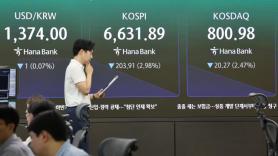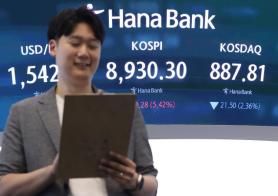
The KOSPI opened 3.1 percent lower and traded as low as 6,669.3. The benchmark was down 210.7 points at 6,699.2 in morning trading.
SK hynix, the world's second-largest memory chipmaker, fell 5.0 percent to 1,721,000 won ($1,279). Samsung Electronics dropped 3.0 percent to 251,750 won ($187).
The losses followed weekend calls from major AI industry figures for a more cautious pace of development amid growing concerns over the risks posed by increasingly powerful models.
Anthropic CEO Dario Amodei called for slowing advances in frontier AI, while OpenAI CEO Sam Altman publicly backed the need to pace development. U.S. President Donald Trump pushed back against the calls, saying the United States must maintain its lead over China in AI.
The selloff in Seoul stood out against the broader semiconductor market.
The Philadelphia Semiconductor Index rose 1.8 percent Friday, but memory and storage names that compete more directly with the two Korean firms fell. Micron Technology slipped 0.2 percent, SanDisk 3.5 percent, Western Digital 3.0 percent and Seagate 3.7 percent.
The divergence suggests investors were treating Seoul primarily as a memory trade rather than a broad semiconductor play, leaving the KOSPI particularly exposed when memory shares underperform the wider chip sector.
The macro backdrop offered little cushion.
Brent crude remained above $100 a barrel as the U.S.-Iran conflict continued to disrupt energy supplies and shipping, while the yield on the 10-year U.S. Treasury note ended Friday near 5 percent.
The Federal Open Market Committee meets Tuesday and Wednesday. Markets were pricing an 86 percent chance of a quarter-point rate increase from the current 3.50 percent to 3.75 percent range after hotter U.S. inflation data.
Foreign investors sold a net 1.1297 trillion won ($839 million) of KOSPI shares early in the session, while institutions sold a net 290.4 billion won ($216 million).
Individual investors bought a net 1.2686 trillion won ($942 million), absorbing much of the selling.
The pattern marked a reversal from the first half of the month.
Retail investors sold a net 5.21 trillion won of Samsung Electronics and 7.82 trillion won of SK hynix between Sept. 1 and Sept. 11. They have been heavy net sellers of the two chip majors since April, according to Korea Exchange data.
Program trades showed net selling of 929.9 billion won ($691 million), almost all of it from non-arbitrage transactions.
Market breadth was heavily negative, with 182 KOSPI issues rising, 666 falling and 44 unchanged.
SK Square, whose main asset is its stake in SK hynix, fell 6.2 percent to 1,021,000 won ($758), a steeper decline than the chipmaker itself.
Energy-linked small caps moved in the opposite direction. Heungkuk Petroleum rose 3.8 percent to 15,160 won ($11).
The KOSDAQ held up better, falling 2.0 percent, or 16.2 points, to 804.4.
The KOSPI 200 Volatility Index, Seoul's fear gauge, climbed 17.7 percent last week to 46.28. Monday's decline left the benchmark roughly 26 percent below its record close in June.
The won was quoted at 1,346.20 against the U.S. dollar, 2.40 won weaker than Friday's close.
Elsewhere in Asia, Japan's Nikkei 225 fell 1.4 percent to 63,112.92, while markets in Shanghai and Hong Kong were nearly flat.
AJP Takeaways:
- Foreign investors sold more than 1.1 trillion won ($839 million) of KOSPI shares, while individual investors bought 1.27 trillion won and absorbed much of the selling.
- Seoul underperformed broader Asian markets as memory-related stocks weakened amid renewed debate over slowing AI development, while oil above $100 and U.S. Treasury yields near 5 percent added pressure.
Copyright ⓒ Aju Press All rights reserved.