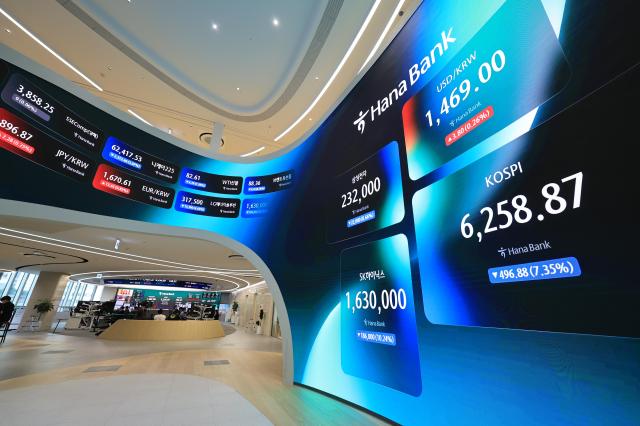
The sell-off was severe enough to activate automatic trading halts on both the benchmark KOSPI and the junior KOSDAQ, including sidecars and circuit breakers designed to curb sharp market declines.
The KOSPI tumbled 10.84 percent to 6,023.66, briefly falling below the 6,000-point mark during the session. The KOSDAQ dropped 7.72 percent to 705.85, also slipping below 700 intraday before paring some losses by the close.
The selloff followed another sharp decline in U.S. semiconductor stocks overnight, with Nvidia falling 4.99 percent and the Philadelphia Semiconductor Index losing 2.23 percent. Micron Technology, Sandisk and AMD also declined, while SK hynix's U.S.-listed shares dropped 7.47 percent, slipping below their recent offering price.
Investor sentiment weakened further after Chinese memory chipmaker CXMT surged more than 400 percent on its market debut the previous day, becoming the world's most valuable listed semiconductor company.
Investor sentiment weakened further after Chinese memory chipmaker CXMT surged more than 400 percent in its market debut the previous day, becoming one of the most valuable listed companies in the world's most populous country.
Separate reports that China has begun mass-producing deep ultraviolet (DUV) lithography equipment also fueled concerns that the country's semiconductor industry is advancing faster than expected, prompting another round of profit-taking across technology shares.
Foreign investors dumped 4.97 trillion won worth of KOSPI shares, while retail investors bought 4.33 trillion won and institutions purchased 678 billion won.
Samsung Electronics led the decline, plunging 13.39 percent to 220,000 won, its lowest closing price since April 30 and its steepest one-day drop of the year. Foreign investors dumped 1.63 trillion won worth of the shares, marking the second-largest net selloff on the main board.
SK hynix fell even further, dropping 14.65 percent to 1,550,000 won, its lowest closing price since early May and its second-largest one-day decline of the year, just short of its record 15.37 percent fall on July 13. Foreign investors offloaded a net 3.21 trillion won worth of the stock, the largest net selling by foreign investors, while institutions bought a net 907.7 billion won, far from enough to offset the heavy foreign selling.
Losses spread rapidly across other major blue-chip stocks. Samsung Electro-Mechanics slid 15.92 percent, SK Square lost 15.60 percent, Samsung Electronics preferred shares fell 12.01 percent, and Samsung C&T declined 10.16 percent.
Other major stocks similarly suffered steep losses, with Hyundai Motor falling 9.68 percent, HD Hyundai Heavy Industries down 7.30 percent, Kia off 6.60 percent, and LG Energy Solution lower by 5.71 percent. KB Financial, Shinhan Financial and Hanwha Aerospace also declined 4.29 percent, 3.90 percent and 2.67 percent, respectively. Samsung Biologics was the only major stock to finish higher, edging up 0.26 percent.
The KOSDAQ also came under heavy pressure. Among heavyweights, Alteogen fell 4.97 percent, EcoPro BM dropped 7.87 percent, EcoPro lost 9.80 percent, Rainbow Robotics declined 10.20 percent, and Jusung Engineering slid 14.08 percent.
The South Korean won strengthened against the U.S. dollar, with the greenback trading at 1,460.1 won, compared to 1,468.5 won in the previous session.
The semiconductor-driven sell-off spread across broader Asian markets. Japan's Nikkei 225 fell 3.83 percent, while China's Shanghai Composite declined 1.16 percent. In contrast, Hong Kong's Hang Seng Index edged up 0.17 percent.

Copyright ⓒ Aju Press All rights reserved.