SEOUL, June 11 (AJP) - South Korea’s employment rate fell by the steepest pace in five years as weakness in manufacturing and youth hiring exposed the limited spillover from a recovery increasingly driven by memory chip exports.
According to data released Thursday by Ministry of Data and Statistics, the employment rate for people aged 15 and older fell 0.5 percentage point to 63.3 percent, marking the sharpest decline since February 2021.
The number of employed people aged 15 and older was tallied at 29.12 million in May, 40,000 short from a year earlier, It marked the first year-on-year decline in employment since December 2024.
Manufacturing was at the center of the downturn. The number of manufacturing jobs fell by 140,000 from a year earlier to 4.295 million.
Employment in agriculture, forestry and fisheries dropped by 121,000, while professional, scientific and technical services shed 89,000 jobs.
Health and social welfare services, a sector reliant on senior and temporary hires, added 212,000 jobs, but the gains were not enough to offset losses in manufacturing, agriculture and higher-value service sectors.
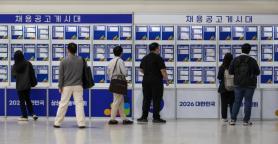
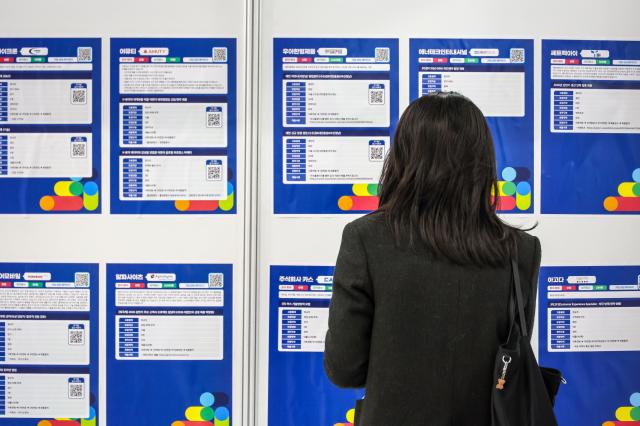
Youth employment deteriorated sharply. The number of employed people aged 15 to 29 fell by 255,000 from a year earlier to 3.427 million, while the youth employment rate dropped 2.4 percentage points to 43.8 percent.
The youth unemployment rate rose 0.6 percentage point to 7.2 percent. The decline in manufacturing jobs, combined with weakness in professional and technical services, appears to have further narrowed opportunities for young people entering the labor market.
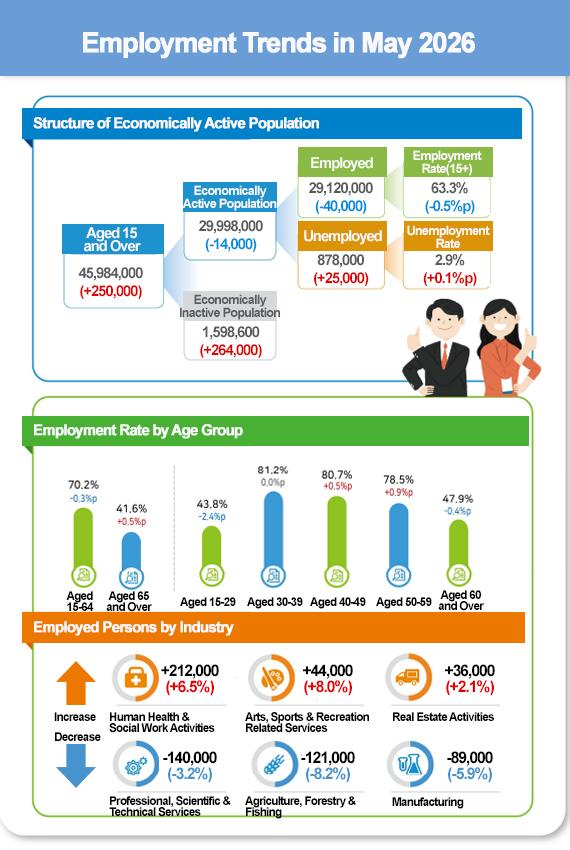
The economically inactive population increased by 264,000 from a year earlier to 15.986 million. Regular employees declined by 7,000 and temporary workers by 121,000. Instead, the number of daily workers rose by 14,000.
The weak labor market data stand in stark contrast to robust headline exports and economic growth.
Exports jumped 53.2 percent from a year earlier to $87.75 billion in May, while imports rose 20.8 percent to $60.8 billion, leaving a trade surplus of $26.95 billion.
Monthly exports topped $80 billion for a third consecutive month for the first time, setting a fresh record.
The divergence highlights the increasingly concentrated nature of South Korea's recovery. While exports continue to reach new highs, much of the growth has been driven by semiconductors and data center-related demand, sectors that generate relatively few jobs compared with traditional manufacturing industries.
Exports excluding semiconductors rose 16.4 percent from a year earlier, while exports excluding both semiconductors and computers increased 9.5 percent — far below the 53.2 percent increase in overall exports.
Outbound shipments from traditional job-intensive sectors continued to struggle. Automobile exports fell 5.9 percent from a year earlier in May, while steel exports declined 2.1 percent.
A Bank of Korea official said at an April 23 briefing that growth in industries excluding semiconductors was estimated at around 0.9 percent, roughly half of the economy's 1.8 percent expansion in the first quarter.
The figures suggest that record semiconductor exports mask worsening in much parts of the domestic economy.
Semiconductors are highly capital-intensive, limiting the extent to which higher production translates into employment gains. According to the Bank of Korea's Economic Statistics System (ECOS), the semiconductor sector generates about 2.0 jobs per 1 billion won ($656,000) of output, less than half the 4.3 jobs generated by the automobile industry.
The weak labor market data added to pressure on already fragile financial markets. The benchmark KOSPI fell more than 2 percent, while the Korean won weakened 3.60 won to 1,528.1 against the U.S. dollar. The yield on three-year government bonds edged up to 3.88 percent as of 11:30 a.m.

Copyright ⓒ Aju Press All rights reserved.