

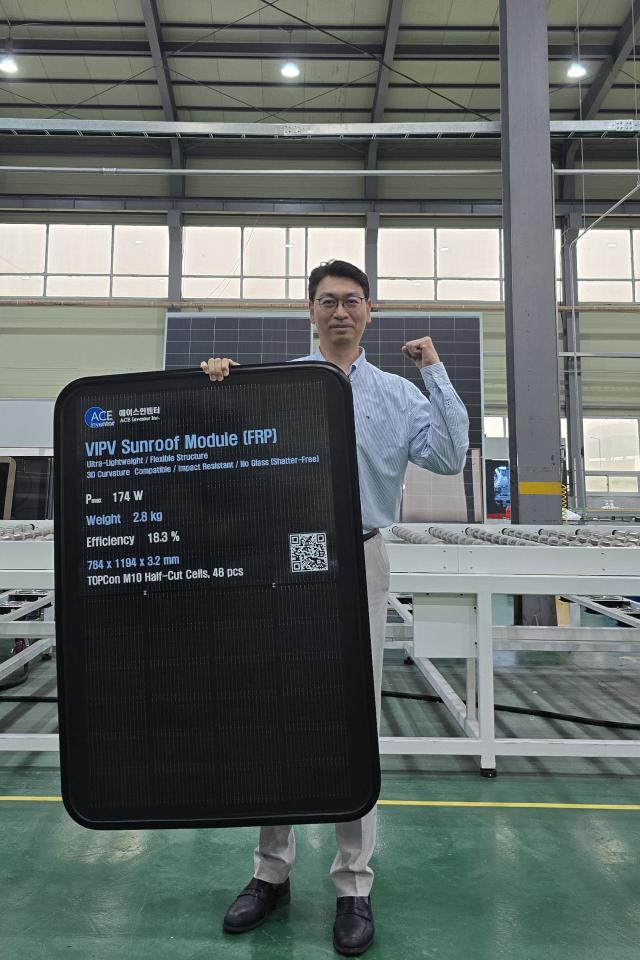
SEOUL, June 11 (AJP) - A technology startup founded by a mechanical engineering professor at Sookmyung Women's University has developed and commercialized a new line of lightweight solar modules designed to melt snow and integrate seamlessly into electric vehicles. The prominent university in Seoul said Thursday.
ACE Inventor, founded by Joung Young-soo, a professor at Sookmyung Women's University's School of Mechanical Systems Engineering, has been receiving research and development support from the university since 2017. The startup is currently building a mass-production system capable of combining multiple cells into large-area modules measuring up to 3.75 (2.5m x 1.5m) square meters. Once operational, the facility is expected to produce up to 50 megawatts of the lightweight solar modules annually. The company has also secured funding from several South Korean government initiatives, including the Ministry of SMEs and Startups.
Traditional solar panels rely on thick glass covers to protect the internal solar cells, making them heavy, rigid, and prone to shattering. The heaviness of the panels limits where they can be installed, often making the solar panel structure difficult to be put on older buildings, large logistics warehouses, or curved architectural structures that cannot support heavy loads. ACE Inventor replaced the standard glass with a specialized fiber-reinforced plastic (FRP). This material reduces the total weight of the solar panel by up to 70 percent while providing the flexibility to bend around curved surfaces.
One of the company's primary products is an FRP solar module equipped with an internal heating film. In regions that experience heavy snowfall, winter weather poses two major problems for solar energy generation. First, accumulated snow physically blocks sunlight, halting electricity production entirely. Second, the sheer weight of heavy snow combined with heavy glass solar panels frequently causes the roofs of agricultural greenhouses, barns, and older factories to collapse.
The heating module can be operated in freezing or snow-accumulation conditions to raise the panel's surface temperature. This melts the snow before it can accumulate into a dangerous, light-blocking hazard. Because the system clears the panels efficiently using minimal power, it restores power generation quickly during winter months and prevents costly structural damage to vulnerable agricultural and industrial buildings.
The company also introduced a vehicle-integrated photovoltaic (VIPV) sunroof module aimed at the electric vehicle market. Range anxiety remains a significant hurdle for electric vehicle adoption, and adding solar panels to a car's roof, hood, or trunk can provide auxiliary power to extend driving range. However, traditional glass panels add significant weight to the vehicle, which paradoxically drains the battery faster.
"In the electric vehicle era, vehicle weight and energy efficiency are directly linked to driving range, making lightweight and safe automotive modules a core technology for the future mobility market," ACE Inventor's chief executive Professor Joung Young-soo said.
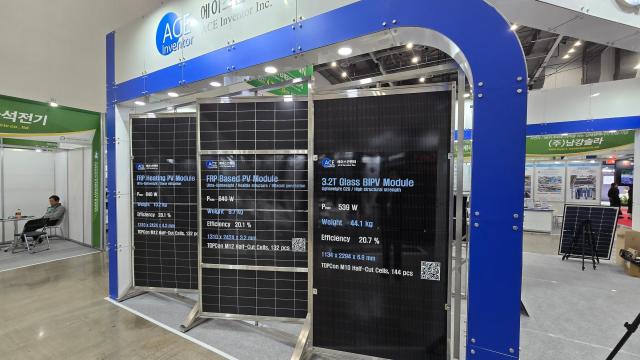
The new FRP automotive module weighs approximately 2.8 kilograms, which is more than 70 percent lighter than traditional double-sided glass modules. Its flexible nature allows it to mold seamlessly to the aerodynamic curves of modern car roofs. Because it contains no glass, it also eliminates the risk of dangerous glass shards scattering in the event of a traffic collision.
"The modules released this time are a meaningful case where original technologies from the laboratory met the university's startup support system and led to actual product launches," Joung said, adding: "Moving forward, we will lead the market for domestic aging industrial facilities and zero-energy buildings, and expand into the global mobility market and heavy snowfall regions to write a success story as a university-originated deep tech company."

Copyright ⓒ Aju Press All rights reserved.
