

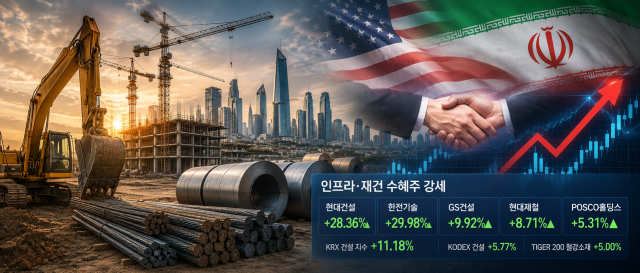
As geopolitical tensions in the Middle East ease and the possibility of a U.S.-Iran peace agreement becomes clearer, investor interest is returning to construction and steel stocks, which have been overlooked recently.
On June 12, the KRX construction index surged 11.18%, the highest gain among all sectors on the KRX. The news of an imminent signing of a memorandum of understanding (MOU) between the U.S. and Iran has alleviated geopolitical uncertainties, leading to a flow of funds into construction and traditional infrastructure stocks that had been overshadowed by a focus on semiconductor stocks.
Large construction firms with significant Middle Eastern contracts drove the index's rise. Hyundai Engineering, the leading stock in the KRX construction index, closed up 28.36% at 157,500 won, while KEPCO Engineering, an engineering firm specializing in nuclear power and infrastructure, rose 29.98% to hit the ceiling price of 151,300 won. GS Engineering and Daewoo Engineering also saw increases of 9.92% and 6.85%, respectively, contributing to the overall index gain. Other infrastructure-related companies, such as Seongkwang Bend (7.71%), HDC (6.50%), and Hanyang Engineering (5.57%), also showed strong performance.
The exchange-traded fund (ETF) market also reacted positively. KODEX Construction and TIGER 200 Construction rose by 5.77% and 5.61%, respectively, while the steel sector, a key material for traditional infrastructure, saw TIGER 200 Steel Materials increase by 5.00%. Major steel companies like Hyundai Steel and POSCO Holdings closed up 8.71% and 5.31%, respectively.
The market's momentum was largely driven by developments in the Middle East. President Donald Trump mentioned the nearing finalization of the MOU, causing West Texas Intermediate (WTI) crude oil prices to drop below $90 per barrel. This decline sparked optimism about peaking inflation and a preference for riskier assets. Consequently, the domestic market experienced strong buying activity, prompting a trading halt on the KOSPI index at one point.
Market analysts suggest that with the recent adjustments in the domestic stock market alleviating the concentration of leading stocks, now is an opportune time to consider adding overlooked sectors with strong earnings visibility to investment portfolios, particularly in light of the Middle East ceasefire momentum.
Han Ji-young, a researcher at Kiwoom Securities, stated, "Despite the recent correction phase, sectors that have not seen significant performance yet still hold their unique investment points are worth considering. Industries like machinery and shipbuilding, which have secured earnings visibility based on their order backlogs, could be good alternatives."
Kang Jin-hyuk, a senior researcher at Shinhan Investment Corp., noted, "While consumer goods such as department stores and cosmetics, which had been defensive plays amid unstable investor sentiment, saw selling pressure, the swift turnaround in the Middle East situation has led to strong rebounds in construction stocks amid reconstruction expectations."
* This article has been translated by AI.
Copyright ⓒ Aju Press All rights reserved.