

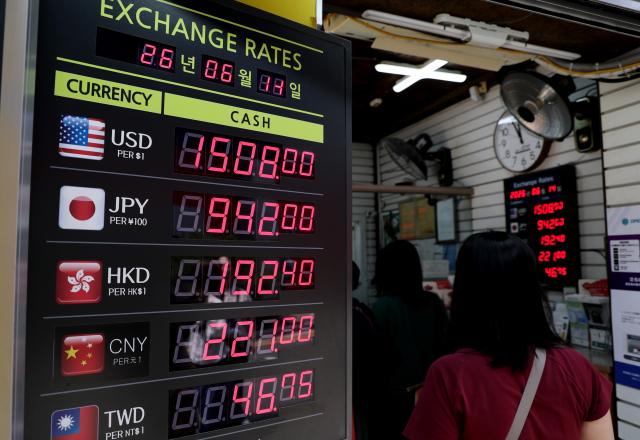
As the exchange rate continues to soar above 1,500 won, three banks are estimated to have incurred over 160 billion won in foreign exchange losses in the first half of the year. Concerns are growing that the increase in risk-weighted assets (RWA) will further limit the capital available for new operations and asset management.
According to the financial sector on June 14, foreign exchange losses for Hana Financial Group and Industrial Bank of Korea are estimated to be around 624 billion to 702 billion won this year. This follows a rise in the won-dollar exchange rate from 1,441.8 won on January 2 to 1,519.8 won on June 12, an increase of nearly 80 won. Both banks reportedly experience foreign exchange losses of about 80 billion to 90 billion won for every 10 won increase in the exchange rate.
Another bank has analyzed that a 10 won increase in the exchange rate results in approximately 20 billion won in foreign exchange losses. Considering this, the market estimates that at least 160 billion won in foreign exchange losses have occurred. Other banks are also affected by the exchange rate fluctuations. The market estimates that for every 10 won increase in the won-dollar exchange rate, the entire banking sector could face foreign exchange losses of 10 billion to 12 billion won.
If we simply calculate the increase in the exchange rate since the beginning of the year, the foreign exchange losses for each bank could reach between 780 billion and 936 billion won. While foreign exchange losses are typically one-time events, they negatively impact banks' non-interest income.
The rise in the exchange rate also puts pressure on banks' foreign currency liquidity and soundness indicators. As the exchange rate rises, the won-denominated value of foreign currency assets increases, leading to a rise in RWA, which in turn enlarges the denominator of the common equity tier 1 (CET1) ratio, reducing the capital ratio. The financial sector estimates that for every 10 won increase in the won-dollar exchange rate, the CET1 ratio drops by approximately 0.01 to 0.03 percentage points.
Despite these challenges, demand for loans continues to grow steadily. At the end of the first quarter, the total loan balance in the banking sector reached 2,061.8 trillion won, an increase of 35.6 trillion won from the previous quarter. As loan assets increase, RWA also expands, meaning that sustained high exchange rates will continue to burden banks.
In response, banks are strengthening their risk management practices. KB Kookmin Bank has introduced a risk-weighted asset return indicator to manage capital adequacy metrics such as the CET1 ratio and the Basel III capital ratio. Shinhan Bank is also developing contingency plans based on high exchange rate scenarios for its group and subsidiaries to manage RWA.
Hana Bank is maintaining a conservative asset management approach, while Woori Bank plans to conduct special inspections focusing on borrowers and industries vulnerable to exchange rate fluctuations if high exchange rates persist. IBK Industrial Bank is supporting export and import companies by extending principal and installment payment deadlines for foreign currency loans by up to one year, extending the maturity of import letters of credit, and offering preferential foreign exchange fees.
A financial sector official stated, "The estimated foreign exchange losses reflect only the impact of exchange rate fluctuations. In reality, they can vary based on the scale and maturity structure of foreign currency assets and liabilities, as well as currency positions. However, it is true that the shock from high exchange rates is affecting not only one-time valuation losses but also soundness and business strategies."
* This article has been translated by AI.
Copyright ⓒ Aju Press All rights reserved.