

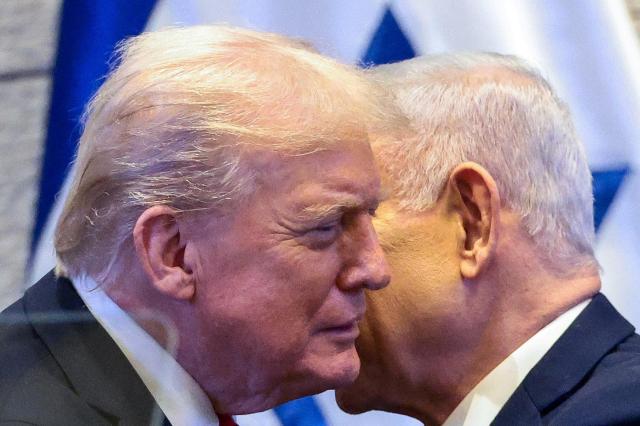
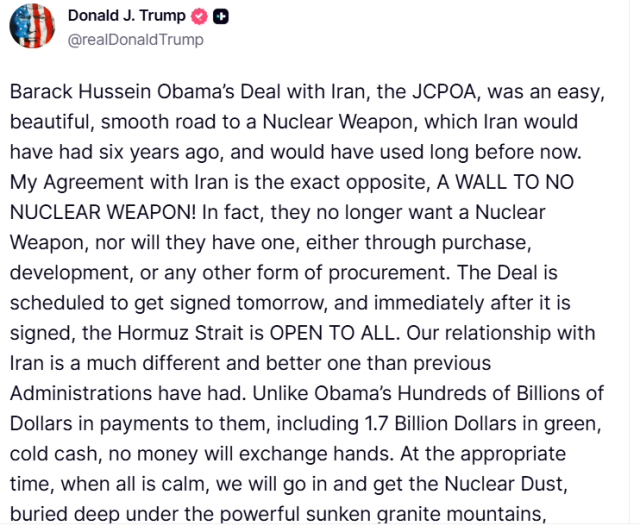
"The Deal is scheduled to get signed tomorrow, and immediately after it is signed, the Hormuz Strait is OPEN TO ALL," Trump wrote Saturday on Truth Social, describing the prospective agreement as a complete break from the 2015 Iran nuclear accord negotiated under former President Barack Obama.
Trump said Iran had agreed to permanently abandon its pursuit of nuclear weapons and pledged that no U.S. funds would be transferred as part of the arrangement.
The announcement marked Trump's strongest indication yet that negotiations are approaching a conclusion after weeks of intermittent talks involving regional mediators and direct contacts between Washington and Tehran.
Pakistan, which has played a central mediating role in the negotiations, also signaled that an agreement may be imminent.
Pakistani Prime Minister Shehbaz Sharif said on X that finalization of the deal was expected within 24 hours and that the accord would likely be signed electronically. He added that technical-level negotiations were expected to begin next week to work through implementation details.
Pakistan's Foreign Ministry separately said preparations were underway for a Sunday signing.
Iran struck a more cautious tone. Foreign Ministry spokesman Esmaeil Baqaei said earlier Saturday that a signing would "not be tomorrow" but acknowledged that an agreement in the coming days remained possible.
The emerging accord appears aimed at ending one of the most disruptive geopolitical crises of the year.
Since the outbreak of war earlier this year, Iran has restricted access through the Strait of Hormuz, the narrow waterway connecting the Persian Gulf to global markets through which roughly a fifth of the world's oil trade normally passes.
Tehran has required ships to obtain authorization from Iranian authorities and established new oversight mechanisms and transit charges, while the United States responded with restrictions targeting Iranian ports.
Although negotiators have not released details of the final text, reopening the strait appears to be one of the central pillars of the agreement.
The issue remains highly contentious.
Iranian Foreign Minister Abbas Araghchi said Friday that Tehran intended to retain authority over the waterway and described the strait as one of Iran's principal deterrence tools.
Washington has repeatedly rejected any arrangement that would leave global shipping vulnerable to future disruptions.
Even as optimism grew, tensions remained evident. U.S. Central Command said Saturday that American forces intercepted multiple Iranian one-way attack drones launched toward commercial vessels transiting the Strait of Hormuz.
Trump condemned the attacks as "totally unacceptable," underscoring the fragile nature of the negotiations.
Another major unresolved issue involves Iran's stockpile of highly enriched uranium.
The United States and Israel have insisted that Iran must permanently surrender nuclear materials capable of being used in a weapons program.
Iran maintains that its nuclear activities are peaceful and has argued that any remaining enriched material should be diluted domestically rather than removed from the country.
Trump reiterated Saturday that Washington would ultimately take possession of what he called "Nuclear Dust" buried beneath Iran's mountainous terrain following earlier U.S. airstrikes.
"When all is calm, we will go in and get the Nuclear Dust ... and downblend and destroy it, whether in Iran, or the United States," Trump wrote.
Israeli Prime Minister Benjamin Netanyahu has said Trump assured him that any final agreement would include the removal or destruction of Iran's enriched nuclear material.
The prospective agreement comes as leaders prepare to gather for the Group of Seven summit in France, where developments in the Middle East are expected to dominate discussions.
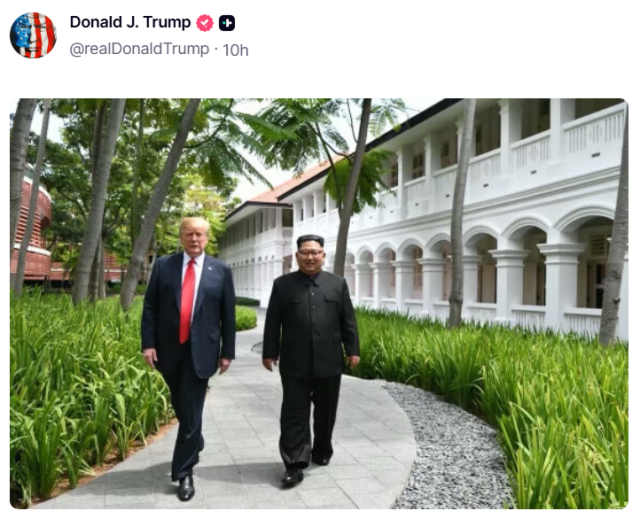
In a separate post later Saturday, Trump uploaded a photograph from his 2018 summit with North Korean leader Kim Jong Un in Singapore without explanation, a move that drew attention because it followed his announcement of a possible Iran denuclearization deal and revived memories of his earlier leader-to-leader diplomacy over nuclear weapons.
Copyright ⓒ Aju Press All rights reserved.
