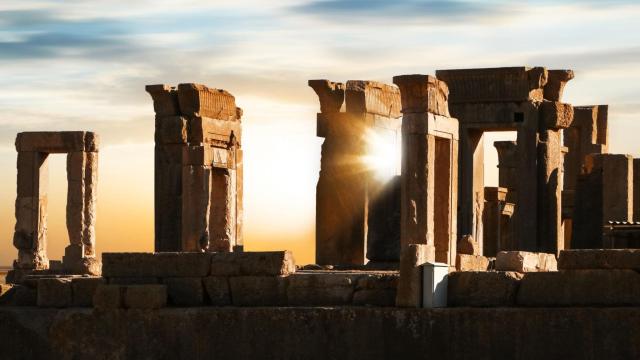
This is the eleventh installment of AJP's Spiritual Asia series exploring the religious traditions, philosophical ideas and moral foundations that have shaped Asia's civilizations. This chapter turns to Zoroastrianism, one of the world's oldest living faiths, and examines how its teachings on truth, free will and moral responsibility continue to resonate in an age increasingly shaped by artificial intelligence.
Humanity is once again asking where civilization is headed.
Artificial intelligence can now understand language, generate knowledge, imitate human reasoning and increasingly perform tasks once reserved for human judgment. Yet while technology advances at extraordinary speed, human wisdom does not necessarily advance with it.
Economies have expanded, but communities have weakened. Information has become abundant, yet truth often seems more elusive. Wars continue to rage across continents, while hatred, disinformation and polarization spread effortlessly through digital networks.
The challenge confronting humanity today is not merely technological. It is moral.
What is good? What is evil? Why should human beings choose truth over falsehood, justice over power and responsibility over convenience?
To follow these questions to their historical roots is to encounter one of the most influential figures in the spiritual history of humanity: Zoroaster, known in ancient Persia as Zarathustra.
Today, Zoroastrianism is a relatively small religion. Yet its influence on world civilization far exceeds its numbers. Many of the moral concepts that later became central to Judaism, Christianity and Islam — including the struggle between good and evil, free moral choice, divine judgment, heaven and hell, salvation and the ultimate triumph of truth — were profoundly shaped by ideas first articulated within the Zoroastrian tradition.
Long before the rise of the great monotheistic religions, Zoroaster sought to answer one of humanity's most enduring questions: How should human beings live?
At the center of his teaching stood Ahura Mazda, the "Wise Lord," the source of truth, wisdom and cosmic order. Human beings, Zoroaster taught, are not passive creatures carried by destiny. They possess freedom. They can choose between truth and falsehood, justice and corruption, compassion and cruelty.
And because they are free, they are responsible. This was a revolutionary idea.
The world, in Zoroaster's vision, was not governed solely by divine decree or blind fate. Human beings themselves became participants in a moral struggle. Every choice mattered. Every action carried consequences.
The popular description of Zoroastrianism as a "religion of fire" captures only part of the story. \
Zoroastrians do not worship fire itself. Fire serves as a symbol of purity, truth and divine illumination. It dispels darkness, reveals what is hidden and consumes what is false.
For that reason, Zoroastrianism may be more accurately understood as a religion of light.
Its ethical teaching can be distilled into three simple principles: Good Thoughts, Good Words and Good Deeds.
The simplicity is deceptive. These principles form not merely a religious code but a philosophy of civilization. Distorted thinking eventually produces distorted speech. Distorted speech leads to destructive actions. In time, institutions weaken, trust erodes and societies descend into confusion.
Few teachings seem more relevant in the age of artificial intelligence.
AI systems can generate words, images and decisions on a scale never before imagined. Yet they remain dependent upon the values of those who design and use them. Technology can amplify human intentions, but it cannot determine whether those intentions are moral.
Algorithms can calculate probabilities. They cannot define virtue. Machines can process information. They cannot provide wisdom.
The influence of Zoroastrianism extended beyond religion and into the realm of politics.
Perhaps no figure embodied its ideals more clearly than Cyrus the Great, founder of the Achaemenid Persian Empire and one of history's most admired rulers.
After conquering Babylon in the sixth century BCE, Cyrus did not seek to erase the identities of conquered peoples. Instead, he permitted them to preserve their traditions and religious practices. Most famously, he allowed exiled Jews in Babylon to return to Jerusalem and rebuild their Temple.
For this reason, Cyrus occupies a unique place in Jewish history. He is remembered not as a conqueror but as a liberator and is one of the few non-Jewish rulers mentioned favorably in the Hebrew Bible.
The encounter between Persian and Jewish civilizations would leave a lasting mark on the development of religious thought throughout the Middle East and, ultimately, on the spiritual traditions of much of the world.
History often demonstrates that acts of tolerance can reshape civilizations more profoundly than acts of conquest.
Although Zoroastrianism declined following the spread of Islam, its followers did not disappear. Many migrated to India, where they became known as the Parsis.
Despite their small numbers, the Parsis exerted extraordinary influence on modern India. Among them was Jamsetji Nusserwanji Tata, founder of the Tata Group, one of the country's most important industrial enterprises.
The story of the Parsis demonstrates how a religious minority can preserve its spiritual identity while contributing profoundly to education, philanthropy, science and economic development.
The influence of Zoroaster also extended into philosophy and literature.
In the nineteenth century, the German philosopher Friedrich Nietzsche chose Zarathustra as the symbolic protagonist of Thus Spoke Zarathustra. Nietzsche's figure was not the historical prophet. Yet the choice itself was revealing.
More than two millennia after his death, Zoroaster remained a powerful symbol through which modern thinkers sought to explore morality, freedom and the future of humanity.
Today, the number of Zoroastrians worldwide is small. Yet the religion's legacy cannot be measured by demographics alone.
Its ideas continue to echo through many of the world's major religious traditions. Even modern popular culture bears traces of its influence. Freddie Mercury, the legendary lead singer of Queen, was born into a Parsi family rooted in the Zoroastrian faith.
Yet the enduring significance of Zoroaster lies not in historical influence but in the questions he posed.
The AI age grants humanity unprecedented power. It enables individuals and societies to reshape economies, cultures and even human knowledge itself.
But power alone does not provide direction.
The fundamental challenge facing humanity remains the same as it was three millennia ago: how to use freedom wisely.
Zoroaster's answer was remarkably simple. Good Thoughts. Good Words. Good Deeds.
In an era increasingly shaped by artificial intelligence, these ancient principles may sound modest. Yet they remind us that civilization ultimately depends not on technological sophistication but on moral clarity.
The followers of Zoroaster did not worship fire. They sought the light that fire represented — the light of truth.
And perhaps that is the lesson ancient Persia still offers the modern world.
As machines become more intelligent, the question that matters most is not whether technology can think like humans.
It is whether humans can continue to think, speak and act with wisdom. More than 3,000 years after Zoroaster first posed the challenge, humanity is still searching for the answer.
*The author is a senior columnist of AJP.
Copyright ⓒ Aju Press All rights reserved.