

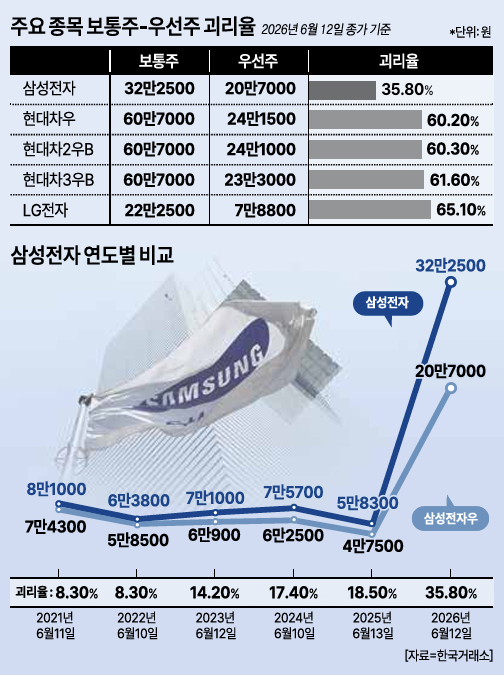
While the stock market is reaching new highs, preferred shares are lagging behind. Major stocks like Samsung Electronics, Hyundai Motor, and LG Electronics are performing well amid a surge in artificial intelligence (AI) and robotics, but the preferred shares of these companies are not keeping pace. As demand for common shares increases, the gap between Samsung Electronics' common and preferred shares has widened to its highest level in five years.
According to the Korea Exchange, as of June 12, Samsung Electronics' common shares closed at 322,500 won, while its preferred shares were at 207,000 won, resulting in a discount of 35.8% for the preferred shares. Although preferred shares do not carry voting rights, they have priority over common shares in terms of dividends. Typically, they trade at lower prices than common shares, with the discount determined by dividend appeal and liquidity.
The price gap between Samsung's common and preferred shares has rapidly increased in recent years. The gap was 8.3% on June 11, 2021, and has steadily grown to 14.2% in mid-June 2023, 17.4% in 2024, and 18.5% in 2025. This year, the gap has soared to 35.8%, marking the highest level in five years.
The prolonged discount on preferred shares, combined with the recent AI rally, has intensified the widening gap as investors focus on common shares. In the past month (from May 12 to June 12), individual investors purchased a net 17.1 trillion won worth of Samsung Electronics' common shares, compared to only 505.6 billion won in preferred shares. The net purchase of common shares was approximately 34 times greater than that of preferred shares, further increasing the price disparity between the two.
Additionally, Samsung Electronics, as the top company by market capitalization on the KOSPI, is heavily included in major indices and exchange-traded funds (ETFs), attracting significant passive investment. In contrast, preferred shares have relatively limited trading volume and index inclusion.
This trend is not unique to Samsung Electronics. As of June 12, the gap between LG Electronics' common and preferred shares reached 65.1%. Hyundai Motor's preferred shares showed discounts of 60.2% and 60.3% for its first and second preferred shares, respectively, while its third preferred shares had a discount of 61.6%. Analysts suggest that during market uptrends, investor funds tend to concentrate on common shares, leading to broader discounts across large preferred stocks.
Market analysts identify shareholder return policies as a key factor in narrowing the discount gap. This year, the focus is on the scale of free cash flow (FCF), share buybacks, and the return ratio between common and preferred shares. Investors are keenly observing how Samsung Electronics' shareholder return policies may evolve and whether they can reduce the historically high discount on preferred shares.
Kim Sun-woo, a researcher at Meritz Securities, predicts that Samsung Electronics' shareholder return plan for 2024 to 2026 will become clearer around November this year. He added, "With improvements in the memory market expected to significantly enhance cash generation capabilities, an increase in shareholder returns and the specification of policies could lead to a reevaluation of stock prices."
* This article has been translated by AI.
Copyright ⓒ Aju Press All rights reserved.