

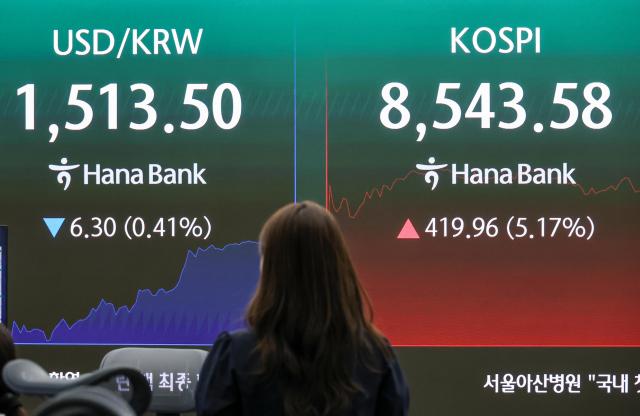
SEOUL, June 15 (AJP)-With the Gulf crisis moving toward resolution, South Korea's stock market faces next test: whether a chip-led rally can carry the KOSPI from one of the world's best-performing markets to a developed-market benchmark.
Semiconductors can lift the index. They cannot, by themselves, make Korea a developed market.
The KOSPI has surged 92.8 percent since end-2025, far outpacing Taiwan's 52.5 percent gain, Japan's 31.1 percent rise and the Dow's 6.5 percent advance.
Yet the same data reveal why Korea's case remains complicated: the market has delivered developed-world scale and technology leadership with emerging-market volatility and unstable foreign flows.
The war-risk discount is now easing. A planned U.S.-Iran memorandum of understanding on Friday could reopen commercial traffic through the Strait of Hormuz and reduce the oil premium that has weighed on Korea, which imports roughly 70 percent of its crude from the Middle East.
Oil prices and the won have already moved in response, allowing investors to refocus on earnings.
Yuanta Securities on Monday said the removal of war risk has confirmed the return of foreign investors. Overseas buyers returned to Korean shares for two consecutive sessions after weeks of selling, concentrating on large-cap semiconductor names.
As of 1:40 p.m., the KOSPI was up 5.3 percent at 8,554.98, with foreign investors turning net buyers of 638 billion won and extending Friday's purchases of 2.7 trillion won. The buying marks a sharp reversal from a near-uninterrupted selling spree that ran from May through Thursday, during which foreigners offloaded 51.5 trillion won worth in KOSPI in May and a further 27.2 trillion won in June.
Yuanta attributed the shift to easing geopolitical tensions, reduced won-dollar volatility and the end of SpaceX-related liquidity migration.
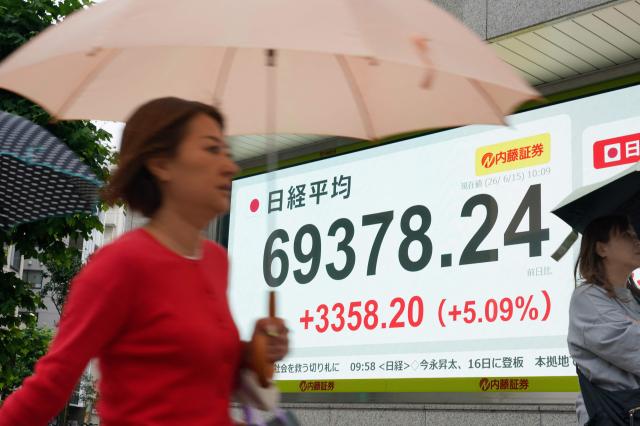
The shift in foreign flows comes with one week to spare before MSCI delivers its annual market-classification verdict on June 23, but industry watchers say MSCI's developed-market watch-list decision on won't be settled by Samsung Electronics and SK hynix alone.
Korea has long sought developed-market status. MSCI removed the country from its developed-market watch list in 2014, citing restrictions on currency trading and other market-access issues. Last year, the index provider again pointed to shortcomings in foreign-exchange reforms and compliance burdens on overseas investors.
Since then, Korea has resumed short selling and is preparing to launch extended won trading hours in July, two reforms long demanded by global investors.
Compared with Japan, Korea has the earnings momentum but not yet the market structure. Japan's rerating was powered not only by technology and exporters but by years of exchange-led reform, broader shareholder returns and a deeper base of long-term global capital. Korea's value-up campaign is moving in the same direction — but it is younger and less tested.
Korean stocks still trade well below Japanese, Taiwanese and American peers, even as chips, shipbuilding, banks, autos and power equipment deliver stronger earnings. Developed-market status, however, requires more than cheap valuations and high returns.
The real checklist is market access, currency convertibility, short-selling normalization, settlement reliability, foreign-investor convenience, governance and shareholder protection.
Korea has made progress, but MSCI will want evidence that reforms are durable, not cyclical.
Korea's strongest argument is that it is no longer simply an emerging-market proxy. It is a core AI supply-chain market with global-scale companies, record earnings and a growing shareholder-return culture.
Its weakest point is that the rally remains too concentrated and too volatile. Just last week, the KOSPI has swayed 4 to 8 percent daily from 7,484.41 to 8,123.62.
After Hormuz, the KOSPI may have enough fuel to test 9,000. To reach developed-market status, Korea must prove it can look less like a spectacular trade and more like a stable market.

Copyright ⓒ Aju Press All rights reserved.
