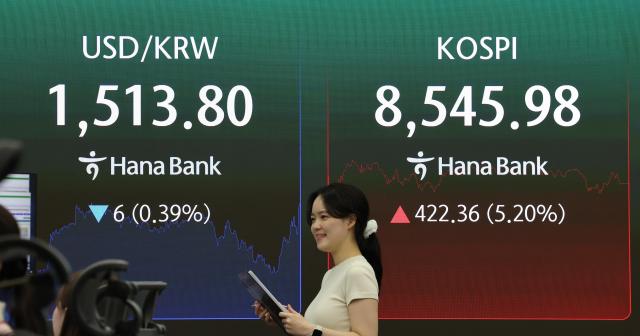
The won closed at 1,511.1 per dollar in the Seoul foreign exchange market, down 8.7 won from the previous session.
South Korean government bonds extended last week's rally. The yield on the three-year government bond fell 6.4 basis points to 3.744 percent, while the 10-year yield dropped 7.7 basis points to 4.118 percent.
The won and bonds were also supported by a recovery in risk appetite. The benchmark KOSPI jumped 5.2 percent to close at 8,545.98, with foreign investors buying a net 985.8 billion ($652.4 million) won worth of shares on the main bourse.
The global market reaction was broad-based. Before regular U.S. stock trading began, Nasdaq-100 futures rose nearly 2 percent and S&P 500 futures gained around 1 percent, while the dollar index fell to its lowest level since June 5 and U.S. Treasury yields declined.
The sharpest move came in oil. Brent crude fell more than 4 percent to the low-$83 range per barrel, while West Texas Intermediate (WTI) dropped more than 5 percent, as markets priced in the possible reopening of the Strait of Hormuz and the lifting of a U.S. naval blockade on Iran.
The market moves came after Pakistan said the United States and Iran had reached a framework aimed at ending the war. U.S. President Donald Trump said Sunday U.S. time that the deal with Iran was “done,” while Pakistani Prime Minister Shehbaz Sharif said the agreement would be formally signed in Switzerland on Friday.
Still, the deal appears closer to a preliminary framework or memorandum of understanding than a final peace agreement. Core issues, including Iran's nuclear program, sanctions relief and frozen assets, are expected to be addressed in follow-up negotiations during a 60-day ceasefire.
For Korean markets, the immediate impact came through oil, the dollar and U.S. Treasury yields rather than a direct shift in Federal Reserve expectations. Lower oil prices eased inflation concerns, while weaker U.S. yields helped support domestic bonds and reduced upward pressure on the dollar-won rate.
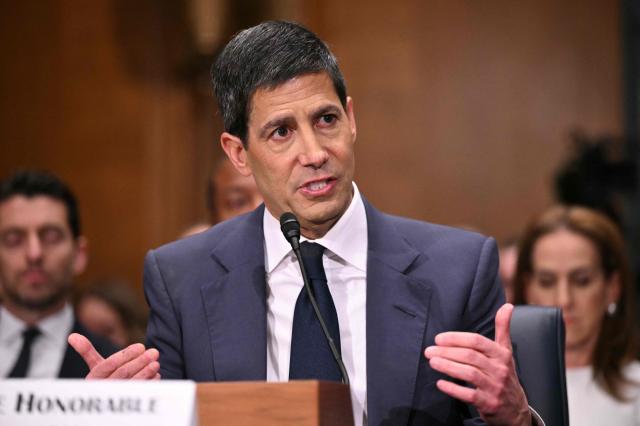
The Federal Reserve is widely expected to keep the federal funds rate unchanged at the current 3.50 to 3.75 percent range this week, leaving investors focused on its updated economic projections and dot plot.
The March dot plot had pointed to one 25-basis-point cut by year-end, but expectations had turned more hawkish before the U.S.-Iran framework was announced, as higher oil prices and strong U.S. employment data raised concerns over renewed inflation pressure.
After the strong jobs data released on June 5, futures markets raised the implied probability of a December rate hike to about 68 percent. According to Reuters, markets on Monday put that probability at around 48 to 50 percent, down from the 69 to 70 percent range seen a week earlier.
The baseline after the agreement is therefore less a dovish pivot than an easing of hawkish pressure. The median dot in the June projections may still point to rates being held through year-end, but the case for higher dots that imply a rate hike in late 2026 has weakened.
Markets are stripping out part of the Middle East inflation premium for now, but the agreement has yet to be formally signed and key issues remain unresolved. If the framework falters, oil prices and inflation risks could quickly return to the center of the FOMC debate, putting renewed pressure on the won and South Korean bonds.

Copyright ⓒ Aju Press All rights reserved.