

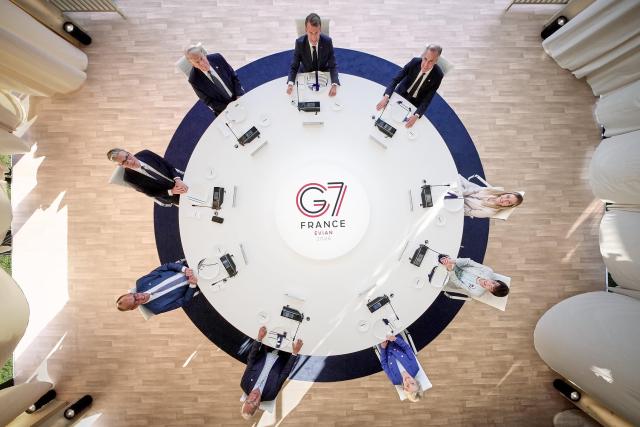
The G7 summit opened in Évian, France, with the Iran war-ending agreement and solutions for the Ukraine conflict at the forefront of discussions. The agenda also included artificial intelligence (AI) and concerns over China's dominance in the rare earth and critical minerals markets, prompting France, the host nation, to focus on reconciling differences among G7 members.
On June 15, President Trump met with French President Emmanuel Macron, the summit's host, stating, "Many great things are happening in the Middle East right now," and added that the Iran agreement would bring significant success globally. He emphasized that oil prices have dropped and stock markets have risen since the agreement.
As part of the agreement, Iran is set to reopen the Strait of Hormuz, with France, the UK, and Germany expressing their willingness to ensure safety in the strait and assist in mine removal. President Macron noted that unrestricted maritime traffic in the Strait of Hormuz is essential for regional stability and the global economy. Europe also views the reopening of the strait as crucial for easing tensions across the Middle East.
The Ukraine conflict is another major topic at the summit. Germany, France, and the UK are working with the U.S. to explore ways to resume peace negotiations between Russia and Ukraine. Europe believes it must move beyond temporary support for Ukraine to provide concrete security guarantees. Ukrainian President Volodymyr Zelensky is also expected to meet with G7 leaders, raising interest in how President Trump will respond to European-led peace initiatives.
President Trump mentioned that he spoke with both President Zelensky and Russian President Vladimir Putin the previous day, expressing optimism that progress could be made on the issue. President Zelensky proposed a direct meeting with President Putin during the G7 summit or a separate meeting in the U.S., but reports indicate that the Russian side has not provided a clear response.
AI and critical mineral supply chains are also significant discussion points. According to Euronews, France has invited key figures from the tech industry, including Sam Altman of OpenAI, Dario Amodei of Anthropic, and Arthur Mensh of Mistral, to discuss safe and rapid AI utilization at the summit.
The issue of China's dominance in the rare earth and critical minerals markets is also on the agenda. Reuters reports that the Trump administration is pursuing a Western trade bloc strategy that includes price support, subsidies, and guaranteed purchases to reduce dependency on China. However, there are notable disagreements within the G7 regarding cost burdens, pricing methods, and operational leadership.
Additionally, leaders from invited countries, including South Korea, India, Brazil, and Kenya, are attending the summit. Leaders from Egypt, Qatar, and the United Arab Emirates (UAE) are also expected to participate in discussions on follow-up measures to the Iran agreement and regional stability during the Middle East session.
* This article has been translated by AI.
Copyright ⓒ Aju Press All rights reserved.