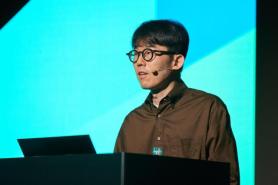
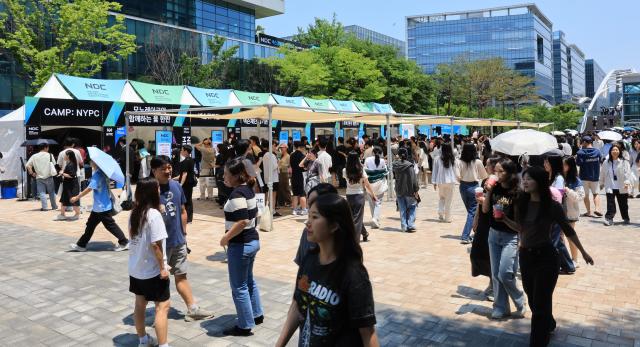
At the 19th Nexon Developers Conference (NDC), which opened a three-day run at Nexon's Pangyo campus in Seongnam, discussions centered less on new releases than on how AI is reshaping one of the country's most important creative industries.
The international conference hall across the road at the Gyeonggi Center for Creative Economy and Innovation was packed beyond capacity, with roughly a quarter of attendees standing throughout several sessions after seats ran out.
The mood was both curious and uneasy.
As AI lowers technical barriers to game development, competitive advantages will increasingly come from human judgment and contextual depth that prompts alone cannot generate, he said.
"A user's day is still 24 hours," Kang added, underscoring that the ultimate constraint is not technology but consumers' limited time and attention.
The numbers illustrate the challenge.
About 2,800 games were launched on Steam in 2015. By 2025, that number had surged to around 20,000. Yet only 608 titles released last year received more than 1,000 user reviews.
For many attendees, however, the concern was immediate and personal.
South Korea's gaming industry is posting record profits while simultaneously shrinking its workforce, with AI sitting at the center of employee anxieties.
A survey of 1,078 unionized employees at major publishers, including Nexon, NC and Netmarble, presented at a National Assembly forum in April found that 77.3 percent felt anxious about job security.
While roughly two-thirds said they already use AI tools regularly and 80.3 percent acknowledged productivity gains, only 26.7 percent said management and labor had formally discussed how those gains should be shared.
Their anxiety stands in sharp contrast to the industry's strongest earnings in years, particularly among publishers built around proprietary intellectual property.
Krafton also logged record results, with revenue jumping 56.9 percent to 1.37 trillion won and operating profit rising 22.8 percent to 561.6 billion won as its PUBG franchise generated more than 1 trillion won in quarterly sales.
The prosperity, however, has become increasingly concentrated.
Studios with strong in-house intellectual property have widened their lead, while many mid-sized publishers lacking fresh hits have drifted toward losses, deepening the industry's reliance on a handful of blockbuster franchises.
At the same time, companies have aggressively trimmed payrolls.
NC reduced its workforce by 35.1 percent, from roughly 4,886 employees to 3,170, between 2024 and late 2025. Krafton accepted about 200 voluntary resignations since last November, while Nexon has largely frozen new hiring, according to industry observers.
Research and development spending has also declined.
Hwang Ji-gang, a 21-year-old game designer, said he attended to study live-service development strategies and was waiting for an afternoon panel featuring Kim Yong-ha, known among fans as the creative force behind Blue Archive.
"AI often shows a lack of consistency in development," Hwang said. "I came to learn what improvements or countermeasures there are."
Another attendee, Kim Jong-uk, 23, an aspiring developer, said he wanted to understand Nexon's long-term vision.
"I came today to see Nexon's vision through the presentation sessions," he said.

Sessions covered live-service operations, workplace AI agents and case studies on developing Arc Raiders, while speakers came not only from Nexon but also from Krafton, Roblox, NC AI, Google DeepMind and Snowflake.
Their presence underscored how gaming is increasingly becoming a test bed for AI development itself.
The industry is already producing both cautionary tales and success stories.
Players discovered AI-generated artwork in Pearl Abyss's Crimson Desert, prompting an apology from the developer. At the same time, Nexon's Arc Raiders has earned praise for using procedural AI to enrich virtual environments.
"AI output still reaches only about 90 percent of human quality," said Jung Nae-hun, a professor at the Tech University of Korea. "Studios tend to avoid using it for visible elements like characters or interfaces. When it slips through, it invites backlash."
The expertise accumulated by Korean game studios is also attracting attention beyond entertainment.
During a recent visit to Seoul, Jensen Huang met executives from Krafton and NC at gaming venues in Gangnam to explore how gaming engines and virtual-world technologies could help train so-called physical AI systems and humanoid robots.

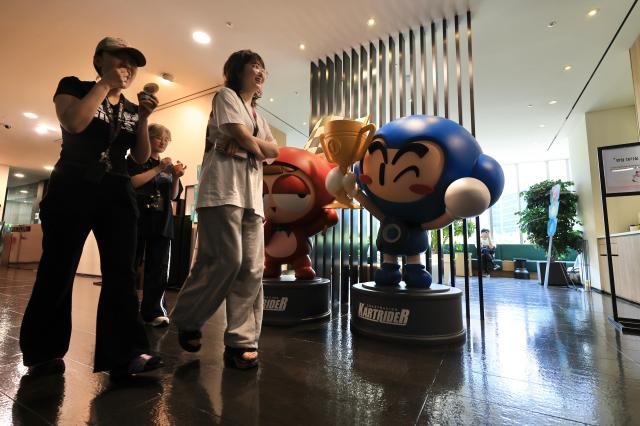
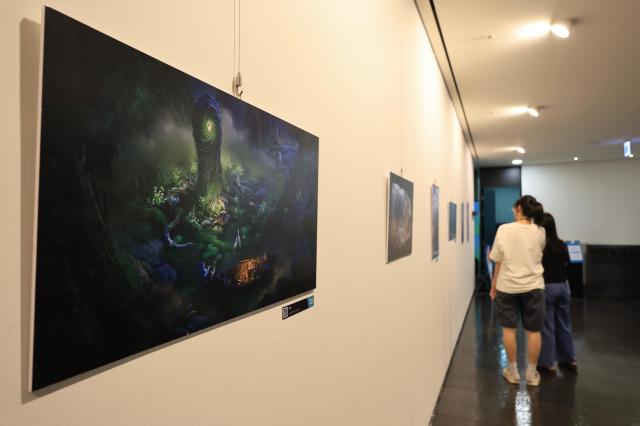
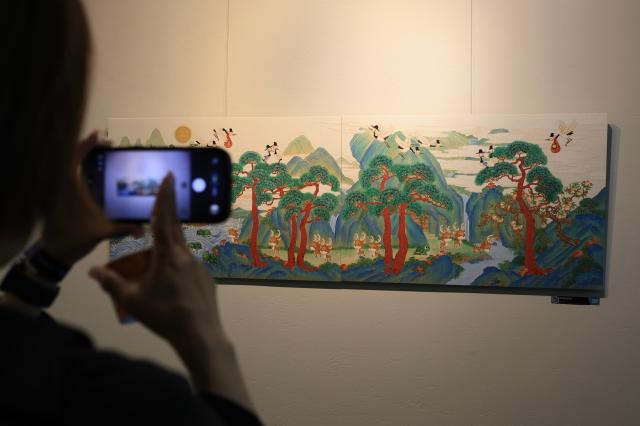
Back inside the conference halls, the NEXTAGE exhibition displayed sculptures, figurines and embroidered dolls inspired by MapleStory, Blue Archive and Mabinogi, returning offline for the first time in seven years.
Nearby, in a darkened soundproof room, footage from The First Berserker: Khazan played through surround-sound speakers — a reminder that despite AI's rapid advance, some aspects of game-making still depend on human imagination.
And that, perhaps, was the question hanging over NDC: not whether AI will build more games, but what kinds of creativity will remain uniquely human once it does.
Copyright ⓒ Aju Press All rights reserved.