

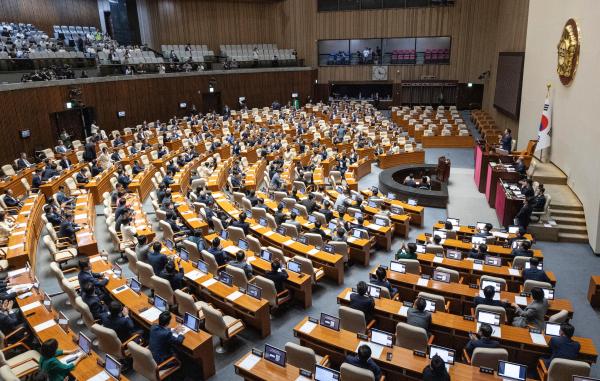
According to sources from the National Assembly and the financial sector, the Democratic Party and the People Power Party will begin formal negotiations this week regarding the committee formation for the second half of the 22nd National Assembly.
Among the 18 standing committees and special committees, the most contentious issues are expected to revolve around the Legislative and Judiciary Committee and the Political Affairs Committee. The Legislative and Judiciary Committee plays a crucial role in reviewing bills that have passed through other committees, serving as the final checkpoint for legislation. The Political Affairs Committee oversees the drafting and revision of financial-related laws. If the ruling party secures both the Legislative and Judiciary Committee and the Political Affairs Committee, the legislative process for financial bills could accelerate significantly. In the first half of the National Assembly, the Democratic Party chaired the Legislative and Judiciary Committee, while the People Power Party led the Political Affairs Committee.
The Democratic Party argues that the ruling party should lead the Legislative and Judiciary Committee to ensure swift processing of bills. They also expressed intentions to reclaim key economic committee positions previously held by the People Power Party.
Han Byeong-do, the Democratic Party's floor leader, stated during a meeting at the National Assembly, "The responsible ruling party must take charge of the Legislative and Judiciary Committee," adding, "We will consider reclaiming major economic committee positions as well."
Conversely, the People Power Party emphasizes the tradition of the first party holding the National Assembly Speaker position and the second party leading the Legislative and Judiciary Committee. They also argue that the opposition should take charge of economic-related committees to facilitate a shift in economic and real estate policy direction.
In the financial sector, there is optimism that the Democratic Party's commitment to reclaiming the Legislative and Judiciary Committee and economic committees will expedite legislative discussions related to finance in the second half of the National Assembly. If negotiations fail, the ruling party, which holds a majority in the National Assembly, could unilaterally elect committee chairs through a vote.
However, if negotiations are successful and the People Power Party retains control of the economic committees, discussions on contentious bills are likely to be delayed. According to data submitted by Democratic Party lawmaker Lee Jae-gwan to the National Assembly Secretariat, the passage rate for the Political Affairs Committee's full meetings was only 17.6% from the opening of the 22nd National Assembly until the end of February this year. If the bottleneck in the Political Affairs Committee is not resolved, it will be challenging for bills such as the compensation liability system for voice phishing victims and improvements to the governance structure of financial holding companies to advance.
The key financial issues to be addressed in the Political Affairs Committee in the second half of the year include the compensation liability system for voice phishing victims and reforms to the governance structure of financial holding companies. Among these, the most significant concern for the industry is the proposed amendment to the Telecommunications Fraud Damage Compensation Act, which aims to introduce a 'no-fault liability system' requiring financial companies to compensate victims regardless of fault in cases of voice phishing. The bill stipulates that the compensation limit for financial companies should be set between 10 million and 50 million won. The industry estimates that if the compensation limit is set at 50 million won, the total compensation burden on the financial sector could reach approximately 280 billion won annually.
The proposed improvements to the governance structure of financial holding companies are also of interest. These improvements aim to enhance transparency in the selection process for the chairperson and CEO of financial holding companies and strengthen the independence of the board of directors. A key issue is the legislation of 'term limits' for reappointments. Currently, Democratic Party lawmaker Kim Hyun-jeong and Justice Party lawmaker Shin Jang-sik have each proposed bills to limit the reappointment of financial holding company chairpersons through special resolutions at shareholder meetings and to prohibit three consecutive terms for chairpersons.
A financial sector representative noted, "In the first half of the year, we were unable to expedite related legislation due to instability in the Middle East and political schedules. The outcome of this month's committee formation negotiations and the schedule for the Political Affairs Committee's review will be a turning point for discussions on financial system reforms in the second half of the year."
* This article has been translated by AI.
Copyright ⓒ Aju Press All rights reserved.