

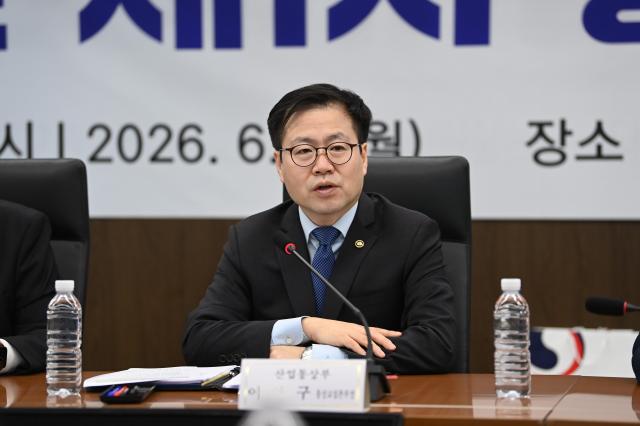
Yeo Han-goo, the head of the Trade Negotiation Bureau at the Ministry of Trade, Industry and Energy, announced plans to finalize the Comprehensive Economic Partnership Agreement (CEPA) between South Korea and Morocco by mid-2027.
In an interview with local online media Hespress on June 16, Yeo stated that South Korea and Morocco will form a working group and begin official negotiations within the year. He emphasized the urgency of finalizing the agreement, noting Morocco's preparations for significant infrastructure investments ahead of the 2030 World Cup. Yeo projected that the CEPA could lead to expanded trade, increased South Korean investments, and enhanced people-to-people exchanges within two to three years after its conclusion.
Yeo's push for a swift agreement stems from concerns that South Korean companies currently face unfavorable conditions compared to their competitors in the Moroccan market. "Under the current circumstances, South Korean companies cannot compete," he said, adding that they are not fully leveraging their substantial potential.
He pointed out that tariffs on South Korean parts, equipment, and materials pose a significant burden for companies looking to use Morocco as a production base for exports to Europe. Some items are subject to non-preferential tariffs of up to 30%, while companies from countries with free trade agreements (FTAs) can import the same materials duty-free or at lower rates.
Yeo stressed that even if more South Korean companies invest in Morocco, it may not be commercially viable without addressing tariffs, investment, and government procurement through the CEPA, which he sees as the only way to level the competitive playing field.
He also noted that South Korea's economic cooperation with Morocco lags behind that of competitors such as China, India, and Japan. China has launched several battery-related projects in Morocco in recent years, with trade between China and Morocco now approximately nine times that of South Korea. India maintains a larger trade relationship with Morocco, while Japan has already established a more stable industrial base in the country.
Despite these challenges, Yeo emphasized the competitiveness of South Korean companies. He cited Hyundai Rotem's $1.5 billion contract to supply trains to Morocco's state railway, stating, "There could be hundreds more opportunities like this." He added that South Korean firms are known for taking greater risks and moving more quickly than their competitors, maintaining a reputation for delivering results within set timelines and budgets.
The potential for collaboration in the battery sector was also discussed. Yeo mentioned that LG Energy Solution is engaged in serious discussions to build a lithium refining facility in Morocco, which he views as a strategic location targeting European, North American, and African markets.
* This article has been translated by AI.
Copyright ⓒ Aju Press All rights reserved.