

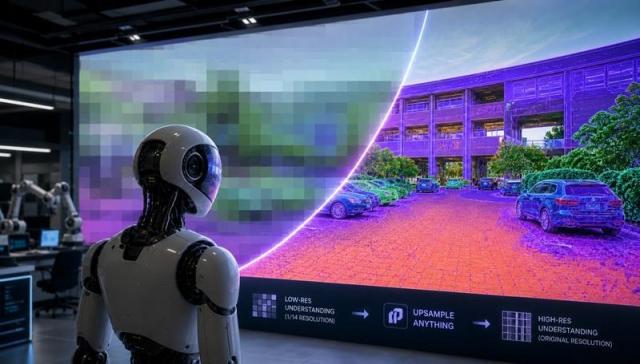
SEOUL, June 17 (AJP) - Researchers in South Korea have developed a technique with the Massachusetts Institute of Technology (MIT) and Microsoft that allows artificial intelligence to process high-resolution visual details while using up to 16 times less computer memory, the Korea Advanced Institute of Science and Technology said Wednesday.
The method, called Upsample Anything, restores fine visual details from compressed, low-resolution data without requiring additional machine learning training. By analyzing the boundaries and colors of a single input image, the system calculates the best way to reconstruct lost details. For a standard 224 by 224 pixel image, the process takes about 0.4 seconds to restore the visual information.
Currently, artificial intelligence models used in self-driving cars, smartphones, and humanoid robots compress images to save memory and process information quickly. However, this compression often causes the models to lose track of tiny objects, fine edges, and minor defects. Conversely, processing every image in high resolution from the beginning requires too much computing power and graphics processing unit memory for mobile devices to handle in real time.
The new technique solves this by finding a middle ground, storing only the compressed core data while using the image's own structure to fill in the missing high-resolution gaps on demand. Because it operates without needing to be retrained on new datasets, the tool can be immediately applied to unseen environments and different artificial intelligence applications.
Led by the Korea Advanced Institute of Science and Technology (KAIST) doctoral student Seo Min-seok, the research was presented at the Computer Vision and Pattern Recognition (CVPR) conference on June 7. The project received the conference's Compute Gold Star for its efficient use of computing resources and was named a Transparency Champion for sharing its code and ensuring the experiments could be reproduced by others.
"This technology is an algorithm that can significantly increase the visual precision of artificial intelligence with minimal resources, and we expect it to accelerate the practical application of humanoid robots and on-device AI," Professor Kim Chang-ick said. "It is even more meaningful that it was recognized at CVPR not only for its performance but also for its computational efficiency and research transparency."
(Reference Information)
Journal/Source: CVPR 2026
Title: Upsample Anything: A Simple and Hard to Beat Baseline for Feature Upsampling
Link/DOI: 10.48550/arXiv.2511.16301

Copyright ⓒ Aju Press All rights reserved.
