

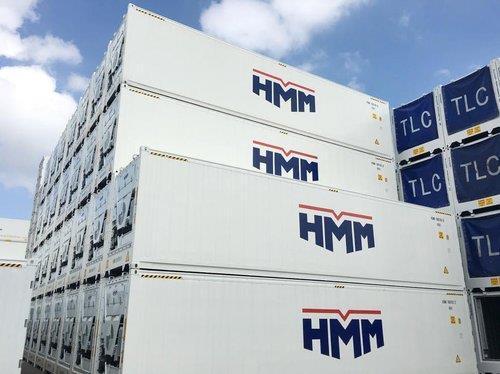
According to industry sources on June 17, HMM will implement a General Rate Increase (GRI) for all cargo departing globally to the United States, Canada, and Mexico, effective July 15.
The increase will be $2,700 for a 20-foot container (TEU) and $3,000 for a 40-foot container. For 40-foot high cube (HC) containers, the rate will be $3,375, while 45-foot containers will see a charge of $3,798.
The GRI is a pricing mechanism used by shipping companies to adjust rates based on market fluctuations and supply-demand conditions. Industry experts view this move as a response to the upward trend in freight rates on North American routes and the anticipated increase in seasonal demand.
Recent data indicates that freight rates for North American routes are indeed on the rise. According to the Korea Customs Service, maritime export rates to the U.S. West Coast increased by 10.1% in May compared to the previous month, while rates to the East Coast rose by 9.9%.
In light of uncertainties in the shipping market, there are also movements to increase fuel surcharges. Jangkum Shipping recently announced plans to adjust the low-sulfur fuel surcharge (LSF) rates applied to imported cargo arriving in South Korea.
The LSF reflects fluctuations in the price of low-sulfur fuel mandated by the International Maritime Organization's 'IMO 2020' environmental regulations. Jangkum Shipping stated, "Due to rising international oil prices, the cost burden for fuel necessary for vessel operations has increased, making rate adjustments unavoidable."
Pan Ocean has also extended its Emergency Bunker Surcharge (EBS) for export and import cargo between South Korea and Japan. The company cited ongoing fuel supply instability and rising prices due to the prolonged conflict in Iran as reasons for the extension. Starting from July 1, a surcharge of $50 will be applied to 20-foot containers and $100 to 40-foot containers for this route.
An industry insider remarked, "While the ceasefire agreement between the U.S. and Iran has alleviated immediate concerns, the shipping market remains vigilant regarding risks from the Middle East. In a situation where oil prices and freight rate volatility are increasing, shipping companies have no choice but to adjust rates and various surcharges to manage cost burdens and profitability."
* This article has been translated by AI.
Copyright ⓒ Aju Press All rights reserved.