SEOUL, June 17 (AJP) — Leveraged ETFs tied to Samsung Electronics and SK hynix now account for nearly a third of trading in the two stocks, amplifying swings in South Korea's benchmark index and prompting an emergency warning from financial regulators.
The Financial Supervisory Service on Wednesday convened investment banks, securities firms, asset managers and market researchers to warn against concentrated bets on a handful of stocks and excessive use of leverage, saying such strategies could aggravate market shocks and expose retail investors to forced liquidations during sharp downturns.
FSS Senior Deputy Governor Hwang Seon-oh urged investors to avoid excessive reliance on high-risk products or debt-financed investments, emphasizing the importance of long-term and diversified investing. He also called on securities firms to strengthen risk disclosures and ensure investors fully understand the products they purchase.
A leveraged ETF is an exchange-traded fund designed to deliver two or three times the daily return of an underlying index or stock rather than simply track its performance.
The FSS said speculative retail trading has intensified market volatility since the launch of single-stock leveraged and inverse ETFs. Margin-call liquidations have reached over 700 billion won so far this month.
According to the Korea Exchange, 16 single-stock leveraged and inverse ETFs held a combined 11.3 trillion won ($8.3 billion) in assets as of Tuesday. Since their launch in late May, the products have averaged 8.3 trillion won in daily trading, accounting for nearly a quarter of South Korea's total ETF turnover.
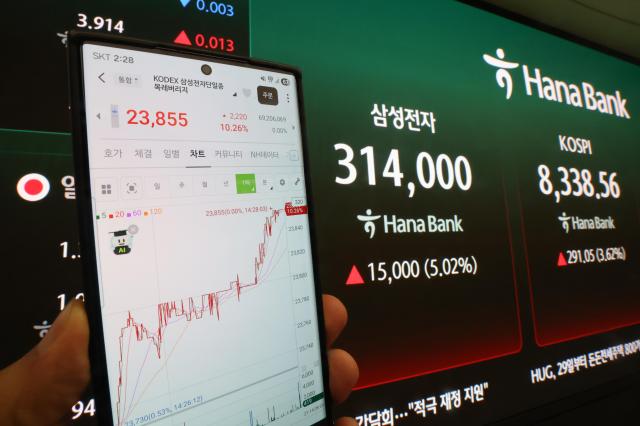
The concentration has become particularly pronounced in Samsung Electronics and SK hynix.
Between May 27 and June 15, Samsung Electronics' single-stock leveraged ETF averaged 3.43 trillion won in daily trading, equivalent to 31.3 percent of turnover in the underlying shares. The figure for SK hynix was even higher at 4.91 trillion won, accounting for 37.7 percent of cash-market trading.
Single-stock leveraged ETFs are designed to deliver twice the daily return of an underlying stock, forcing funds to buy more shares as prices rise and sell as they fall. The mechanism amplifies gains during rallies but can accelerate losses during selloffs.
The effect became particularly evident this month.
Since the launch of the products on May 27, open interest in Samsung Electronics futures has surged nearly 18 percent, rising from 5.7 million contracts to 6.7 million by June 4.
The market then abruptly reversed after U.S. chipmaker Broadcom issued a disappointing earnings outlook on June 5, triggering a semiconductor selloff.
As leveraged ETFs lost value while their futures positions remained largely unchanged, the funds became more leveraged than intended.
To restore their target exposure, fund managers were forced to sell both shares and futures contracts, adding further downward pressure on prices. By the close, Samsung Electronics and SK hynix had fallen as much as 6.4 percent.
The following sessions saw equally violent reversals, with Samsung Electronics dropping another 10.2 percent on June 8 before rebounding 9 percent the next day.
Futures trading surged alongside the volatility. Samsung Electronics futures trading volume jumped from 4.36 million contracts on June 4 to 11.83 million by June 9, while turnover more than doubled to 36.8 trillion won.
Authorities also pointed to the growing frequency of marketwide trading halts as a sign of mounting instability.
Sidecar curbs, which suspend program trading for five minutes when the benchmark index rises or falls by more than 5 percent, have been triggered 26 times this year, the highest number since the 2008 global financial crisis. Six of those halts occurred this month alone as markets repeatedly swung between rallies and selloffs.
Market participants say the trading pattern increasingly resembles a short-gamma dynamic, in which ETF rebalancing flows amplify price swings instead of absorbing them, reinforcing momentum in both directions and exacerbating volatility.

Copyright ⓒ Aju Press All rights reserved.