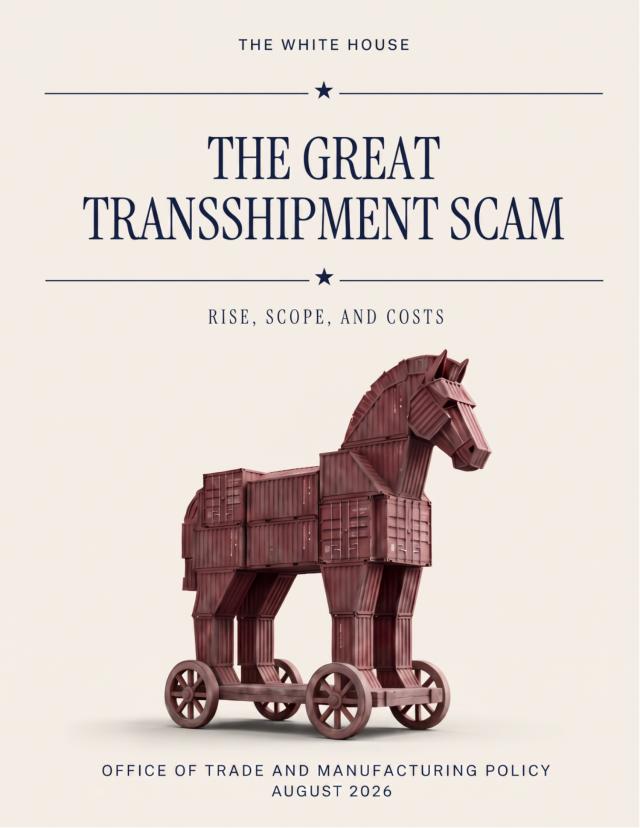
SEOUL, August 14 (AJP) -The White House has placed South Korea in the top tier of countries exposed to potential Chinese tariff evasion, singling out Gyeonggi Province's semiconductor belt as a possible conduit for China-linked chips as Washington prepares an artificial intelligence-powered crackdown on what it calls a global "shadow transshipment network."
A report released by the White House Office of Trade and Manufacturing Policy identifies more than 40 countries and jurisdictions where Chinese-origin goods could be routed, processed or relabeled before entering the United States under a different country of origin.
South Korea was grouped with Canada, the European Union, India, Israel, Japan, Mexico and Taiwan in Tier 1, which the White House calls "Diversified Scale Leaders."
The designation does not mean the White House found that South Korean companies were illegally transshipping Chinese goods.
Rather, Tier 1 covers large economies with significant volumes of China-linked trade, diversified industrial bases and major export platforms serving the U.S., where the report says potential transshipment risk is mixed into much larger legitimate trade flows.
The report acknowledges that the shift in U.S. sourcing away from China since tariffs were imposed does not establish that the displaced trade was illegally rerouted. Some reflects legitimate changes in production, investment and sourcing, it said.
For Korea, however, the report goes further than simply placing the country in a broad risk category.
It specifically identifies Gyeonggi's semiconductor belt - home to memory powers Samsung Electronics and SK hynix and their component suppliers - as a potential route for integrated circuits classified under HS 854239, arguing that China-linked goods moving through the Korean chip hub could put U.S. semiconductor production in Phoenix, Austin, Portland and San Jose under pressure.
The White House labels such foreign and American manufacturing corridors "Ugly Sister Cities," arguing that increased production or routing activity at overseas transshipment-risk hubs can translate into lost orders, lower factory utilization and employment pressure in corresponding U.S. industrial centers.
The pairings are based on product-level trade categories identified as having significant China-linked rerouting risk and matched against U.S. manufacturing regions producing the same or similar products. They are presented as potential exposure channels rather than case-specific findings of customs violations.
The Korea reference could nevertheless add a new point of friction to trade relations between Seoul and Washington because semiconductors sit at the center of both countries' industrial strategies.
The Trump administration argues that large differences between tariffs imposed on China and those applied to U.S. trading partners create an incentive to shift the apparent origin of Chinese goods.
The report puts the average U.S. tariff on Chinese exports at close to 50 percent. Goods routed through Mexico or Canada and improperly made to appear eligible for tariff treatment under the U.S.-Mexico-Canada Agreement could enter at zero or near-zero rates, while routes through South Korea, Japan, Vietnam or the EU would still face tariffs substantially below the Chinese rate, it said.
The White House says the process can involve limited assembly, finishing, testing or component integration as well as repackaging, relabeling, re-invoicing and changes to shipping documentation. The enforcement challenge is determining when genuine manufacturing has occurred and when goods have merely passed through another jurisdiction to acquire a new declared origin.
The Trump administration traces the expansion of such routing to the Section 301 tariffs imposed on China beginning in 2018.
As China's direct share of U.S. imports declined, imports from the more than 40 jurisdictions identified as carrying elevated transshipment risk increased, according to the report. The White House calls that shift the "Great Reallocation," while acknowledging that legitimate supply-chain diversification also contributed to the change.
Five government and private-sector analyses cited by the White House put annual transshipment or related trade-transfer exposure at between $40 billion and $303 billion.
The Council of Economic Advisers estimated potential illegal transshipment at $34.2 billion to $89.6 billion, while supply-chain analytics firm Exiger produced a central estimate of about $75 billion.
The Commerce Department calculated a broader $109 billion trade-transfer benchmark, while Altana's $303 billion figure represents what the report describes as a broad upper-bound exposure measure rather than a direct estimate of proven illegal shipments.
The White House cautioned that the estimates are not directly comparable because they use different datasets and definitions.
Under its central scenario of $75 billion in annual illegal transshipment, the report estimates that the resulting displacement of U.S. production could affect about 450,000 jobs, reduce annual GDP by between $113 billion and $150 billion and cut federal revenue by $19 billion to $26 billion.
Those figures are model-based estimates, not observed job losses, and rely on assumptions about how additional imports affect production, employment and economic output.
Washington plans to use AI to make those judgments at the border. The White House describes an emerging "Detective Border" system that would combine global shipping data, declared origins, routing histories, product classifications, ownership links and indicators of factory production capacity to flag suspicious trade flows.
Algorithms would look for anomalies between declared origins and actual supply chains, while computer vision and machine-learning systems could analyze container markings, packaging and X-ray images. The aim is to distinguish legitimate foreign investment and nearshoring from goods that merely pass through a lower-tariff country before reaching the U.S.
The report says flagged shipments could ultimately face interdiction, additional duties, penalties or exclusion from the U.S. market, pairing the AI system with tougher importer and ownership-disclosure requirements under Trump's June customs-enforcement order.
AJP Takeaways
- South Korea was placed in the White House's Tier 1 group for potential China-linked tariff transshipment, alongside Japan, the EU, Canada, India, Mexico, Israel and Taiwan, although the report says the risk is embedded within extensive legitimate trade.
- Gyeonggi's semiconductor belt was singled out as a possible conduit for China-linked integrated circuits, with the White House linking the corridor to competing chip-production centers in Phoenix, Austin, Portland and San Jose.
- Washington plans an AI-powered "Detective Border" to examine origins and supply chains, raising the prospect of tougher scrutiny of Chinese components that undergo limited processing in Korea or other lower-tariff jurisdictions before being exported to the U.S.
Copyright ⓒ Aju Press All rights reserved.