Young adults without a four-year university education and those from outside Seoul showed weaker social connections across several measures, according to a National Assembly Futures Institute (NAFI) study based on a nationwide survey of 5,185 people aged 19 to 39 conducted from November to December 2025.
The clearest divide was between those who had attended four-year universities and those who had not.
Using graduates of four-year universities outside the Seoul metropolitan area as a reference group, the study found that young people who did not attend university were 4.3 percentage points more likely to eat alone on weekdays and 6.3 percentage points less likely to use social media regularly. They also participated in leisure activities 29.2 percent less frequently than the reference group.
The institute found no significant differences across most social-connection indicators among graduates of different four-year universities.
Lee D.S., who is in his late 20s and did not attend university, said limited opportunities to meet people had made dating feel increasingly distant.
“How are you supposed to date when you are living on a deserted island?” Lee said. “If you miss the time when everyone is meeting people, it just gets even harder.”
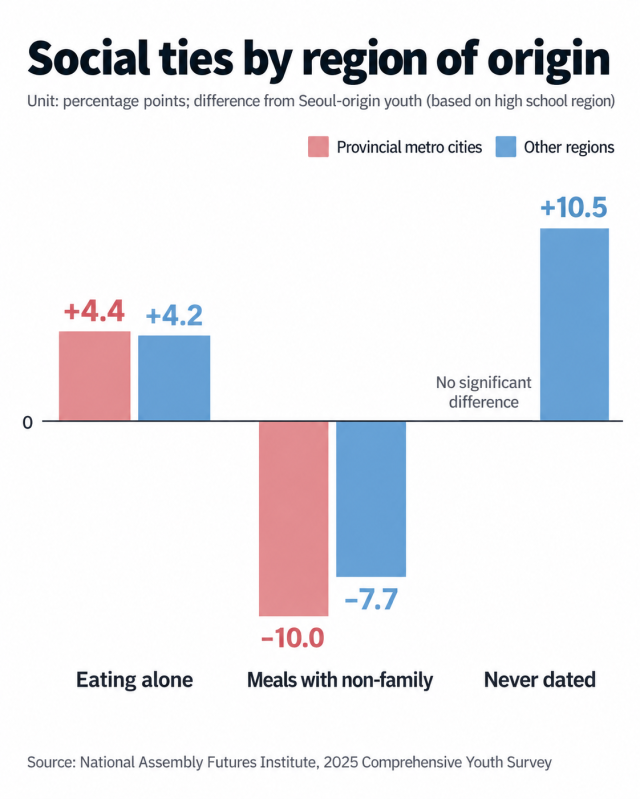
Geography also mattered. Young people from large cities outside Seoul took part in a narrower range of leisure activities than those from the capital. Among those from smaller cities and rural areas, the share who had never dated was 10.5 percentage points higher than among those from Seoul.
For Choi J.M., a 36-year-old office worker who graduated from university in Incheon and now lives in Seoul, the gap is closely tied to jobs and money.
“I came to Seoul because I could not find a decent job,” Choi said. “Without a stable job or friends nearby, it is easy to become isolated. Dating and even eating with others can start to feel like a luxury.”
Choi’s move reflects a broader flow of young people toward the capital region, which recorded a net inflow of about 48,300 people in their 20s in 2025. Seoul alone gained a net 35,900.
The Honam region in the southwest lost about 15,700 people in that age group, while the Yeongnam region in the southeast lost about 28,500, according to the Ministry of Data and Statistics’ 2025 Internal Migration Statistics released on Jan. 29.
The draw of the capital region also extends to graduates of regional universities. A separate NAFI study published on July 30 found that 20.5 percent of graduates of universities outside the capital region were living in the Seoul metropolitan area at the time of the survey.
Yee Jae-yeol, a sociology professor at Seoul National University, said young people are being pulled toward the capital region as good jobs become harder to find elsewhere, even as building a life there becomes more expensive.
“Once they arrive, they face intense competition and find life there extremely difficult,” Yee said.
“In some ways, life in the capital region is becoming more like living in a densely concentrated city-state such as Hong Kong or Singapore.”
Housing is a major barrier.
“For young people, buying a home in Seoul has become almost impossible,” Yee said. “Even with a decent job, marriage and setting up a household can be difficult. For some, living alone is not so much a choice as something circumstances push them into.”
The pressure comes as Seoul apartment prices continue to rise. Prices gained 0.13 percent in the week through Sept. 21, marking an 85th consecutive weekly increase, according to data released by the Korea Real Estate Board on Sept. 24.
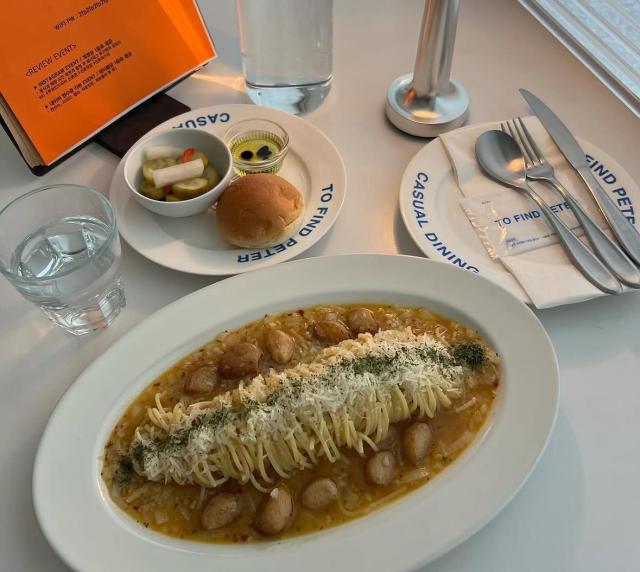
Yet eating or living alone does not always signal social isolation, Yee said.
“Highly educated young people may feel more confident being single and see it as a personal choice rather than a social stigma,” he said. “If buying a home is out of reach, they may choose to spend on a better car, travel alone or enjoy a good meal instead.”
Katie Lee, 34, who works in the human resources department at a major South Korean conglomerate, said eating alone began to feel different as her circumstances improved.
“When my life was unstable, I used to wear a hat and avoid crowded restaurants because I felt uncomfortable eating alone,” she said. “Now I eat alone and even post photos. It feels totally different because my life has changed.”
A similar educational divide appears in the labor market.
A Bank of Korea study released on Jan. 20 found that young adults out of work with a high-school or two-year college education were 6.3 percentage points more likely than four-year university graduates to be classified as “resting.” The term refers to economically inactive people who are neither working nor actively seeking work or training.
The likelihood of falling into that category was 4 percentage points higher for each additional year spent out of work.
Employment can also shape social ties. Stable work provides income, colleagues, routines and opportunities to meet people. Long periods out of work can reduce those everyday connections.
The findings carry implications for regional policy as well.
Yee said South Korea’s earlier decentralization efforts had clear limits. Moving public institutions to newly built innovation cities, in his view, was not enough to strengthen existing local communities.
“Young people should be able to find good jobs and attractive places to eat, spend time and enjoy life without having to leave their own regions,” he said.
Local governments also need greater control over their budgets to respond more directly to local needs, he added.
“Without deeper decentralization, it will be difficult to create a sustainable future for young people in the regions.”
NAFI’s July 7 report made a similar argument, saying economic support alone cannot address youth isolation and unequal social ties. It recommended expanding cultural, leisure and sports infrastructure outside the capital region.
It also called for what it described as “relationship infrastructure” in struggling regions, along with easier access to workplace and community activities for young people without a four-year university degree.
The institute proposed adding social connection to youth-policy evaluations alongside conventional measures such as employment, income and marriage, and conducting the national youth survey regularly to track changes over time.
Eating alone can be a choice, as can staying single. But education, work and geography help determine how much choice young people have in building their social lives.
“Sometimes it is not that you want to be alone,” Choi said. “Being alone is simply the easiest option when meeting people takes money, time and energy.”
AJP Takeaways
- Young adults without a four-year university education showed weaker social connections across several measures. Differences among graduates of different four-year universities were limited.
- Regional gaps also appeared in leisure activities and dating, while migration data showed young adults continuing to move toward the capital region.
- NAFI called for youth policy to address social connections alongside jobs and income, with more cultural, leisure and community opportunities outside the capital region.

Copyright ⓒ Aju Press All rights reserved.