
SEOUL, November 20 (AJP) - Most of the companies backed by Kazakhstan's state export insurer now sell processed goods abroad rather than raw materials, as the country tries to make its economy less dependent on oil.
The Export Credit Agency of Kazakhstan (ECA) gave domestic exporters 667.7 billion tenge ($1.49 billion) in support in the first 10 months of the year, according to Madina Yerzhanova, deputy chairperson of its management board. In remarks released by the agency, she said more than 80 percent of the exporters it supported in 2025 and 2026 made medium- or high-processed goods.
Oil still brings in about half of the country's export earnings. Crude oil and petroleum products made up 49.8 percent of exports from January to August, according to the Bureau of National Statistics.
At home, factories have nearly caught up. Manufacturing output rose 8.6 percent in the first nine months while mining fell 4.3 percent on lower oil and gas production. That left manufacturing with 46.5 percent of industrial output and mining with 46.9 percent.
The ECA is part of Baiterek, the state's national holding company. It insures export contracts against buyers who fail to pay and helps companies raise the bank loans they need to fill foreign orders.
"Kazakhstan has long outgrown the role of a mere raw materials supplier," Yerzhanova said. Selling finished products abroad, she added, "requires substantial financial investment and reliable risk protection."
The agency puts the wider economic return on its work at more than 1.9 trillion tenge. That estimate counts more than 761 billion tenge in export revenue, over 1 trillion tenge in manufactured output and about 80 billion tenge in tax payments.
Yerzhanova tied the agency's direction to President Kassym-Jomart Tokayev's State of the Nation Address on Oct. 28, which she said made deep processing and domestic manufacturing priorities.
Fats-and-oils producers Sei-Nar, Maslo-Del and Qazaq-Astyq Group are among the agency's clients, with projects that range from plant expansions to refining. Kazcentrelectroprovod, a cable plant in Saran in Karaganda Region, makes products for the power, telecommunications and rail sectors and sells to Germany, Denmark, Italy and Uzbekistan. The Prima Kus poultry farm, Shin-Line and several livestock and metals companies are also in the portfolio.
Many exporters get stuck on collateral, Yerzhanova said. A signed export contract shows there is demand for a product, but companies often lack the assets a bank wants before it will lend against that contract. Once the goods ship, they also face the risk that a foreign buyer pays late or not at all.
Smaller companies make up most of the agency's business. Small and medium-sized enterprises account for 61 percent of its portfolio, and more than 377 applications have gone through its online Exporter's Portal. A digital showcase called Made in Kazakhstan lists about 1,100 products from 540 companies.
Kazakh goods have a strong position in Central Asia, Yerzhanova said, and also ship to China, Russia, Türkiye, Germany and the United Arab Emirates. She named Southeast Asia and the Persian Gulf as markets with strong potential.
In May, the ECA hosted the Berne Union's Spring Meeting in Astana. It was the first time the world's largest association of export credit and investment insurers had met in Central Asia. Yerzhanova said the agency has also joined the union's Short-Term Committee.
Park Sae-jin
Experienced journalist and editor at AJU PRESS specializing in multilingual news. I cover international diplomacy, geolpolitics, and policy, consistently delivering highly accurate, compelling reporting for a worldwide audience.
Copyright ⓒ Aju Press All rights reserved.
Related News
-
 AJP Forum: Kazakhstan urges Korean investment in smart city
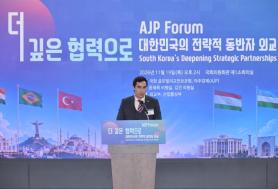
Asset Issenali, Kazakhstan's ambassador to South Korea, delivers a speech at the AJP 2nd Anniversary Forum at the National Assembly Members' Office Building in Yeongdeungpo-gu, Seoul, on Nov. 19, 2026. AJP Han Jun-gu SEOUL, November 19 (AJP) - Kazakhstan is seeking stronger South Korean investment in its flagship Alatau City development and critical minerals industry, its ambassador said Thursday, urging Korean companies to take a more active role in turning the countries' newly upgraded strategic partnership into concrete industrial projects. Speaking at AJP Forum at the National Assembly Members' Office Building in Seoul, Kazakh Ambassador Asset Issenali outlined investment opportunities spanning urban infrastructure, artificial intelligence, advanced manufacturing and mineral processing. "Today we have excellent opportunities to expand collaboration in trade, investment, energy, transport, and logistics," Issenali said. "We also see great potential in new areas such as artificial intelligence, digital transformation, critical minerals, science and innovation." The ambassador identified Alatau City, a major urban development project in southeastern Kazakhstan, as one of the most promising opportunities for Korean companies looking to expand into Central Asia. "We aim to develop our city into a modern center for business, innovation and new technologies," he said. "We welcome the active involvement of Korean partners in this important project." The project has already attracted substantial investment interest. According to Kazakhstan's government, Alatau City's development pipeline had reached 67 projects worth approximately $6.9 billion as of August, with the potential to generate around 55,000 jobs. South Korea's Korea Overseas Infrastructure & Urban Development Corporation (KIND) has been involved in discussions over the city's development, including urban planning, infrastructure and smart-city technologies. During Kazakh President Kassym-Jomart Tokayev's visit to Seoul in September, the Alatau City Authority and KIND exchanged an agreement on developing a master plan for the project. Another major area of cooperation is critical minerals, where Kazakhstan hopes to combine its extensive natural resources with South Korea's advanced industrial technologies. Asset Issenali, Kazakhstan's ambassador to South Korea, speaks during a panel discussion at the AJP 2nd Anniversary Forum at the National Assembly Members' Office Building in Yeouido, Seoul, on Nov. 19, 2026. AJP Han Jun-gu "Kazakhstan has significant mineral resources, while Korea has advanced technologies and industrial expertise," Issenali said. He pointed to the opening of a joint Kazakh-Korean rare metals technology center in Almaty in October as an example of cooperation moving beyond traditional resource trade. The center, established at Satbayev University's Institute of Metallurgy and Ore Beneficiation, is intended to support joint research into mineral processing, rare-metal extraction and advanced materials. The initiative reflects growing efforts by both countries to strengthen industrial supply chains through technological cooperation rather than relying solely on raw material exports. The ambassador's remarks came two months after President Tokayev and South Korean President Lee Jae Myung agreed on September 15 to elevate bilateral ties to a "future-oriented comprehensive strategic partnership." The upgrade marked a new phase in relations established in 1992, with the two governments seeking to expand cooperation beyond traditional trade and energy into artificial intelligence, robotics, science and space technology. Issenali said the first Korea-Central Asia Summit, held in Seoul the following day, had also established a broader political framework for cooperation between South Korea and the resource-rich region. Participants pose for a group photo at the AJP 2nd Anniversary Forum at the National Assembly Members' Office Building in Yeouido, Seoul, on Nov. 19, 2026. AJP Han Jun-gu "Our region has significant natural resources, growing economic potential and a strategic geographic position connecting Asia and Europe," he said, emphasizing the complementary strengths of Central Asian economies and South Korea's technological capabilities. The ambassador also highlighted Kazakhstan's ongoing economic modernization, pointing to President Tokayev's October 28 state-of-the-nation address, which emphasized digital transformation, infrastructure development and the creation of a competitive technology-driven economy. He said the reforms would create opportunities for Korean businesses ranging from supplying construction equipment and materials to establishing local production facilities and introducing advanced technologies. Beyond economic cooperation, Issenali emphasized the historical and cultural bonds between the two countries, noting that more than 120,000 ethnic Koreans live in Kazakhstan. The two countries are preparing to mark the 90th anniversary of the Korean diaspora's resettlement in Central Asia in 2027, alongside the 35th anniversary of diplomatic relations. Returning to the economic agenda, Issenali urged Korean businesses to explore opportunities more actively across Kazakhstan and the wider Central Asian region. "We are urging Korean companies to be more aggressive and to find new ways of collaboration and interaction," he said. "Our responsibility now is to make this framework work."
-
 KT&G Begins Direct Sales of Heated Tobacco Products in Kazakhstan
KT&G has started direct sales of heated tobacco products in Kazakhstan, leveraging its existing local business foundation established through its traditional tobacco operations. The company aims to accelerate its market penetration by integrating its own distribution and sales strategies into its overseas electronic cigarette business, which has previously focused on collaborations with global tobacco firms. On November 9, KT&G announced the launch of its heated tobacco device 'Flex' and four exclusive stick varieties named 'Faiim' in Kazakhstan last October. Flex and Faiim are rebranded versions of the 'lil AIBLE' and 'AIIM' products sold in South Korea, tailored for the local market. Sales have commenced in Almaty, the largest city in Kazakhstan, with plans to gradually expand the distribution network. The company is also increasing its engagement with local consumers. KT&G operates a flagship store for the Flex brand in the Forum Mall, a major shopping center in Almaty, where it offers product introductions and customer consultations to enhance brand awareness. This expansion aligns with KT&G's strategy to establish independent sales capabilities in the overseas electronic cigarette market. The company has previously expanded its overseas heated tobacco business through partnerships with Philip Morris International (PMI). This year, KT&G secured a foundation for independent commercialization of certain products, allowing it to pursue direct overseas operations under its own brand. Kazakhstan is a market where KT&G has built a local business foundation through its traditional tobacco operations. The company has been strengthening its competitive edge by expanding production facilities and distribution networks centered around its local subsidiary. Last year, it completed a factory in Kazakhstan and began product manufacturing. With the launch of these electronic tobacco products, KT&G aims to diversify its existing tobacco-centric business structure and secure new revenue streams in the local market. KT&G has identified the expansion of its overseas NGP business as a key component of its long-term growth strategy. In a corporate value enhancement strategy announced on November 5, the company set a goal to increase the share of NGP sales within its tobacco business to over 30% by 2030. To achieve this, KT&G plans to expand its local direct operations alongside global partnerships. A KT&G official stated, "The launch of Flex and Faiim in the Kazakhstan market marks a new starting point for our global NGP business expansion. We will extend our operations into untapped regions and strengthen our growth momentum based on strategies optimized for local markets."* This article has been translated by AI.
-
Kazakhstan's Tokayev Announces $14.2 Billion National Infrastructure Initiative
Kazakhstan President Kassym-Jomart Tokayev announced plans to allocate 6.5 trillion tenge (approximately $14.2 billion) from the national fund for a major infrastructure initiative that aims to build hospitals, schools, railways, and power plants across the country by 2029. Starting in January, the monthly minimum wage will increase from 85,000 tenge to 110,000 tenge.During his annual state address on October 28, President Tokayev referred to this initiative as 'People's Construction' (Haliktyk Kurilis) and described it as the largest infrastructure project in Kazakhstan's history. He proposed designating next year as 'The Year of National Construction.'"Kazakhstan must transform into a vast construction site," Tokayev stated, emphasizing the need for comprehensive construction efforts across all regions rather than isolated projects.The address, titled 'Challenges Facing Kazakhstan in a New Historical Cycle,' marks the first state address since the new constitution, which was confirmed by a national referendum on March 15 and took effect on July 1, replaced the bicameral parliament with a unicameral assembly called the Kurultai.The national fund is a sovereign wealth fund that manages oil revenues. Tokayev cited International Monetary Fund (IMF) projections, stating that this year's gross domestic product (GDP) is expected to approach $400 billion, with per capita GDP exceeding $19,000. Combined gold and foreign exchange reserves and national fund assets exceed $130 billion.Of the allocated budget, 1.5 trillion tenge will be designated for the commencement of social infrastructure projects from this year until February next year. The initial phase includes approximately 70 medical facilities and around 50 educational, sports, and cultural facilities, as well as expansions in gas and drinking water supply.The government is required to prepare a list of regional projects by the end of the year, with qualified local small and medium-sized enterprises participating in the construction. Tokayev stated that this initiative will create hundreds of thousands of jobs.In the healthcare sector, eight maternity centers and seven children's hospitals will be constructed. The children's hospitals will be located in Atyrau, Aktobe, Almaty, Shymkent, Kaskelen, Semey, and Aktau, with two additional medical facilities in the capital, Astana.Conditions have been set for budget utilization. Tokayev emphasized that public funds should serve as a catalyst for attracting private investment, stating, "It is unacceptable to use national fund resources for import payments." He called for an increase in domestic production of construction materials, metal structures, and engineering equipment.The minimum wage increase will benefit approximately 1.8 million people, including over 370,000 public sector workers. On the same day, salaries for primary healthcare professionals will also rise by up to 40% based on years of service, affecting around 77,000 individuals.Welfare programs will focus on those in need, with new systems to be piloted before broader implementation. With over 237,000 children requiring integrated education, there is a need to expand related facilities and specialized personnel, while also reducing administrative burdens on teachers.Tokayev also addressed the issue of taxing the wealthy, stating, "I believe it is time to discuss applying higher tax rates to large asset holders," while assuring that legally acquired wealth will be protected. He instructed the government to propose selective amendments to the new tax law to eliminate ambiguous provisions and excessive burdens on businesses.The new civil code is targeted for adoption by the Kurultai by the end of 2027, and the establishment of a capital markets law is underway. The banking sector's assets exceed 75 trillion tenge, with deposits surpassing 52 trillion tenge. Tokayev identified price stability and real income growth as key priorities, calling for cooperation between the government and the central bank, as well as an expansion of long-term investment loans.To address power shortages, Tokayev set a deadline. Kazakhstan produces approximately 123 billion kWh annually but still faces electricity deficits. He pledged to achieve a stable surplus in power supply by 2029 through the modernization of new power facilities and transmission networks, as well as expanding environmentally friendly coal power and solar-based renewable energy.Nuclear power development is accelerating. Construction of the Balkhash Nuclear Power Plant is expected to begin as early as next year, and Tokayev urged swift construction of the second plant, the Moinkum Nuclear Power Plant, following a comprehensive cooperation agreement. Despite being the world's largest uranium producer, Kazakhstan currently has no operational nuclear power plants.He called on international partners for technology transfer, support for advanced industries, and training of domestic specialists. A national strategy for uranium reserves to fuel domestic nuclear power plants over the next century is also under consideration. The government must revise the national energy supply plan by 2035 to reflect industrial demand and the increase in AI and data centers.In logistics, Tokayev clarified the goal of surpassing transit countries. He stated, "We must immediately transition to fully organizing international cargo flows." This includes fostering domestic transport companies and establishing collection and delivery centers, as well as manufacturing and trade hubs in transportation nodes.The Bakhyt-Ayagoz railway, connecting to China, is set to open in 2027, increasing cargo transport capacity between the two countries by 20 million tons. The Aral-Caspian corridor, which began construction in August, will reduce the Caspian Sea crossing route by approximately 1,000 kilometers and shorten transport times by up to three days, linking China and Europe through Kazakhstan, the Caspian Sea, Azerbaijan, and Georgia.In the digital sector, two supercomputers are currently operational under the 'Digital Kazakhstan' strategy, with plans to add a third by the end of the year. A submarine fiber optic cable in the Caspian Sea has also been completed.Tokayev emphasized the need to move beyond fragmented automation projects to an AI-based digital economy, calling for the commercial application of blockchain and asset tokenization. Asset tokenization involves converting asset ownership into digital tokens, allowing companies to raise capital directly and enabling more citizens to share in asset ownership.By the end of the year, a simplified legal framework for digital employment will be established, and next year, a pilot project will assist rural producers in selling agricultural products through digital platforms in collaboration with the government and businesses. AI will also be introduced into administration to reduce bureaucracy and identify inefficient budget expenditures, while a digital twin of urban infrastructure will be developed.Small and medium-sized enterprises account for 40% of GDP and approximately 70% of fixed capital investment. Tokayev instructed the government to develop long-term financing and technological modernization plans for medium-sized enterprises, as well as to reserve a portion of public procurement for small businesses.He also proposed a three-year moratorium on government inspections for small businesses and micro-enterprises starting January 1, 2027, reflecting lessons learned from the 2020-2023 moratorium. Additional decriminalization of economic offenses, fair competition, and the eradication of illegal interference in business activities were also emphasized.The investment attraction system will be streamlined. A proposal was made for the state development holding company, Baiterek Holding, to take on a more active role alongside the Ministry of Economy and the Ministry of Foreign Affairs.A special legal framework will be established in the new city of Alatau City, with an investment court following the British common law model to handle commercial cases, while other cases will be addressed by a separate civil court. The government is required to submit necessary legal amendments to the Kurultai by the end of January.In the minerals sector, the government has been tasked with innovating geological exploration technology, disclosing geological information, and expanding private investment. By the end of the year, a management system for core mineral reserves must be proposed, along with plans for non-ferrous metals and rare earth reserves.Agriculture grew by approximately 6% last year, with agro-industrial production reaching 15 trillion tenge. Baiterek Holding has identified promising projects in the food industry worth 500 billion tenge, which require low-interest financing. Tokayev urged the acceleration of AI adoption in agriculture during the visit of Jensen Huang, CEO of NVIDIA, to Astana this month.Water scarcity has been identified as an urgent issue. The government has been instructed to reduce leaks in the water supply network, enhance usage management, and expedite the reform of water tariffs and the establishment of a national water resource information system.Deadlines for administrative reforms have also been set. The presidential office must present a comprehensive administrative reform plan covering all levels from central government to rural administrative bodies by June 1, 2027. The presidential office, the Strategic Planning and Reforms Agency, and research institutions are to develop a long-term national development vision within a year.The new Astana airport is set to begin construction in 2027, with all land border checkpoints scheduled for reconstruction in the same year.* This article has been translated by AI.