

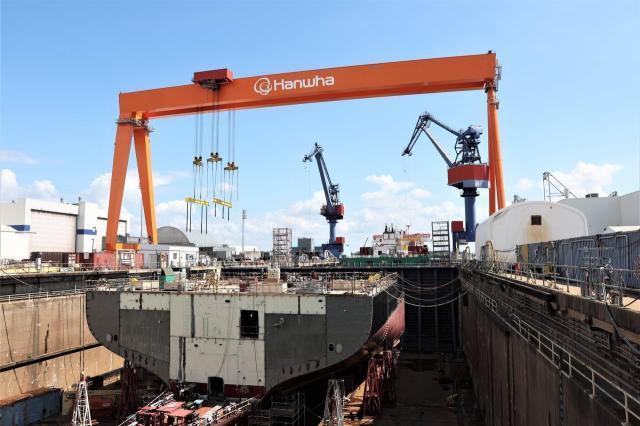
SEOUL, August 14 (AJP) -U.S. President Donald Trump has opened a potentially significant procurement route for South Korean shipbuilders under Seoul's $150 billion MASGA partnership, allowing qualifying foreign yards to build the first two ships in selected U.S. naval programs at home before shifting subsequent construction to American shipyards.
The move, contained in a presidential memorandum signed Thursday, could turn part of the Korea-U.S. Make American Shipbuilding Great Again (MASGA) initiative from an investment pledge into actual ship orders.
A separate Trump proclamation on the same day also put South Korea inside Washington's drive to restructure another strategic supply chain — drones and their components — giving Korean products a preferential tariff ceiling of 15 percent while imposing rates as high as 100 percent on other imports.
Together, the measures show Washington increasingly using procurement, tariffs and investment incentives to pull allied industrial capacity into U.S.-centered defense supply chains, with South Korea positioned on both sides of that shift.
The shipbuilding memorandum does not name South Korea or MASGA specifically.
But its provisions closely match the structure of the U.S.-Korea shipbuilding partnership agreed last year.
The memorandum adopts what the White House calls the "Finland Model," under which a qualifying foreign shipbuilder may construct the first two vessels at its parent shipyard while simultaneously investing in American capacity. Ships after the first two would have to be built in the United States.
The foreign supplier must build a new U.S. shipyard or take ownership or a majority equity position in an existing one, hire and train American workers, license its proprietary shipbuilding technology to the U.S. yard and develop a U.S. supply chain.
The memorandum also orders the U.S. government to devise within 90 days a new international procurement approach covering surface combatants capable of anti-submarine warfare, surface warfare and convoy escort missions.
A parallel plan will cover Consolidated Cargo Replenishment at Sea tankers and roll-on, roll-off vessels.
Most significantly for Korea, Trump directed the departments of War, Commerce and Transportation to develop a plan for channeling financial resources pledged through U.S. trade agreements into the American maritime industrial base.
That provision provides a potential bridge to MASGA.
The joint fact sheet issued by Trump and President Lee Jae Myung in November identified $150 billion of Korean investment specifically for shipbuilding. The two governments also agreed to work on shipyard modernization, maintenance and repair, workforce development and supply-chain resilience, and expressly raised the possibility of constructing U.S. vessels in South Korea.
The new memorandum now establishes a mechanism under which that possibility could move toward procurement.
U.S. law generally restricts construction of Armed Forces vessels in foreign shipyards, but the memorandum delegates authority to grant national-security waivers for projects satisfying the new model, subject to notification of Congress and a 30-day waiting period.
For Korean yards, that could be consequential.
Hanwha Ocean, HD Hyundai Heavy Industries and Samsung Heavy Industries have already been building relationships with U.S. yards and defense contractors.
The White House said in October that HD Hyundai and Cerberus Capital Management planned a $5 billion program to modernize American shipyards, while Hanwha Ocean announced a $5 billion infrastructure plan for Philly Shipyard. Samsung Heavy Industries and Vigor Marine agreed to cooperate in naval maintenance and repair, automation and construction of U.S.-flagged vessels.
Those arrangements do not automatically qualify the companies for contracts under Thursday's memorandum. Specific ship classes, contractors and procurement terms still have to be determined.
But the requirement that foreign builders invest directly in U.S. yards makes Korean groups that have already established American partnerships particularly relevant as Washington begins drawing up the programs.
Drones create another Korean opening — with a catch
Trump's drone proclamation creates a different mix of opportunity and pressure.
The president ordered a 100 percent tariff on drones with a maximum takeoff weight above 25 kilograms, drones equipped with thermal imagers, docking stations and certain critical components.
Smaller drones generally face a 25 percent tariff, while another category of drone components will become subject to a 25 percent duty after a 180-day delay. The first tariffs take effect Sept. 3, while the delayed component tariffs take effect Feb. 9, 2027.
South Korea, however, is among a group of U.S. partners receiving preferential treatment.
For qualifying products from Korea, Japan, Taiwan, Switzerland, Liechtenstein and the European Union, the total duty will be capped at 15 percent. British products receive a ceiling of 10 percent.
The Korean preference is conditional. To qualify, importers must certify that substantially all critical components and technology come from the United States or one of the designated partner economies.
That provision could prove particularly important for Korea because its domestic drone industry is still trying to reduce dependence on Chinese and other foreign components.
South Korea's aerospace agency launched a K-Drone supply-chain initiative last year specifically to address foreign dependence in aircraft and core components. The government said in June that Korea had about 600 drone manufacturers but that many remained small and lacked critical-component technology, leaving much of the industry closer to assembly operations using Chinese parts.
The Defense Ministry has separately been pushing to localize flight controllers, batteries, motor controllers, remote controls, GPS systems and optical cameras for military training drones.
That means a drone assembled in Korea would not necessarily qualify automatically for the U.S. 15 percent ceiling merely because the final product carries Korean origin.
The composition of its supply chain will matter. The rule could therefore accelerate a localization effort already underway in Korea while creating potential demand for Korean-made batteries, electronics, sensors and other components that can satisfy the U.S. trusted-origin requirement.
Washington is providing an additional incentive to move production onto American soil.
The proclamation authorizes an onshoring program under which companies committing to build, refurbish or expand U.S. drone and component facilities before Jan. 20, 2029 may receive relief from Section 232 tariffs on covered products, supply-chain inputs and production equipment while the plants are under construction.
For Korean manufacturers, the emerging pattern resembles shipbuilding on a smaller scale: access to the U.S. market remains available to allies, but increasingly on condition that they reduce reliance on third-country supply chains and put more capital, technology and production capacity inside the United States.
South Korea had urged Washington during the Section 232 investigation last year to address excessive concentration of the global drone market while strengthening supply chains through cooperation with allies such as Korea.
AJP Takeaways
- Trump's shipbuilding memorandum potentially gives Korea's $150 billion MASGA initiative a direct procurement route, allowing qualifying foreign builders to construct the first two vessels in selected programs at their home yards before shifting later ships to U.S. facilities.
- Korean drones and components receive preferential U.S. tariff treatment, but not an exemption: qualifying Korean products face a duty capped at 15 percent rather than the broader 25 percent or 100 percent rates.
- Origin rules could reshape Korea's drone supply chain, because the 15 percent treatment requires substantially all critical components and technology to come from the United States or designated partner economies, putting pressure on Korean manufacturers to replace Chinese components and potentially encouraging new Korean investment in U.S. production.
Copyright ⓒ Aju Press All rights reserved.
