

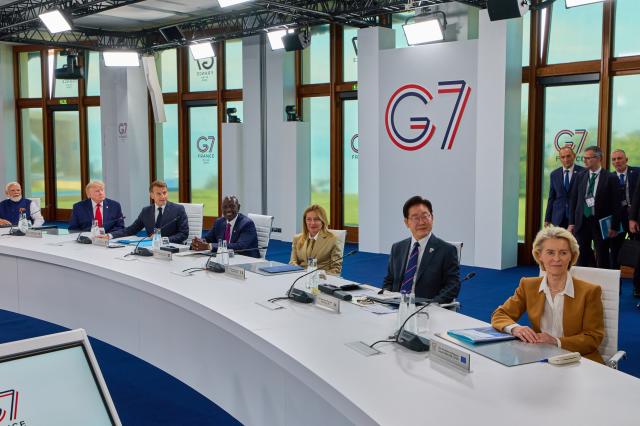
The session included G7 leaders, the heads of five invited countries, Kristalina Georgieva, Managing Director of the International Monetary Fund (IMF), and Mathias Cormann, Secretary-General of the Organisation for Economic Co-operation and Development (OECD).
President Lee highlighted the global challenge of economic imbalance and proposed three collaborative measures to restore inclusive growth.
First, he emphasized the need for practical discussions and international cooperation based on trust and collaboration to alleviate global imbalances.
He suggested seeking policy coordination within a framework of mutual trust and cooperation rather than blame-shifting.
President Lee also noted that the 'G7 Economists' Report' presented by the French presidency could serve as a starting point for future discussions, and he pledged that South Korea would contribute to deriving practical cooperation measures by acting as a bridge between developed and developing countries, as well as between surplus and deficit nations.
He stressed the importance of solidarity and cooperation in strengthening the resilience of energy supply chains.
Recent crises in the Middle East have revealed the vulnerability of energy supply chains in the Asia-Pacific region, and he stated that South Korea would support the International Energy Agency (IEA) in enhancing the resilience of energy supply chains in Asia.
To this end, he mentioned plans to closely consult with major countries on expanding and strengthening the existing global energy security framework established and operated by the IEA, including the 'IEA Singapore Regional Cooperation Center.'
President Lee also underscored the need for joint efforts by the international community to stabilize and diversify supply chains for critical minerals.
He expressed strong support for G7 efforts to diversify and enhance the resilience of critical mineral supply chains.
Additionally, he stated that South Korea, as a major consumer and holder of key processing technologies for critical minerals, would actively participate in international cooperation efforts to stabilize these supply chains.
President Lee emphasized that South Korea is a key partner of the G7 and will work to ensure that the discussions lead to practical cooperation among participating countries, resulting in positive changes in the lives of their citizens.
Earlier that day, France adopted two additional outcome documents on 'Countering Drug Trafficking' and 'Addressing Illegal Immigration.'
The drug trafficking document includes measures to enhance maritime and port security, establish a G7+ port network, prevent infiltration by criminal organizations, and track illicit funds.
The government expressed its agreement on the necessity of international cooperation to combat drug trafficking and plans to consult with relevant ministries to participate in the G7+ port network.
The illegal immigration document emphasizes dismantling networks for human trafficking and illegal immigration, collaborating with online platforms, and strengthening safe and legal return procedures with countries of origin and transit.
South Korea joined both documents, reaffirming its commitment to addressing transnational crime and international security cooperation with the G7 and key partner countries.
In the first session of the expanded meeting the previous day, President Lee emphasized the importance of sharing the benefits of artificial intelligence (AI) technology with all countries and growing together.
He noted that while the AI revolution presents new challenges and opportunities for growth, many developing countries are unable to fully access these opportunities.
He added, "We must ensure that the technological gap between countries does not translate into a growth gap," and proposed a vision of a 'Global AI Basic Society' where all humanity can share the benefits of AI development.
He also presented concrete alternatives to address the issue of insufficient public funding in light of rising development demands. President Lee stated, "Given the increasing development needs, public resources are not sufficient, so partnerships that integrate aid, investment, technology, and systems are necessary," identifying a model for mobilizing investment linked to private capital as a solution.
He cited the Korea International Cooperation Agency's (KOICA) support for Indonesian startups as a successful example, noting that $1 million in grants successfully attracted $50 million in private investment.
Additionally, he highlighted that the true value of development cooperation lies in the tangible improvements in the quality of life experienced by the citizens of recipient countries, presenting the 'LG Vocational Training School' established in Ethiopia as another success model.
President Lee promised that the South Korean government would fulfill its responsibilities and roles in building international partnerships based on its experience and capabilities as a country that has transitioned from being a recipient of aid to a donor.
France adopted three key agenda documents on 'Mutually Beneficial International Partnerships,' 'Cancer Eradication,' and 'Ebola Response,' to which the South Korean government officially expressed its support.
* This article has been translated by AI.
Copyright ⓒ Aju Press All rights reserved.