

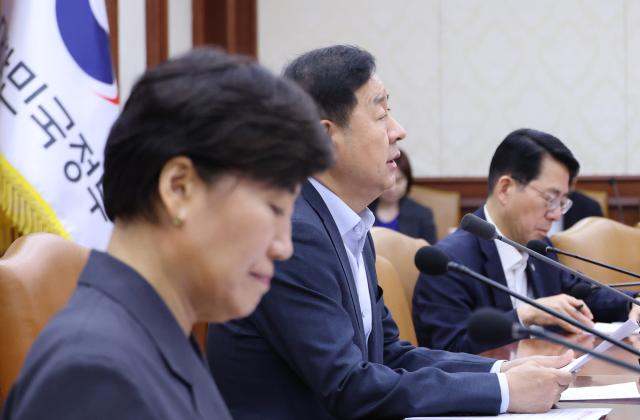
Deputy Prime Minister and Minister of Economy and Finance Koo Yun-cheol announced plans to maintain a freeze on local public utility rates for the second half of the year, citing ongoing inflationary pressures from rising energy prices. The government aims to collaborate with local governments to stagger rate increases and minimize their impact on citizens.
During a task force meeting on living costs at the Government Seoul Building on June 18, Koo stated, "It will take time for international energy production, transportation infrastructure, and logistics supply chains to fully normalize." He emphasized the need to remain vigilant and utilize all available measures to stabilize living costs.
The meeting focused on strategies for managing local public utility rates in the second half of the year. With inflationary pressures from rising energy prices still present, the government has committed to keeping these rates as stable as possible.
In collaboration with the Ministry of the Interior and Safety, local governments will work to delay increases in water and sewage fees, as well as garbage bag prices. If increases are unavoidable, the government plans to spread them out to lessen the burden on citizens. Additionally, local governments actively working to stabilize prices will receive financial support, such as special grants.
While the government noted a slight easing of geopolitical risks due to ongoing negotiations for a ceasefire in the Middle East conflict, it acknowledged that rising raw material prices and supply chain uncertainties remain significant challenges.
Koo remarked, "Just because the immediate waves have calmed does not mean the hidden reefs have disappeared." He reiterated the commitment to focus on stabilizing living costs amid ongoing uncertainties.
Furthermore, to alleviate the transportation sector's fuel cost burdens, the government plans to extend the fuel price-linked subsidies for freight and passenger vehicles, set to expire at the end of this month, until the end of September. The support will also be expanded to include charter buses. Plans for discount support, supply expansion, and measures to reduce the burden on vulnerable populations will be announced soon.
Regarding the seventh oil price ceiling designation, Koo stated, "Future operations will be discussed and reviewed in light of the ceasefire agreement in the Middle East, domestic and international oil price trends, and the impacts on living costs and government finances."
* This article has been translated by AI.
Copyright ⓒ Aju Press All rights reserved.