

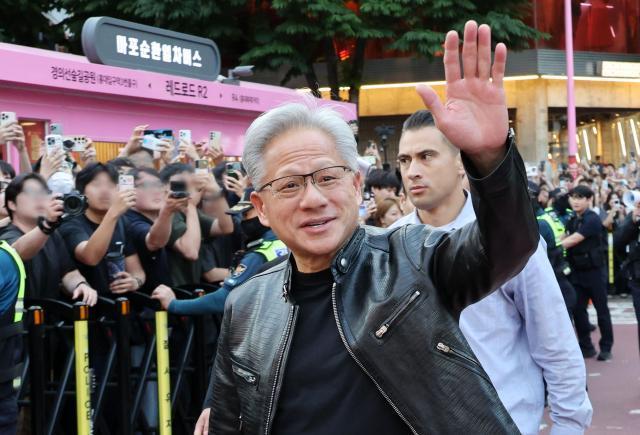
In the early summer of 2026, the industrial map of Asia experienced another massive tremor. Jensen Huang, the founder and CEO of Nvidia—one of the world's most valuable companies—embarked on back-to-back visits to Taiwan and South Korea. This was no ordinary overseas business trip or routine client management. It was an on-the-ground inspection of the new global industrial order and power dynamics forged by the AI revolution. Simultaneously, it was a strategic move to gauge the restructuring of supply chains and the direction of industrial alliances for the next decade.
In Taiwan, Huang was literally treated like a hero. Crowds flocked to airports and event venues, and the media broadcast his every move almost live. This is not just a "star CEO" phenomenon. Today, Taiwan serves as the physical beating heart of the AI empire Nvidia has built. The GPUs designed by Nvidia are manufactured by TSMC, while countless Taiwanese suppliers provide servers, substrates, packaging, cooling systems, and network equipment. A substantial portion of the massive industrial ecosystem that makes up AI data centers is concentrated in Taiwan.
Currently, a single top-tier AI server rack contains hundreds of thousands of components, and large-scale data centers require millions. Taiwan sits at the very center of this complex value chain. While the chips Nvidia designs are changing the world, the manufacturing prowess that turns them into tangible products is largely driven by Taiwan. Thus, Taiwan is Nvidia’s most crucial strategic partner, and Huang’s visit was fundamentally an inspection of his industrial empire’s core production base.
Paradoxically, however, Taiwan is both Nvidia’s greatest strength and its greatest vulnerability. The concentration of the world’s most advanced semiconductor manufacturing capacity in a single region is an asset for efficiency, but a massive geopolitical risk. As strategic competition between the US and China intensifies and military tensions in the Taiwan Strait rise, the global supply chain inevitably becomes more unstable. This is exactly why the US government and global corporations are constantly emphasizing supply chain diversification.
This is precisely where South Korea’s strategic value comes to light. The reason Huang visited South Korea immediately after Taiwan was not simply to offer encouragement to HBM (High Bandwidth Memory) suppliers. He is already looking toward the post-generative AI world. His focus goes far beyond GPU sales volume; he is looking at how AI will fundamentally transform real-world industries and societies. And at the center of that future lies Physical AI.
South Korea possesses strengths that are completely different from Taiwan’s. While Taiwan boasts the world’s absolute best semiconductor manufacturing ecosystem, South Korea is a comprehensive industrial powerhouse that simultaneously houses semiconductor, automotive, battery, shipbuilding, steel, telecommunications, platform, and content industries. Samsung Electronics and SK Hynix practically dominate the memory semiconductor market, while the Hyundai Motor Group secures world-class competitiveness in electric vehicles, autonomous driving, and robotics. LG is expanding its battery and automotive electronics businesses, and Naver operates its own proprietary AI models and cloud platforms.
This industrial structure carries immense significance in the era of Physical AI. If generative AI transformed the realms of text, image, and video, Physical AI will revolutionize factories, logistics warehouses, hospitals, farms, construction sites, and entire cities. As AI merges with robotics, manufacturing, and mobility, the entire physical world will transition into a colossal AI platform. What Jensen Huang wanted to see in South Korea was not merely its memory chip production capacity, but the national capability to actually realize this industrial transformation.
Therefore, it is fascinating that the most symbolic scene from this visit to Korea involved pork belly (samgyeopsal) and somaek (a soju and beer cocktail). While the media portrayed this as a symbol of his human connection and approachable management style, from the perspective of industrial history, it holds an entirely different weight. It was a scene where the company holding hegemony over the global AI industry sat across from the nation possessing the world’s best manufacturing capabilities to negotiate the future industrial order.
In the world of international business, however, hospitality and friendship do not last forever. What remains are interests and structures. NVIDIA needs South Korea, but South Korea also needs NVIDIA. The critical question is: who is more desperate? Up until now, South Korean companies have reaped growth opportunities through Nvidia. Yet, as the AI era deepens, Nvidia will increasingly require South Korea's manufacturing prowess, industrial data, and Physical AI testing grounds. This is exactly the space where South Korea can exercise its negotiating power.
The samgyeopsal and somaek dinner was undeniably warm. But the check left on that table was coldly calculated. It was not a simple restaurant bill; it was a ledger determining how the power and added value of the AI industry will be distributed over the next ten years.
The Essence of the AI Semiconductor War
The Winner is the One Who Dominates the Ecosystem, Not the Chip
Many people declare Nvidia the winner of the AI era. More accurately, however, Nvidia is not an AI semiconductor company; it is an AI ecosystem company. Today, Nvidia's true competitiveness lies not in the GPU itself, but in the massive platform built around it.
Looking back at the history of the tech industry, the true victors have always been the companies that monopolized the standard. IBM opened the computer era, but Microsoft ruled the world with its operating system. Nokia dominated mobile phones, but Apple and Google conquered the smartphone ecosystem. Hardware changes, but platforms endure. Platforms attract developers, lock in users, accumulate data, and create new markets.
Nvidia’s true weapon is not the GPU, but CUDA. Millions of developers worldwide are building AI models within the CUDA environment, and countless universities, research institutions, and corporations center their education and R&D around it. A network effect takes hold: more developers lead to more software, which in turn attracts even more developers. Once this structure is solidified, it becomes incredibly difficult for competitors to dismantle the ecosystem, even if they engineer a superior chip.
Ultimately, the AI semiconductor market is not a simple battle of chips. It is a war of platforms, operating systems, and data. True power in the AI era comes not from manufacturing the chips, but from dictating the rules by which AI operates.
Currently, the global AI industry operates under a structure where the US controls the platforms and software, Taiwan handles the production, and South Korea supplies the memory. American Big Tech companies dominate AI models and cloud platforms, while Nvidia provides the core operating system for that ecosystem. Taiwan is responsible for cutting-edge manufacturing capacity, and South Korea shoulders the memory supply chain, centered around HBM.
The underlying issue is: who captures the highest added value here? The answer is clear. It is the entity that owns the platform. Platforms create markets, dictate prices, and hoard data. Manufacturing, on the other hand, is always susceptible to the emergence of new competitors. While semiconductor manufacturing undeniably has incredibly high barriers to entry, it remains far more replaceable than a platform.
South Korea’s strengths are undeniable. Samsung Electronics and SK Hynix are the world's premier memory companies. HBM is emerging as a core component of the AI era, and the proliferation of AI data centers offers immense opportunities for Korean chipmakers. Objectively speaking, however, HBM is not yet a platform. It is an indispensable component, but it does not dictate the rules of the market.
The larger looming challenge is the era of Physical AI. Moving forward, AI will expand into factories, vehicles, robots, and urban infrastructure. In this process, the core competitive edge will be industrial data. Operational data and shop-floor know-how are the most vital assets for the AI of the future. If this data flows into foreign platforms, South Korea risks becoming a data colony, despite remaining a manufacturing powerhouse.
Thus, the upcoming battle expands beyond semiconductors into a war for data sovereignty. If data is the oil of the AI era, manufacturing data is the gold mine of the Physical AI era. Whoever controls this will determine the future of their nation.
South Korea's Choice
Beyond Nvidia's Partner to a Physical AI Powerhouse
South Korea now stands at a historically pivotal crossroads. We are no longer a developing nation. We are an advanced industrial state with top-tier global competitiveness in semiconductors, automotive, batteries, shipbuilding, steel, and digital industries. Yet, simultaneously, we still have a long way to go in terms of platform sovereignty.
South Korea’s greatest strength is its industrial diversity. The US is strong in platforms but weak in its manufacturing base; Taiwan is highly specialized in semiconductor fabrication; Japan is a powerhouse in precision manufacturing but sluggish in its transition to digital platforms. South Korea, by contrast, simultaneously possesses semiconductors, automobiles, batteries, robotics, platforms, and content. This portfolio presents explosive potential in the Physical AI era.
However, potential only becomes reality when backed by strategy. What is required right now is a national-level strategy for the AI industry. First, we must not grow complacent with our success in HBM. While maintaining a hyper-gap in memory, South Korea must expand its reach into AI system semiconductors, advanced packaging, and data center infrastructure. Second, we must build a uniquely Korean Physical AI platform. This requires creating an integrated ecosystem where semiconductors, automobiles, robots, and the cloud are seamlessly connected. Third, we must establish a Sovereign AI framework that protects our manufacturing data. Moving forward, data sovereignty will become a strategic asset on par with national security.
In particular, conglomerates like Hyundai Motor Group, Samsung Electronics, SK Group, LG Group, and Naver must now evolve beyond mere manufacturing enterprises into platform companies. The "fast follower" strategy that served as the formula for past success can no longer guarantee the future. Now, we must write our own standards and architect our own ecosystems.
The Physical AI era presents both a crisis and an opportunity for South Korea. Cooperating with Nvidia is necessary. But that cooperation must not turn into subordination. We must leverage Nvidia's technology while simultaneously building our own independent platforms and asserting our data sovereignty. This is what true strategic independence looks like.
What is truth? It is facing the reality that power in the AI era belongs not to the chip, but to the platform and the data. What is justice? It is ensuring that the fruits of the industrial data and technology created by South Korea rightfully return to South Korea. What is freedom? It is having the capability to choose our own future without being subjugated to someone else's platform.
The Jensen Huang syndrome is not just a fleeting obsession with a celebrity CEO. It is a mirror reflecting South Korea's current standing in the AI era. In that mirror, we see two distinct reflections: our profound pride as a world-class manufacturing powerhouse, and our lingering anxiety over having not yet secured platform sovereignty.
Now, South Korea must make a choice. We must choose the path that leverages Nvidia’s success without being beholden to it. We must choose the path of remaining a core partner in the global supply chain while building our own independent ecosystem. We must choose the path that takes us beyond being an AI semiconductor powerhouse to becoming a true titan of Physical AI.
Jensen Huang's visit to Korea is over. But the questions he left behind are only just beginning. Will we view the world from the shoulders of a giant? Or will we rise to become a new giant ourselves? South Korea's next twenty years will be decided entirely by how we answer that question.
Copyright ⓒ Aju Press All rights reserved.
