

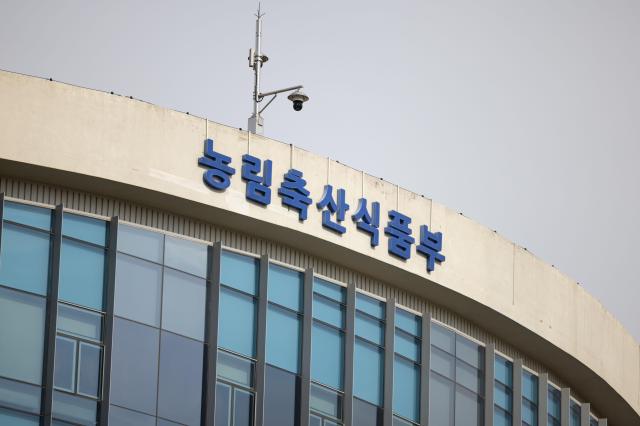
Ministry of Agriculture, Food and Rural Affairs in Sejong City. [Photo by Yu Dae-gil]
The South Korean government is expanding its reserves of key agricultural products and enhancing crop monitoring in preparation for summer weather extremes, including heatwaves and heavy rainfall.
The Ministry of Agriculture, Food and Rural Affairs announced on June 19 that it held the 4th Agricultural Supply Adjustment Committee at the aT Center in Yangjae-dong, Seoul.
The Agricultural Supply Adjustment Committee operates under the Ministry's advisory framework, as stipulated by the Enforcement Rules of the Act on Distribution and Price Stabilization of Agricultural and Fishery Products. It includes participants from producers, consumers, academia, and government officials to discuss major agricultural supply policies.
During the meeting, revisions to the agricultural supply management guidelines and key measures for stabilizing agricultural supplies were reviewed.
To enhance the effectiveness of the guidelines, the ministry updates the crisis price benchmarks for each product annually, reflecting average prices, management costs, and shipping expenses. Following the advisory opinions presented during the meeting, the ministry plans to revise the guidelines and periodically review their appropriateness.
Additionally, in anticipation of abnormal weather conditions such as summer heatwaves and heavy rains, the ministry will increase reserves of key agricultural products and strengthen crop management through the operation of a related monitoring committee. Currently, the ministry has stockpiled 34,000 tons of napa cabbage and radishes in response to decreased shipments due to recent rainy weather, with plans to further increase these reserves.
The ministry also intends to provide support for agricultural chemicals and materials to combat bacterial plant diseases, such as rot, that proliferate during the rainy season.
Park Jeong-hoon, head of the Food Policy Bureau at the Ministry of Agriculture, stated, "We will implement rational supply management policies based on the opinions of stakeholders, including producers and consumers, and ensure that there are no disruptions in the supply of key agricultural products during the summer."
The Ministry of Agriculture, Food and Rural Affairs announced on June 19 that it held the 4th Agricultural Supply Adjustment Committee at the aT Center in Yangjae-dong, Seoul.
The Agricultural Supply Adjustment Committee operates under the Ministry's advisory framework, as stipulated by the Enforcement Rules of the Act on Distribution and Price Stabilization of Agricultural and Fishery Products. It includes participants from producers, consumers, academia, and government officials to discuss major agricultural supply policies.
During the meeting, revisions to the agricultural supply management guidelines and key measures for stabilizing agricultural supplies were reviewed.
To enhance the effectiveness of the guidelines, the ministry updates the crisis price benchmarks for each product annually, reflecting average prices, management costs, and shipping expenses. Following the advisory opinions presented during the meeting, the ministry plans to revise the guidelines and periodically review their appropriateness.
Additionally, in anticipation of abnormal weather conditions such as summer heatwaves and heavy rains, the ministry will increase reserves of key agricultural products and strengthen crop management through the operation of a related monitoring committee. Currently, the ministry has stockpiled 34,000 tons of napa cabbage and radishes in response to decreased shipments due to recent rainy weather, with plans to further increase these reserves.
The ministry also intends to provide support for agricultural chemicals and materials to combat bacterial plant diseases, such as rot, that proliferate during the rainy season.
Park Jeong-hoon, head of the Food Policy Bureau at the Ministry of Agriculture, stated, "We will implement rational supply management policies based on the opinions of stakeholders, including producers and consumers, and ensure that there are no disruptions in the supply of key agricultural products during the summer."
* This article has been translated by AI.
Copyright ⓒ Aju Press All rights reserved.