

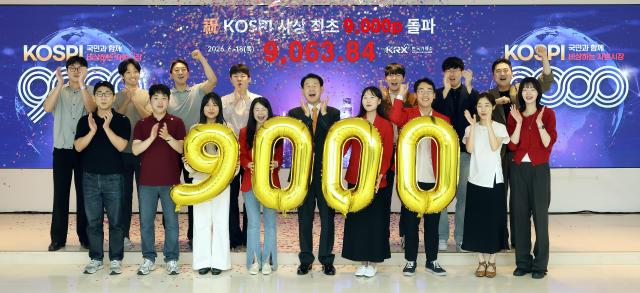
The KOSPI has surpassed the 9000 mark for the first time in history, and next week, the domestic stock market is expected to explore its direction amid semiconductor performance momentum, U.S. inflation indicators, and the MSCI market classification review results. While investor sentiment has improved due to reduced geopolitical risks between the U.S. and Iran, the focus is shifting back to earnings and inflation as the Federal Reserve's hawkish stance has been confirmed.
According to the Korea Exchange on June 20, the KOSPI closed at 9052.42, down 11.42 points (0.13%) from the previous trading day. Over the week from June 15 to 19, the KOSPI rose by 11.43%, while the KOSDAQ fell by 6.07%. The KOSPI broke the 9000 mark for the first time on June 18 and briefly exceeded 9300 during trading on June 19, continuing its strong upward trend.
This week, large-cap semiconductor stocks led the domestic market's rise. The signing of a memorandum of understanding (MOU) to end hostilities between the U.S. and Iran eased geopolitical risks in the Middle East, stabilizing international oil prices and market interest rates. Foreign investors resumed net buying, focusing on major semiconductor stocks like SK Hynix and Samsung Electronics. Although the Federal Open Market Committee (FOMC) hinted at the possibility of interest rate hikes later this year, strong earnings expectations offset this concern, allowing the KOSPI to surpass 9000.
In contrast, the KOSDAQ continued to struggle due to a withdrawal of individual investors, lack of profit improvement expectations, and interest rate pressures.
Next week, several significant global events are scheduled. The BIO USA conference will take place from June 22 to 25, likely impacting investor sentiment in the domestic biotech sector. On June 23, the MSCI annual market classification review will be announced. If Korea is included as a candidate for the developed markets index, expectations for long-term valuation improvements may rise. On June 25, Micron Technology's earnings report and the U.S. Personal Consumption Expenditures (PCE) price index for May will be released, serving as indicators for the semiconductor industry and the Fed's monetary policy outlook.
Lee Jae-won, a researcher at Yuanta Securities, stated, "Next week, the key focus will be Micron's earnings report, which will be released early on June 25, Korean time. With the FOMC and geopolitical risks having been digested, the market's attention is expected to shift back to second-quarter earnings and the potential for upward revisions in earnings per share (EPS)." He added, "If semiconductor exports remain strong and memory prices rise, along with improvements in KOSPI EPS, the index's lower bound could be established at a higher level than before."
Market analysts suggest that a differentiated market focusing on sectors with confirmed earnings is likely to continue for the time being. Although the predictability of the Fed's policies has decreased following the FOMC, assessments indicate that the likelihood of consecutive interest rate hikes is limited. Consequently, preference for sectors with clear earnings momentum, such as semiconductors and IT hardware, is expected to persist.
Na Jeong-hwan, a researcher at NH Investment & Securities, noted, "Being designated as a candidate for observation does not immediately lead to capital inflows or outflows, but expectations for valuation re-rating due to potential inclusion in the developed markets index could positively influence stock prices. While the uncertainty surrounding interest rates may increase volatility after the FOMC, the onset of the second-quarter earnings season is likely to result in stock price differentiation centered on sectors with solid earnings."
* This article has been translated by AI.
Copyright ⓒ Aju Press All rights reserved.