

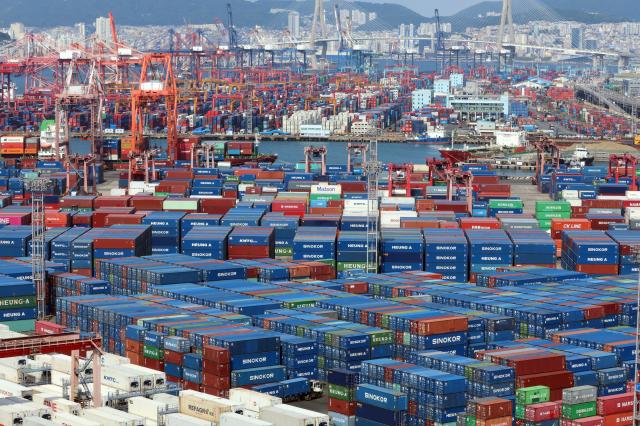
Containers stacked at Busan Port's Sinseondae and Gamman docks. [Photo=Yonhap News]
While exports and production are rebounding rapidly, particularly in the semiconductor sector, the job market is not feeling the benefits. The surge in semiconductor exports, driven by the rise of artificial intelligence (AI), is boosting South Korea's economic growth indicators. However, youth employment and jobs in the manufacturing sector are declining, raising concerns about a 'semiconductor illusion' where export recovery does not translate into improved employment conditions.
◆Exports Surge 53.4% While Employment Drops, Especially Among Youth
On June 21, the Korea Customs Service released confirmed data for May, showing that exports increased by 53.4% year-on-year to reach $87.8 billion. Imports rose by 20.7% to $60.8 billion, resulting in a trade surplus of $27 billion. Exports have now increased for 12 consecutive months, and the trade balance has been in surplus for 16 months.
The primary driver of this export growth was semiconductors, which saw a staggering 167.7% increase compared to the same month last year. While exports of petroleum products, ships, and wireless communication devices also rose, semiconductors led the overall recovery. This surge is attributed to the growing demand for AI servers and high-bandwidth memory (HBM).
In contrast to these positive export figures, the job market is cooling rapidly. According to employment trends released by the National Data Agency, the number of employed individuals aged 15 and older fell by 40,000 in May compared to the same month last year, totaling 29.12 million. This marks the first decline in employment since December 2024. The employment rate for those aged 15 and older dropped by 0.5 percentage points to 63.3%.
The impact on youth employment is particularly pronounced. The number of employed individuals aged 15 to 29 decreased by 255,000 compared to a year ago, with the employment rate falling by 2.4 percentage points to 43.8%. Employment in the manufacturing sector, which has a significant share of the job market, also declined by 140,000, exacerbating the overall weakness in employment.
◆Capital-Intensive Semiconductor Sector Grows Alone, Leading to Jobless Growth
Despite strong export performance, the sluggish job market can be attributed to the structural characteristics of the semiconductor industry. While semiconductors are a cornerstone of South Korea's exports, they are also a capital-intensive industry. The reliance on large-scale capital investment and automated processes limits the extent to which increased production and exports lead to job growth.
Typically, the employment generation coefficient for semiconductors is about two jobs per 1 billion won in final demand. A lower coefficient indicates a smaller impact on employment relative to growth. The semiconductor sector's employment generation coefficient is lower than the average for all industries and manufacturing. The National Data Agency estimates that semiconductors account for about 4% of total manufacturing employment.
The expansion of semiconductor production capacity is further widening the gap between growth and employment. According to analysis from the National Statistical Portal (KOSIS), the semiconductor manufacturing capacity index (2020=100) reached 194.5 last month, an 11.3% increase from a year earlier, marking over a 90% increase in production capacity over the past five years.
In contrast, the production capacity of non-semiconductor manufacturing has weakened. The overall manufacturing capacity index stands at 104.8, showing minimal growth. The other machinery and equipment manufacturing sector, which employs the most workers, has seen a decline to 89.4. The automotive and trailer manufacturing sector is at 111.4, and shipbuilding is at 105.1, indicating a significant gap compared to semiconductors. Thus, while semiconductors are experiencing growth, traditional manufacturing sectors, which have a larger employment impact, are stagnating or contracting.
This industrial polarization raises concerns about jobless growth. The government is closely monitoring the potential for increased employment shocks during the industrial transition. As the shift towards AI and eco-friendly practices accelerates, the demand for labor across industries is bound to change. The decline in youth employment further heightens these concerns.
The government is working on measures to address youth employment based on the Youth New Deal initiative. This includes providing job training, work experience, and support for re-entering the workforce to 100,000 young people. A new 'K-New Deal Academy' will be established for 10,000 individuals, focusing on job training in high-demand sectors such as AI, semiconductors, finance, and content creation.
On June 19, Deputy Prime Minister and Minister of Economy and Finance Ku Yun-cheol stated during an emergency economic meeting, "We will sequentially prepare and announce sector-specific response measures, including a 'Youth Job Recovery Plan,' based on a thorough analysis of struggling sectors such as manufacturing, construction, and agriculture, as well as vulnerable groups like youth. We will expedite the implementation of previously announced Youth New Deal initiatives and expand projects that show sufficient demand and high performance."
◆Exports Surge 53.4% While Employment Drops, Especially Among Youth
On June 21, the Korea Customs Service released confirmed data for May, showing that exports increased by 53.4% year-on-year to reach $87.8 billion. Imports rose by 20.7% to $60.8 billion, resulting in a trade surplus of $27 billion. Exports have now increased for 12 consecutive months, and the trade balance has been in surplus for 16 months.
The primary driver of this export growth was semiconductors, which saw a staggering 167.7% increase compared to the same month last year. While exports of petroleum products, ships, and wireless communication devices also rose, semiconductors led the overall recovery. This surge is attributed to the growing demand for AI servers and high-bandwidth memory (HBM).
In contrast to these positive export figures, the job market is cooling rapidly. According to employment trends released by the National Data Agency, the number of employed individuals aged 15 and older fell by 40,000 in May compared to the same month last year, totaling 29.12 million. This marks the first decline in employment since December 2024. The employment rate for those aged 15 and older dropped by 0.5 percentage points to 63.3%.
The impact on youth employment is particularly pronounced. The number of employed individuals aged 15 to 29 decreased by 255,000 compared to a year ago, with the employment rate falling by 2.4 percentage points to 43.8%. Employment in the manufacturing sector, which has a significant share of the job market, also declined by 140,000, exacerbating the overall weakness in employment.
◆Capital-Intensive Semiconductor Sector Grows Alone, Leading to Jobless Growth
Despite strong export performance, the sluggish job market can be attributed to the structural characteristics of the semiconductor industry. While semiconductors are a cornerstone of South Korea's exports, they are also a capital-intensive industry. The reliance on large-scale capital investment and automated processes limits the extent to which increased production and exports lead to job growth.
Typically, the employment generation coefficient for semiconductors is about two jobs per 1 billion won in final demand. A lower coefficient indicates a smaller impact on employment relative to growth. The semiconductor sector's employment generation coefficient is lower than the average for all industries and manufacturing. The National Data Agency estimates that semiconductors account for about 4% of total manufacturing employment.
The expansion of semiconductor production capacity is further widening the gap between growth and employment. According to analysis from the National Statistical Portal (KOSIS), the semiconductor manufacturing capacity index (2020=100) reached 194.5 last month, an 11.3% increase from a year earlier, marking over a 90% increase in production capacity over the past five years.
In contrast, the production capacity of non-semiconductor manufacturing has weakened. The overall manufacturing capacity index stands at 104.8, showing minimal growth. The other machinery and equipment manufacturing sector, which employs the most workers, has seen a decline to 89.4. The automotive and trailer manufacturing sector is at 111.4, and shipbuilding is at 105.1, indicating a significant gap compared to semiconductors. Thus, while semiconductors are experiencing growth, traditional manufacturing sectors, which have a larger employment impact, are stagnating or contracting.
This industrial polarization raises concerns about jobless growth. The government is closely monitoring the potential for increased employment shocks during the industrial transition. As the shift towards AI and eco-friendly practices accelerates, the demand for labor across industries is bound to change. The decline in youth employment further heightens these concerns.
The government is working on measures to address youth employment based on the Youth New Deal initiative. This includes providing job training, work experience, and support for re-entering the workforce to 100,000 young people. A new 'K-New Deal Academy' will be established for 10,000 individuals, focusing on job training in high-demand sectors such as AI, semiconductors, finance, and content creation.
On June 19, Deputy Prime Minister and Minister of Economy and Finance Ku Yun-cheol stated during an emergency economic meeting, "We will sequentially prepare and announce sector-specific response measures, including a 'Youth Job Recovery Plan,' based on a thorough analysis of struggling sectors such as manufacturing, construction, and agriculture, as well as vulnerable groups like youth. We will expedite the implementation of previously announced Youth New Deal initiatives and expand projects that show sufficient demand and high performance."
* This article has been translated by AI.
Copyright ⓒ Aju Press All rights reserved.