

According to Kyodo News on June 20, a Ukrainian defense intelligence official stated that the impact error range of these missiles, which was at least 1 kilometer in 2024, has narrowed to between 1 and 5 meters as of April this year.
The official suggested that Russia may have enhanced these weapons based on data collected from the battlefield.
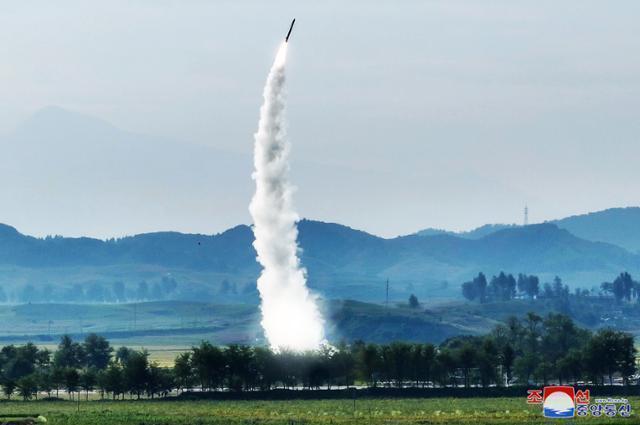
The missiles identified as having improved accuracy include the KN-23, which is similar to Russia's Iskander, and the KN-24, which resembles the U.S. Army Tactical Missile System (ATACMS).
In North Korea, these missiles are referred to as 'Hwasong-11a' and 'Hwasong-11b.' They are characterized by their rapid launch capability and ability to fly on irregular trajectories.
Military experts believe that improvements in the quality of the inertial navigation systems used for missile guidance may have contributed to the enhanced accuracy.
North Korean short-range ballistic missiles have been actively deployed on the Ukrainian battlefield since early 2024. Initially, their error range was between 1 and 3 kilometers, with many missiles exploding in mid-air before reaching their targets.
In the first half of 2024, Ukrainian authorities analyzed missile debris and reported that the quality of the North Korean missiles launched by Russia was very low, with a hit rate of only about 20%.
Kyodo News reported that at least 100 KN-23 and KN-24 missiles have been used in Ukraine, resulting in approximately 170 casualties.
Since Russia's full-scale invasion of Ukraine in February 2022, North Korea has strengthened military cooperation with Russia by supplying various weapons. North Korea has also been conducting repeated missile test launches over the East Sea.
This analysis highlights that as North Korea continues to advance its nuclear and missile programs, the deepening defense cooperation between North Korea and Russia poses a serious threat to security in East Asia.
* This article has been translated by AI.
Copyright ⓒ Aju Press All rights reserved.