

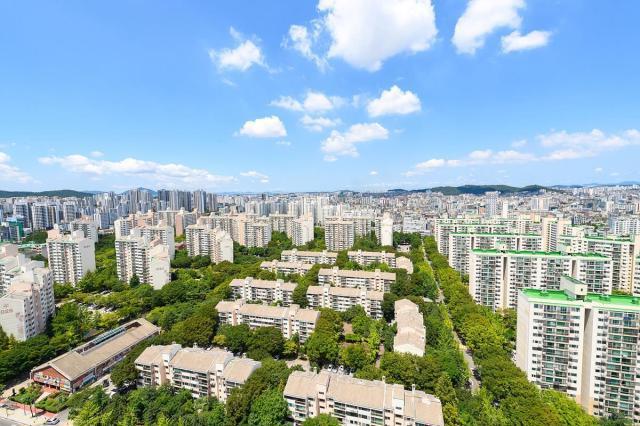
As the Mokdong reconstruction project in Yangcheon District accelerates, there is growing interest in how the anticipated relocation of over 26,000 households will impact the surrounding housing market. Experts predict that if there is a shortage of jeonse (long-term rental) apartments in the area, demand may spill over into mixed-use developments and officetels, potentially driving up prices.
According to the construction industry on June 21, the large-scale relocation is expected to begin around 2027-2028, considering the pace of the Mokdong New Town apartment project. The total number of units targeted for reconstruction is 26,629, which will transform into a residential complex equivalent to a "mini new town" with approximately 47,000 units upon completion.
Of the 14 complexes in the Mokdong New Town project, eight have completed the designation of project implementers through a trust method. Among those pursuing a cooperative method, complexes 4, 8, and 12 have received approval for their establishment, while complexes 3 and 7 are in the process of forming a promotion committee.
The fastest-moving project is Mokdong Complex 6, which became the first among the 14 complexes to pass the integrated review by the Seoul city government last month and is set to hold a general meeting for contractor selection next month.
Market analysts believe that the large-scale relocation demand will initially flow into the jeonse market for apartments in Mokdong and Shinjeong-dong. However, they note that Mokdong has a limited supply of new apartments, with many older complexes built in the 1980s, making it challenging to absorb all the rental demand.
Nearby new complexes include Mokdong Hillstate and Raemian Mokdong Adelic. In contrast, Mokdong Daelim Apartments and Mokdong Lotte Castle Winner are over 20 years old. Industry experts warn that if relocation demand concentrates in these areas, there could be significant upward pressure on jeonse prices.
Demand may also spread to the broader southwestern areas of Seoul, including Gangseo District's Hwagok, Deungchon, and Gayang-dong, as well as Yeongdeungpo and Guro districts.
Particularly, if there is a shortage of jeonse apartments in the vicinity, mixed-use developments and officetels such as Hyundai Hyperion, Trapalace, and Paragon may gain attention as alternative housing options. This influx of prospective residents seeking good school districts and essential amenities could lead to simultaneous increases in both rental and sale prices.
Mokdong Paragon is a large officetel with 700 units, featuring a structure similar to apartments. According to the Ministry of Land, Infrastructure and Transport's real transaction disclosure system, a unit with a floor area of 95 square meters was sold for 1.85 billion won (approximately $1.4 million) in March, marking a record high.
Mokdong Hyundai Hyperion is another prominent residential mixed-use development, completed in 2003, with current market prices ranging from 1.7 billion to 1.8 billion won. Mokdong Trapalace, built in 2009 by Samsung C&T, also saw a unit with a floor area of 124.94 square meters sell for over 3.1 billion won last December.
However, there are clear limitations to mixed-use developments and officetels. While typical apartments have a usable area ratio of around 80%, mixed-use developments range from 70% to 75%, and officetels only offer 40% to 50%. Thus, even with the same supply area, the actual usable space is relatively smaller. Additionally, these properties are often located in prime areas, leading to higher land costs and, consequently, elevated sale and rental prices.
Song Seung-hyun, CEO of Urban and Economic Research, stated, "As the Mokdong reconstruction relocation begins in earnest, there could be a short-term rental crisis, and the pressure on rental prices may spread beyond Mokdong and Shinjeong-dong to areas like Gangseo, Yeongdeungpo, and Guro." He also noted that mixed-use developments and officetels could see price increases due to the influx of alternative housing demand, but the market impact will vary depending on the timing of relocations and the scale of new housing supply.
In response to the potential market shock from the large-scale relocations, Yangcheon District has initiated measures to minimize disruptions. On June 16, the district held a report meeting to kick off a study on stabilizing the Mokdong apartment reconstruction relocation plan, analyzing the relocation demand and its effects on the housing market.
Yangcheon District plans to review the current residency status by complex, the expected relocation volume by year, and the market impacts of concentrated relocations to develop stable housing transition strategies. A district official stated, "We are currently in the initial phase, comprehensively analyzing the scale and timing of relocations and market impacts. A mid-term report will be presented in September, with final results expected by the end of the year."
* This article has been translated by AI.
Copyright ⓒ Aju Press All rights reserved.