

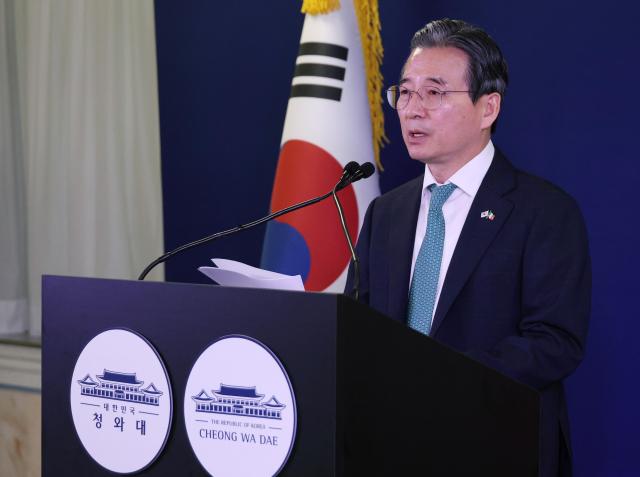
Kim Yong-beom, Chief Policy Officer of the Blue House [Photo=Yonhap News]
The People's Power Party launched a fierce attack on Kim Yong-beom, the Chief Policy Officer of the Blue House, on June 21 for reiterating calls for the normalization of real estate taxation. Jung Jeom-sik, the party's floor leader, argued that Kim should be dismissed, while Choi Bo-yun, the party's chief spokesperson, accused him of inciting real estate speculation.
In a Facebook post, Jung stated, "We must dismiss Kim, who has repeatedly made outrageous claims like 'high interest rates, high exchange rates, and high prices are the costs of success,' and who, immediately after the election, hinted at increases in property and capital gains taxes, causing confusion among the public."
Choi also criticized Kim for revealing his "true colors" regarding tax increases in a Facebook post the previous day. He called for Kim to take responsibility for past policy failures and arrogant statements by resigning.
"His clever wordplay only disguises the essence of a tax increase aimed at the public's wallets," Choi said, adding that Kim's approach is an arrogant attempt to wield regulatory power. He further noted that the market and the public interpreted Kim's comments as a guideline for investment prospects, suggesting that money would flow into preferred real estate areas once performance bonuses and export payments are released in the second half of the year, accusing Kim of acting as a catalyst for real estate speculation.
Choi pointed out that the fundamental reason for rising housing prices is the government's failure to supply adequate housing, stating, "Is there no basic economic understanding that prices rise when there is a lack of supply? What the public wants is not a tax burden but a place to live."
Choi Eun-seok, the party's senior spokesperson, also weighed in, mentioning that Kim had posted 37 messages on Facebook over the past four months. He remarked, "The top official responsible for South Korea's economic policy has essentially been engrossed in Facebook politics every three days." Choi questioned why a policy chief who repeatedly disrupts the market and stirs social controversy remains in his position, emphasizing that Kim should resign.
In response, the Democratic Party accused the People's Power Party of squandering opportunities for economic advancement. Park Ji-hye, the party's spokesperson, stated in a written briefing, "The People's Power Party has been consistent in distorting and criticizing Kim's message," arguing that it is the government's duty to work towards stabilizing the market through reasonable adjustments to property and capital gains taxes.
She added, "Now is not the time for baseless attacks that divide public opinion, but rather a time for both parties to collaborate on policy alternatives that can turn the fruits of growth into hope for small business owners and ordinary citizens. The Democratic Party will focus on seeking recovery measures for people's livelihoods in cooperation with the government."
Meanwhile, Kim, in a Facebook post the previous day, analyzed that consumer spending on luxury goods could revive in the second half of the year, and that buying sentiment for real estate in preferred areas might begin to stir again. He emphasized the need for normalizing real estate taxation through adjustments to property and capital gains taxes.
He also warned that if the wealth generated by the semiconductor industry is absorbed into real estate windfalls, and if the benefits of growth are concentrated in a few, the economic boom will not last long. He suggested that connecting this wealth to youth, vulnerable groups, and future industries could serve as a starting point for South Korea's economy to emerge from a low-growth tunnel.
In a Facebook post, Jung stated, "We must dismiss Kim, who has repeatedly made outrageous claims like 'high interest rates, high exchange rates, and high prices are the costs of success,' and who, immediately after the election, hinted at increases in property and capital gains taxes, causing confusion among the public."
Choi also criticized Kim for revealing his "true colors" regarding tax increases in a Facebook post the previous day. He called for Kim to take responsibility for past policy failures and arrogant statements by resigning.
"His clever wordplay only disguises the essence of a tax increase aimed at the public's wallets," Choi said, adding that Kim's approach is an arrogant attempt to wield regulatory power. He further noted that the market and the public interpreted Kim's comments as a guideline for investment prospects, suggesting that money would flow into preferred real estate areas once performance bonuses and export payments are released in the second half of the year, accusing Kim of acting as a catalyst for real estate speculation.
Choi pointed out that the fundamental reason for rising housing prices is the government's failure to supply adequate housing, stating, "Is there no basic economic understanding that prices rise when there is a lack of supply? What the public wants is not a tax burden but a place to live."
Choi Eun-seok, the party's senior spokesperson, also weighed in, mentioning that Kim had posted 37 messages on Facebook over the past four months. He remarked, "The top official responsible for South Korea's economic policy has essentially been engrossed in Facebook politics every three days." Choi questioned why a policy chief who repeatedly disrupts the market and stirs social controversy remains in his position, emphasizing that Kim should resign.
In response, the Democratic Party accused the People's Power Party of squandering opportunities for economic advancement. Park Ji-hye, the party's spokesperson, stated in a written briefing, "The People's Power Party has been consistent in distorting and criticizing Kim's message," arguing that it is the government's duty to work towards stabilizing the market through reasonable adjustments to property and capital gains taxes.
She added, "Now is not the time for baseless attacks that divide public opinion, but rather a time for both parties to collaborate on policy alternatives that can turn the fruits of growth into hope for small business owners and ordinary citizens. The Democratic Party will focus on seeking recovery measures for people's livelihoods in cooperation with the government."
Meanwhile, Kim, in a Facebook post the previous day, analyzed that consumer spending on luxury goods could revive in the second half of the year, and that buying sentiment for real estate in preferred areas might begin to stir again. He emphasized the need for normalizing real estate taxation through adjustments to property and capital gains taxes.
He also warned that if the wealth generated by the semiconductor industry is absorbed into real estate windfalls, and if the benefits of growth are concentrated in a few, the economic boom will not last long. He suggested that connecting this wealth to youth, vulnerable groups, and future industries could serve as a starting point for South Korea's economy to emerge from a low-growth tunnel.
* This article has been translated by AI.
Copyright ⓒ Aju Press All rights reserved.