

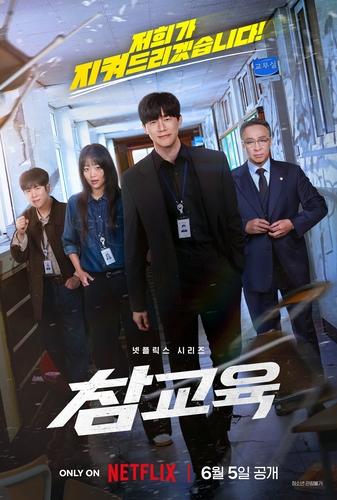
The Netflix drama 'True Education' has ignited a heated debate across online communities and social media. The series, which provocatively addresses real issues in education such as school violence, infringement of educational rights, and malicious complaints, has garnered significant attention since its release. Viewers are divided, with some praising it for its "refreshing and satisfying" narrative, while others criticize it for "packaging violence as education."
'True Education' is based on a webtoon of the same name and depicts a fictional organization, the Educational Rights Protection Bureau, sending inspectors to schools to rectify a failing education system. The story features students who bully others, parents who infringe on teachers' rights, and teachers who engage in inappropriate behavior, with inspectors meting out harsh punishments.
Central to the controversy are scenes where teachers violently subdue students or take matters into their own hands. Some viewers have reacted positively, feeling that the drama addresses frustrations they experience in real life. Victims of school violence and those concerned about educational rights have expressed that it is "satisfying to see those who are not punished in reality face consequences in the drama."
Comments on online forums include sentiments like, "Teachers today feel powerless in schools," and "The drama reflects a reality where bullies are protected while victims and teachers suffer." Others noted, "While it’s a fantasy, I understand why people are excited about it." Some argue that the violent scenes should be viewed in light of the frustrations that led to such reactions.
However, there is also significant criticism. Some viewers warn that even in a drama, consuming scenes of students being hit can be dangerous. They argue that solving educational issues through violence only perpetuates further violence, stating, "Anger over school violence does not justify corporal punishment or physical retribution." Critics assert that while the drama touches on real issues, it oversimplifies potential solutions.
This controversy extends beyond the show's content, reflecting broader discussions about educational rights and school violence. In recent years, teachers have reported struggles with malicious complaints, child abuse allegations, and classroom disruptions, leading to increased societal awareness of the need to protect educational rights. Analysts suggest that these real-world issues contribute to the popularity of 'True Education.'
Many online commenters argue that the drama should not be dismissed as exaggerated but rather examined for why such fantasies resonate with viewers. One user pointed out, "If victims of school violence were adequately protected and teachers could conduct their duties without fear, would this drama have gained such attention?" Another noted, "While the violent scenes are uncomfortable, they reflect the frustrations with the current system."
Conversely, those with opposing views express concern over the show's provocative approach. They argue that addressing real issues does not justify violent solutions, emphasizing that while restoring educational rights is necessary, returning to corporal punishment is a separate issue. They caution against the prevailing atmosphere that accepts dramatic scenes as real solutions.
Supporters of the show argue that 'True Education' should be viewed as genre fantasy rather than a realistic educational solution. They contend that the drama serves to alleviate viewer frustrations through action and retribution, not as a call to allow violence in schools. They assert, "Just as crime films do not endorse crime, the punitive scenes in the drama should be distinguished from reality."
On the other hand, critics argue that the more sensitive the subject matter, the more careful the portrayal should be. Given the complexities involving victims of school violence, teachers, students, and parents, emphasizing sensational catharsis can distort the discussion. Comments like, "School issues cannot be simplified into good versus evil, yet the drama presents solutions too easily," reflect this concern.
Ultimately, the debate surrounding 'True Education' reveals the complex emotions society holds regarding educational issues. On one side is the anger over the erosion of educational rights and recurring school violence, while on the other is the concern that violent solutions may create further problems. This divergence in viewer reactions to the same scenes illustrates the complexity of the issue.
Regardless of expert interpretations, a common point among online opinions is the general agreement that there are significant problems in today's educational environment. However, opinions diverge on whether the solutions should focus on harsh punishment and retribution or on institutional protection and restorative education.
This controversy is significant not only for the drama's popularity but also for the attention it has drawn to real educational issues. The impactful scenes in 'True Education' have left a strong impression on viewers while simultaneously raising questions about the essence of education. As calls to protect educational rights clash with warnings against violence, the debate surrounding the show is likely to continue for some time.
Ultimately, it is crucial to avoid mistaking the fantasy presented in the drama for real solutions. While school violence and infringement of educational rights are pressing issues that must be addressed, the methods of resolution should be safe, fair, and sustainable. The 'True Education' phenomenon serves as a catalyst for society to reconsider how to navigate conflicts within the educational landscape.
* This article has been translated by AI.
Copyright ⓒ Aju Press All rights reserved.