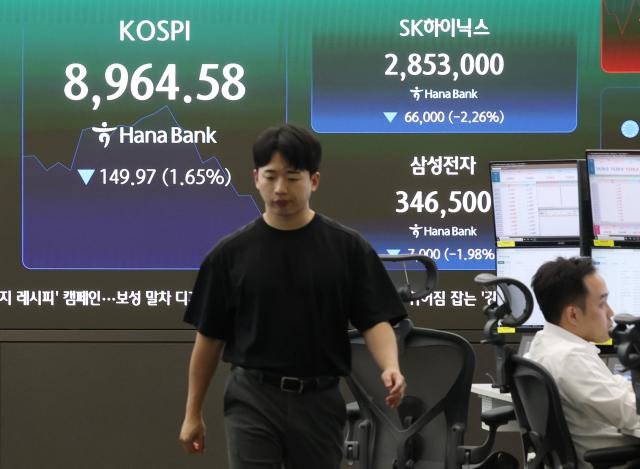
SEOUL, June 23 (AJP) — South Korean stocks succumbed to foreign-led profit-taking Tuesday, pushing the benchmark KOSPI back below the 9,000 mark and sending the won toward 1,540 per dollar, as a broad correction in artificial intelligence stocks spread across Wall Street and Asia.
As of 9:56 a.m., the benchmark KOSPI fell 1.73 percent to 8,957.02, while the junior KOSDAQ sank 3.40 percent to 935.47. The correction followed a record-setting streak in Seoul that had propelled the KOSPI to successive all-time highs, though the pullback was milder in Tokyo, where the Nikkei 225 edged down 0.16 percent to 72,237.85.
The battle for market leadership has become one of the market's defining investment themes after SK hynix overtook Samsung Electronics in common-share market capitalization to become the KOSPI's largest listed company, marking the first change at the top in 25 years. Analysts said the shift reflects how aggressively investors have embraced the memory-chip maker's dominance in AI-related products.
Yet the rivalry has also exposed the bellwether stocks to profit-taking. Both chipmakers came under pressure as investors locked in gains following the recent AI-fueled rally and turned cautious after overnight weakness in U.S. technology shares. SK hynix fell 1.78 percent to 2,867,000 won, while Samsung Electronics slid 2.97 percent to 343,000 won.
SK Group affiliates remained relatively resilient. SK Square rose 6.95 percent to 2,107,000 won, underscoring continued optimism surrounding AI and semiconductor-related businesses despite the broader market selloff.
Samsung affiliates traded mixed. Samsung Life Insurance jumped 6.10 percent to 478,000 won, while Samsung C&T gained 1.73 percent to 529,000 won and Samsung Biologics rose 1.93 percent to 1,320,000 won. In contrast, Samsung Electronics preferred shares fell 1.56 percent to 220,500 won and Samsung Electro-Mechanics tumbled 6.33 percent to 2,087,000 won.
LG Energy Solution edged up 0.52 percent to 387,500 won, while automakers came under pressure. Hyundai Motor fell 5.68 percent to 548,000 won and Kia lost 3.43 percent to 146,200 won. HD Hyundai Heavy Industries slipped 2.36 percent to 621,000 won, while Doosan Enerbility rose 1.70 percent to 95,800 won.
Financial shares bucked the broader downturn, with KB Financial Group gaining 2.99 percent to 161,700 won.
Losses were broad-based on the KOSDAQ, with secondary battery and growth stocks leading the decline.
EcoPro BM fell 5.58 percent to 157,400 won, while Rainbow Robotics dropped 6.98 percent to 533,000 won. Jusung Engineering slid 5.36 percent, Wonik IPS lost 5.97 percent and EO Technics fell 4.54 percent as investors reduced exposure to high-growth technology names.
The weakness followed a mixed session on Wall Street, where investors rotated out of mega-cap technology shares amid concerns over higher interest rates and growing skepticism over the pace of AI spending.
The Nasdaq Composite fell 1.33 percent overnight, while the S&P 500 slipped 0.37 percent. The Dow Jones Industrial Average, however, rose 0.29 percent as investors shifted toward value stocks and sectors expected to benefit from easing geopolitical risks and lower oil prices.
The retreat in technology shares was led by SpaceX, which plunged more than 16 percent after announcing plans to issue $20 billion worth of investment-grade bonds to finance its AI infrastructure expansion. Alphabet also declined after reports that a senior Google DeepMind executive would leave for rival Anthropic. Meta, Amazon and Microsoft also fell as investors questioned whether the billions of dollars being poured into AI infrastructure can be sustained.
Oil prices remained soft as geopolitical tensions eased after the United States and Iran reportedly made progress in follow-up negotiations to implement their ceasefire agreement.
Brent crude futures fell more than 3 percent overnight, while U.S. West Texas Intermediate crude also declined as investors dialed back fears of supply disruptions in the Middle East.
The market instead turned wary over the U.S. interest-rate outlook.
Bank of America said overnight that the Federal Reserve could raise interest rates by 25 basis points each in September, October and December, a view that pushed Treasury yields higher and strengthened the dollar. The greenback traded at 1,539.40 won, up from the previous session's close of 1,537.0 won.
Market participants said the tug-of-war between foreign profit-taking and domestic AI optimism is likely to define trading in the coming sessions, with investors closely watching several key events this week.
Investors are also looking ahead to Micron Technology's quarterly earnings and guidance due on June 25, which could provide fresh clues about the sustainability of the AI-driven memory-chip boom and the outlook for South Korean semiconductor stocks. Meanwhile, U.S. May personal consumption expenditures inflation data will be closely watched for signals on the Federal Reserve's policy path.
Another closely watched event is MSCI's annual market classification review. Investors are hoping South Korea will be added to the watch list for developed-market status, a move that could further improve sentiment and support a re-rating of Korean equities.

Copyright ⓒ Aju Press All rights reserved.