

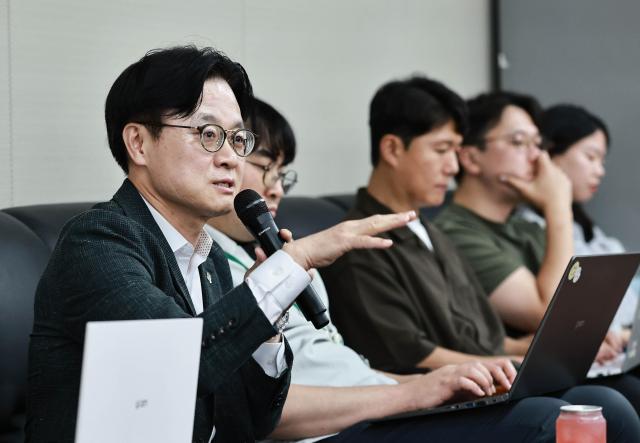
Minister of Trade, Industry and Energy Kim Jeong-kwan emphasized the need for institutional improvements regarding the ongoing bonus controversy, which has gained traction among labor and business circles. He noted that the perspective of investors is missing from the discussion. He also highlighted the necessity of utilizing the expected surplus tax revenue, estimated to be in the tens of trillions of won, for the transition to industrial artificial intelligence (M.AX).
During a meeting with reporters on June 22 at the government complex in Sejong, Kim addressed the bonus debate based on operating profit, stating, "The business community feels burdened, and personally, I believe it is not a suitable subject for dispute." He added, "In the absence of clear legal guidelines, compensation for investors should be guaranteed differently."
Previously, Samsung Electronics and its labor union agreed to establish a special management bonus funded by 10.5% of the semiconductor division's business performance as part of wage negotiations. However, shareholder groups have argued that bonuses based on operating profit violate commercial law.
In this context, Kim pointed out, "Those involved in operating profit include not only management and labor unions but also investors who took risks. While workers have their salaries guaranteed, compensation for investors should be assured differently from labor negotiations."
He further stated, "I believe discussions from the investor's perspective are necessary for those intending to invest in the future," and noted that the current discussion framework lacks room for investor participation, indicating a need for institutional enhancements.
Regarding the surplus tax revenue, Kim remarked, "If we do not proceed with M.AX, I believe no industry can sustain survival and growth." He stressed that industrial policy should focus heavily on M.AX in terms of workforce, productivity, and efficiency.
He also mentioned the need to strengthen resource security, especially in light of recent conflicts in the Middle East, stating, "One of the chronic issues is the short-term perspective, so we must develop long-term strategies for resource security."
On the topic of the maximum price system for petroleum products, he said, "We are considering when to end it. Given that current oil prices have significantly decreased, there may be reasons to lower the maximum price. However, we must also consider that recent oil prices have high premiums."
He added, "While international oil prices have fallen, the premium, which used to be around $0.50, has risen to about $20, indicating a significantly high level."
Regarding speculation about Samsung Electronics and SK Hynix investing in a new semiconductor plant in Gwangju, Kim noted, "There are two issues: the expansion of the semiconductor market and the need for new semiconductor investments. Since discussions are ongoing, I will provide updates at an appropriate time," avoiding a direct answer.
Concerning the joint exploration priority negotiations between Korea National Oil Corporation and BP for the development of the East Sea deep-sea gas field, he stated, "Concrete negotiations are underway," and emphasized the need for both parties to discuss matters to avoid repeating past mistakes. He assured that BP's exploration would proceed in a manner beneficial to national interests.
* This article has been translated by AI.
Copyright ⓒ Aju Press All rights reserved.