

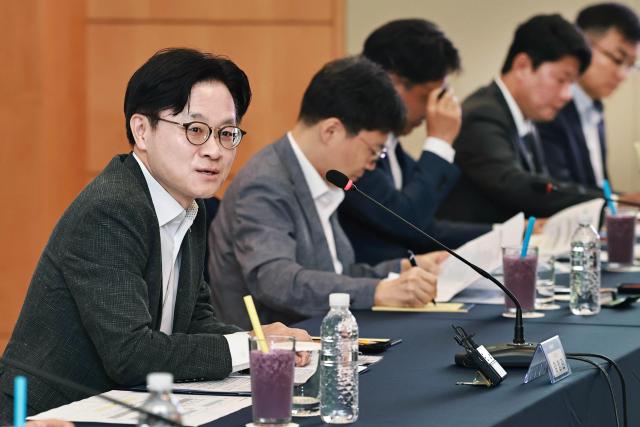
“We are hopeful as we await the result,” Kim told reporters after returning from visits to Kazakhstan, Europe and the Middle East.
South Korea’s Hanwha Ocean is competing with Germany’s ThyssenKrupp Marine Systems, or TKMS, for Canada’s plan to acquire up to 12 conventionally powered submarines.
Asked about speculation that the announcement could be delayed until July or that the contract could be divided between the Korean and German bidders, Kim said Seoul had received no official notice of any change.
“We have not received anything officially, so we are waiting until the end of June,” he said.
Kim acknowledged that South Korea could face a disadvantage if Canada places greater priority on strengthening cooperation with NATO.
Still, he said the Korean offer was stronger in other areas.
“We believe we are more competitive in terms of the submarine itself and the industrial package,” Kim said.
Hanwha Ocean is offering a version of its KSS-III submarine, while TKMS has proposed its Type 212CD platform. The multibillion-dollar program is expected to include long-term maintenance, infrastructure and industrial cooperation in addition to the vessels.
Kim also said South Korea had made progress in negotiations with the European Union over new steel import restrictions scheduled to take effect July 1.
The EU plans to reduce its overall zero-tariff steel import quota from 33.82 million tonnes to 18.35 million tonnes, a cut of about 46 percent, while raising tariffs on imports exceeding the quota from 25 percent to 50 percent.
South Korea currently holds a quota of about 2.58 million tonnes and has been negotiating to limit the reduction applied to its shipments.
“There was a consensus that even if the overall quota is reduced, ours would not be cut by the full 46 percent,” Kim said, without disclosing a final figure.
Asked whether Seoul had offered concessions in return, Kim said it had not.
“We are not giving the EU anything in particular,” he said. “We strongly argued that the measure violates the free trade agreement and that we could also take retaliatory action.”
The government plans to announce support measures for domestic steelmakers once South Korea’s final quota is confirmed.
On the first project under South Korea’s $350 billion investment pledge to the United States, Kim said the newly launched Korea-U.S. Strategic Investment Corp. was proceeding with the required procedures.
He declined to say whether a single project or several projects would be announced initially.
Kim also said South Korean companies operating in the Middle East were interested in taking part in reconstruction efforts once conditions improve.
But he said the government remained cautious about Iran because U.S. and European sanctions remain in place and negotiations involving Tehran have made limited progress.
“There is still uncertainty over what risks could arise,” Kim said, adding that the government may consider ways to support reconstruction efforts once those risks are reduced.
Kim said the government was considering when to lift the fuel price cap and whether to lower it first.
International oil prices remain elevated but have fallen from wartime levels, creating room to lower the price cap, he added.

Copyright ⓒ Aju Press All rights reserved.
