

[Source: National Data Agency]
In 2024, women produced 2.7 times more unpaid household labor than men, resulting in a surplus of 107.6 trillion won for women and a corresponding deficit of the same amount for men.
According to the National Data Agency's National Time Transfer Accounts (NTTA) released on June 23, the life-cycle deficit (consumption minus production) showed a deficit among youth, while the working-age and elderly populations recorded surpluses.
The youth group (ages 0-14) incurred a deficit of 116.6 trillion won due to high caregiving consumption. In contrast, the working-age group (ages 15-64) had consumption of 336.1 trillion won and production of 444.4 trillion won, resulting in a surplus of 108.3 trillion won. The elderly group (ages 65 and older) also showed a surplus, with consumption at 129.7 trillion won and production at 138 trillion won, yielding an 8.3 trillion won surplus.
Compared to five years ago, the youth deficit decreased by 7.5 trillion won, while surpluses for both the working-age and elderly groups also declined.
The youth deficit was covered by inter-household transfers of 9.4 trillion won and intra-household transfers of 107.3 trillion won. The working-age group experienced net outflows of 3.7 trillion won in inter-household transfers and 104.6 trillion won in intra-household transfers. The elderly also had net outflows, with 5.7 trillion won in inter-household transfers and 2.7 trillion won in intra-household transfers, largely due to caregiving for grandchildren.
Gender differences were pronounced. Men recorded a deficit of 107.6 trillion won due to higher consumption of household labor compared to production, while women had a surplus of the same amount as their production exceeded consumption.
Household labor consumption increased significantly among the working-age and elderly groups. Consumption among youth decreased by 6.0% to 116.6 trillion won compared to five years ago, while the working-age group's consumption rose by 19.4% to 336.1 trillion won. The elderly group saw a dramatic increase of 62.6%, reaching 129.7 trillion won.
The elderly's share of total household labor consumption rose by 5.8 percentage points to 22.3%, while the youth's share fell by 5.5 percentage points to 20.0%.
In terms of gender-specific consumption, men's household labor consumption reached 264.1 trillion won, a 20.5% increase from five years ago. Women's consumption rose by 19.6% to 318.3 trillion won. Men accounted for 45.4% of total consumption, while women made up 54.6%.
Household labor production increased for both the working-age and elderly groups. The working-age group's production rose by 12.1% to 444.4 trillion won, while the elderly group's production surged by 55.1% to 138 trillion won.
In terms of gender, men's household labor production increased by 35.3% to 156.6 trillion won, while women's production rose by 15.2% to 425.8 trillion won. Although men's growth rate was higher, women's production was 2.7 times that of men's.
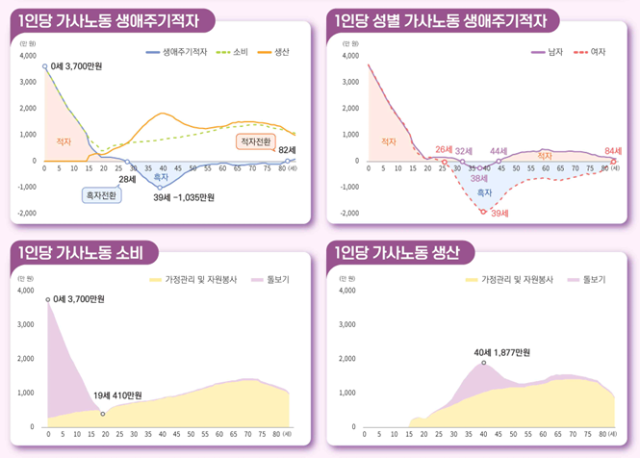
The per capita life-cycle deficit was highest at 37 million won for those aged 0. The deficit turned into a surplus at age 28, peaking at 10.35 million won at age 39, before reverting to a deficit starting at age 82.
For men, the surplus began at age 32, peaked at age 38, and turned into a deficit again at age 44, lasting only 12 years. Women transitioned to a surplus at age 26, peaked at age 39, and re-entered a deficit at age 84, enjoying a surplus period of 58 years, significantly longer than men.
The National Time Transfer Accounts measure the production, consumption, and transfers of unpaid household labor, which includes activities such as cleaning, meal preparation, and caregiving, by age and gender.
According to the National Data Agency's National Time Transfer Accounts (NTTA) released on June 23, the life-cycle deficit (consumption minus production) showed a deficit among youth, while the working-age and elderly populations recorded surpluses.
The youth group (ages 0-14) incurred a deficit of 116.6 trillion won due to high caregiving consumption. In contrast, the working-age group (ages 15-64) had consumption of 336.1 trillion won and production of 444.4 trillion won, resulting in a surplus of 108.3 trillion won. The elderly group (ages 65 and older) also showed a surplus, with consumption at 129.7 trillion won and production at 138 trillion won, yielding an 8.3 trillion won surplus.
Compared to five years ago, the youth deficit decreased by 7.5 trillion won, while surpluses for both the working-age and elderly groups also declined.
The youth deficit was covered by inter-household transfers of 9.4 trillion won and intra-household transfers of 107.3 trillion won. The working-age group experienced net outflows of 3.7 trillion won in inter-household transfers and 104.6 trillion won in intra-household transfers. The elderly also had net outflows, with 5.7 trillion won in inter-household transfers and 2.7 trillion won in intra-household transfers, largely due to caregiving for grandchildren.
Gender differences were pronounced. Men recorded a deficit of 107.6 trillion won due to higher consumption of household labor compared to production, while women had a surplus of the same amount as their production exceeded consumption.
Household labor consumption increased significantly among the working-age and elderly groups. Consumption among youth decreased by 6.0% to 116.6 trillion won compared to five years ago, while the working-age group's consumption rose by 19.4% to 336.1 trillion won. The elderly group saw a dramatic increase of 62.6%, reaching 129.7 trillion won.
The elderly's share of total household labor consumption rose by 5.8 percentage points to 22.3%, while the youth's share fell by 5.5 percentage points to 20.0%.
In terms of gender-specific consumption, men's household labor consumption reached 264.1 trillion won, a 20.5% increase from five years ago. Women's consumption rose by 19.6% to 318.3 trillion won. Men accounted for 45.4% of total consumption, while women made up 54.6%.
Household labor production increased for both the working-age and elderly groups. The working-age group's production rose by 12.1% to 444.4 trillion won, while the elderly group's production surged by 55.1% to 138 trillion won.
In terms of gender, men's household labor production increased by 35.3% to 156.6 trillion won, while women's production rose by 15.2% to 425.8 trillion won. Although men's growth rate was higher, women's production was 2.7 times that of men's.
The per capita life-cycle deficit was highest at 37 million won for those aged 0. The deficit turned into a surplus at age 28, peaking at 10.35 million won at age 39, before reverting to a deficit starting at age 82.
For men, the surplus began at age 32, peaked at age 38, and turned into a deficit again at age 44, lasting only 12 years. Women transitioned to a surplus at age 26, peaked at age 39, and re-entered a deficit at age 84, enjoying a surplus period of 58 years, significantly longer than men.
The National Time Transfer Accounts measure the production, consumption, and transfers of unpaid household labor, which includes activities such as cleaning, meal preparation, and caregiving, by age and gender.
* This article has been translated by AI.
Copyright ⓒ Aju Press All rights reserved.