

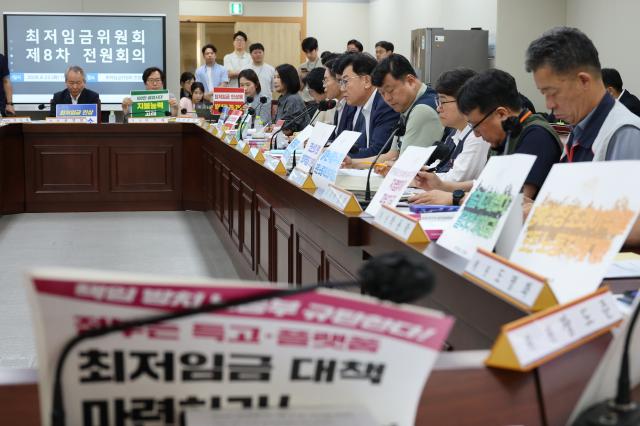
The Minimum Wage Commission convened its eighth plenary meeting on June 23 at the Government Sejong Center to begin discussions on the minimum wage level for the upcoming year.
Labor representatives are calling for an increase to 12,000 won per hour, which is 1,680 won (16.3%) higher than this year’s minimum wage of 10,320 won. This equates to a monthly wage of 2,508,000 won based on 209 working hours.
Ryu Gi-seop, Secretary-General of the Korean Trade Union Confederation (KCTU), stated, "The minimum wage is a system designed to ensure workers' living costs. We must reflect the significant decline in real wages for low-income workers due to rising inflation and energy prices."
Lee Mi-sun, Deputy Chair of the Korean Confederation of Trade Unions (KCTU), also argued, "It is difficult to manage the soaring prices of basic goods and public utilities with the current minimum wage. The demand for a minimum wage of 12,000 won is not a luxury but a necessity for survival." She emphasized that increasing workers' purchasing power is essential for revitalizing domestic consumption and local businesses.
Lee also countered claims that productivity should limit minimum wage increases, stating, "Freezing or lowering the minimum wage based on productivity contradicts the purpose of the system. The demand for 12,000 won per hour is not just for a better life but a safety net for workers' families to meet basic living needs."
Conversely, business representatives argue that increasing the minimum wage could burden the job market and small business operations.
Ryu Gi-jeong, Executive Director of the Korea Employers Federation, noted, "Over the past decade, the minimum wage has increased by 79.7%, significantly outpacing nominal wage growth and consumer price inflation. It has already reached a relatively high level."
He highlighted that in the accommodation and food service sectors, the rate of businesses paying below the minimum wage exceeds 30%, stating, "In some industries, it is already challenging to comply with the current minimum wage."
Yang Ok-seok, Head of the Human Resources Policy Division at the Korea Federation of Small and Medium Enterprises, warned, "If the minimum wage rises beyond productivity levels, it could lead to job cuts, automation, and reduced investment. Decisions must consider the realities of small businesses and self-employed individuals."
Public interest committee members urged both sides to engage in discussions based on objective data and facts. Sung Jae-min, a public interest committee member, remarked, "The minimum wage should be determined by comprehensively considering workers' living costs, wages of similar workers, labor productivity, and income distribution rates. It is necessary to share each other's reasoning and broaden the understanding through discussions."
The legal deadline for minimum wage deliberations is June 29, 90 days after the Minister of Employment and Labor requested the review. While this deadline is a guideline, it is not mandatory.
The Minimum Wage Commission plans to hold several more plenary meetings to receive revised proposals from labor and management and narrow the gap. However, as seen last year, when the minimum wage proposal was approved past the legal deadline, intense negotiations are expected to continue until the last moment this year.
* This article has been translated by AI.
Copyright ⓒ Aju Press All rights reserved.