

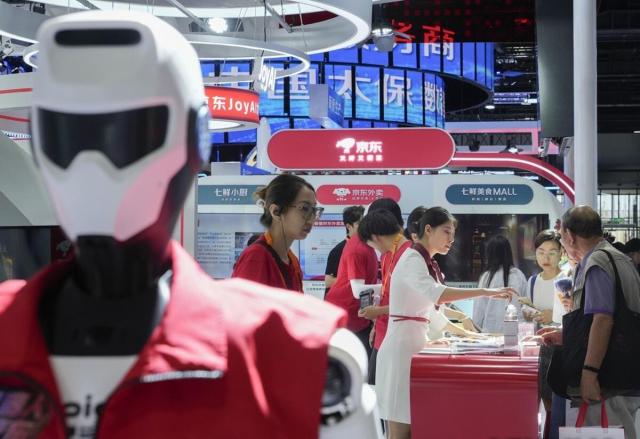
The founder of JD.com, a major Chinese e-commerce company, has predicted that 700,000 delivery workers could eventually be replaced by robots.
As concerns grow over the impact of artificial intelligence (AI) and robotics on the labor market, JD.com has announced plans to retrain its existing delivery workforce for technical roles.
According to Yonhap News on June 23, Hong Kong's Sing Tao Daily and China's Observer Network reported that Liu Qiangdong, founder and chairman of JD.com, stated at the '2026 APEC China CEO Forum' held in Beijing on June 21, "In the future, robots will handle all delivery tasks, and delivery workers will no longer be needed."
Liu projected that the 700,000 blue-collar workers currently employed by JD.com could be replaced by robots in the long term, but he also unveiled a transition plan to ensure job security for these employees.
"I do not want my 700,000 brothers to lose their jobs," he said, adding that the company plans to collaborate with over 120 schools nationwide to provide technical training for its staff. JD.com is working on transitioning delivery personnel to roles in robot maintenance and management.
Liu explained, "When machines break down, ultimately, humans must repair them," emphasizing the need to transition physical laborers working in harsh conditions to technical positions.
JD.com, often referred to as the Chinese equivalent of Coupang, has built its own logistics and delivery network. Last year, it entered the food delivery market, signing formal labor contracts with 150,000 full-time riders and operating a large-scale logistics workforce.
Liu's comments come amid rising concerns that AI and robotics will replace human jobs, particularly as leaders of other major tech companies have refrained from directly addressing employment reduction issues. Liu's public acknowledgment of the potential for large-scale automation has drawn attention.
While some view the proposed retraining and job transition plan positively, questions remain about the feasibility of changing the roles of such a large workforce of 700,000.
According to Yonhap News, local Chinese media have described this scale of workforce reallocation as an unprecedented attempt in the industry.
* This article has been translated by AI.
Copyright ⓒ Aju Press All rights reserved.