SEOUL, August 10 (AJP) — Investors in publicly offered overseas real estate funds can lose their entire principal, South Korea's financial watchdog warned, cautioning that the products are riskier than their property backing suggests.
According to a report released by the Financial Supervisory Service (FSS) on Monday, along with a list of major dispute cases involving overseas real estate funds, to raise awareness of the risks such funds bear. Overseas funds typically buy property with loans from local financial institutions, a leveraged structure that magnifies losses. If the senior loan is not repaid by maturity, the lender can enforce its security and force a sale of the property. Principal losses follow.
Local loan agreements may also trigger a cash trap, under which rental income goes to the lender rather than the investor. FSS said distributions can stop once the loan-to-value ratio is breached or vacancy rates climb.
Getting money out early is rarely an option. Most real estate funds are set up as closed-end products that bar redemption before maturity.
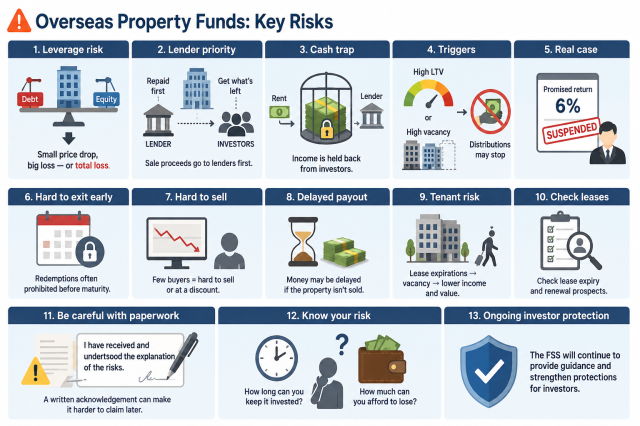
Investors who say the lockup was never explained to them will find that argument hard to win. The FSS said such claims are unlikely to be recognized as mis-selling, because the restriction is intrinsic to how a real estate fund works and is usually spelled out in the prospectus.
Money can be slow to come back even after maturity. "The timing of recovery can be delayed depending on the sale of the property or the liquidation process," the FSS said. "Even if investors vote against an extension at the beneficiaries' meeting, recovery can be delayed if the fund does not hold enough cash."
Fund maturities are normally set to match the tenant's lease term. When market conditions deteriorate, the maturity gets extended past it, raising the risk that the tenant moves out and the space sits empty. Rental income falls, asset values drop, and investors lose principal.
The regulator also told investors to think twice before signing a confirmation that the product was explained to them. Once that signature is on the document, holding the seller liable for a failure to explain becomes difficult.
Investors should weigh their own investment horizon and how much loss they can absorb before buying, the FSS said, even when a salesperson is recommending the product.
"If the sales staff's explanation is insufficient, investors must ask for further explanation before signing," the regulator said.
AJP Takeaways
• South Korea’s Financial Supervisory Service (FSS) warned on August 10, 2026, that investors in overseas real estate funds can lose their entire investment because borrowing can magnify even relatively small declines in property values.
• Overseas real estate funds may suspend distributions when “cash trap” provisions are triggered, allowing lenders to retain rental income even when tenants continue paying rent.
• Investors may be unable to redeem overseas real estate fund investments before maturity and can face additional repayment delays if underlying properties cannot be sold on time.
• The Financial Supervisory Service advised investors to check loan-to-value (LTV) conditions, vacancy rates, major tenant lease expirations and renewal prospects before investing.
• The regulator also warned investors to fully understand product risks before signing statements confirming that risks were properly explained, as such documents could affect later compensation claims.

Copyright ⓒ Aju Press All rights reserved.